







Question: please I need the solution in Python, thanks in advance Consider the nonlinear partial differential equation t22f=v2(x22f+2xfx22f),with0 for the real function f(x,t) subject to periodic
please I need the solution in Python, thanks in advance
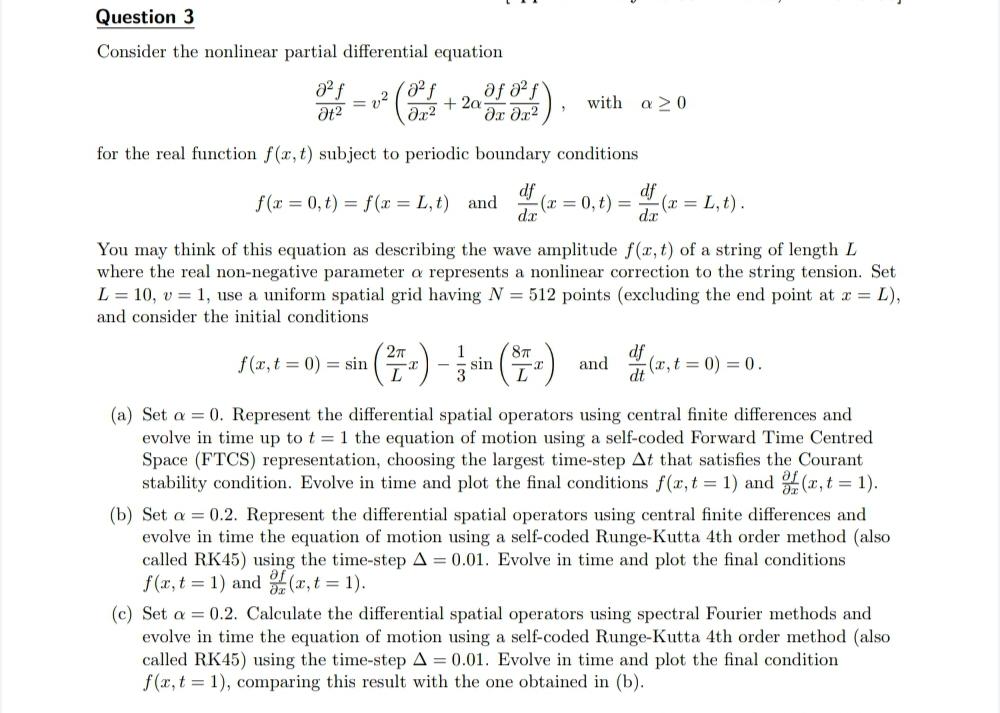
Consider the nonlinear partial differential equation t22f=v2(x22f+2xfx22f),with0 for the real function f(x,t) subject to periodic boundary conditions f(x=0,t)=f(x=L,t)anddxdf(x=0,t)=dxdf(x=L,t). You may think of this equation as describing the wave amplitude f(x,t) of a string of length L where the real non-negative parameter represents a nonlinear correction to the string tension. Set L=10,v=1, use a uniform spatial grid having N=512 points (excluding the end point at x=L ), and consider the initial conditions f(x,t=0)=sin(L2x)31sin(L8x)anddtdf(x,t=0)=0. (a) Set =0. Represent the differential spatial operators using central finite differences and evolve in time up to t=1 the equation of motion using a self-coded Forward Time Centred Space (FTCS) representation, choosing the largest time-step t that satisfies the Courant stability condition. Evolve in time and plot the final conditions f(x,t=1) and xf(x,t=1). (b) Set =0.2. Represent the differential spatial operators using central finite differences and evolve in time the equation of motion using a self-coded Runge-Kutta 4th order method (also called RK45) using the time-step =0.01. Evolve in time and plot the final conditions f(x,t=1) and xf(x,t=1). (c) Set =0.2. Calculate the differential spatial operators using spectral Fourier methods and evolve in time the equation of motion using a self-coded Runge-Kutta 4th order method (also called RK45) using the time-step =0.01. Evolve in time and plot the final condition f(x,t=1), comparing this result with the one obtained in (b)
Step by Step Solution
There are 3 Steps involved in it

Get step-by-step solutions from verified subject matter experts
 Study Help