







Question: Please I really need help with this. Please :( Link to the online simulation: https://ophysics.com/l12.html PHYS 2092 Lab 7: Thin Lenses Image Formation INSTRUCTIONS Introduction
Please I really need help with this. Please :(
Link to the online simulation: https://ophysics.com/l12.html
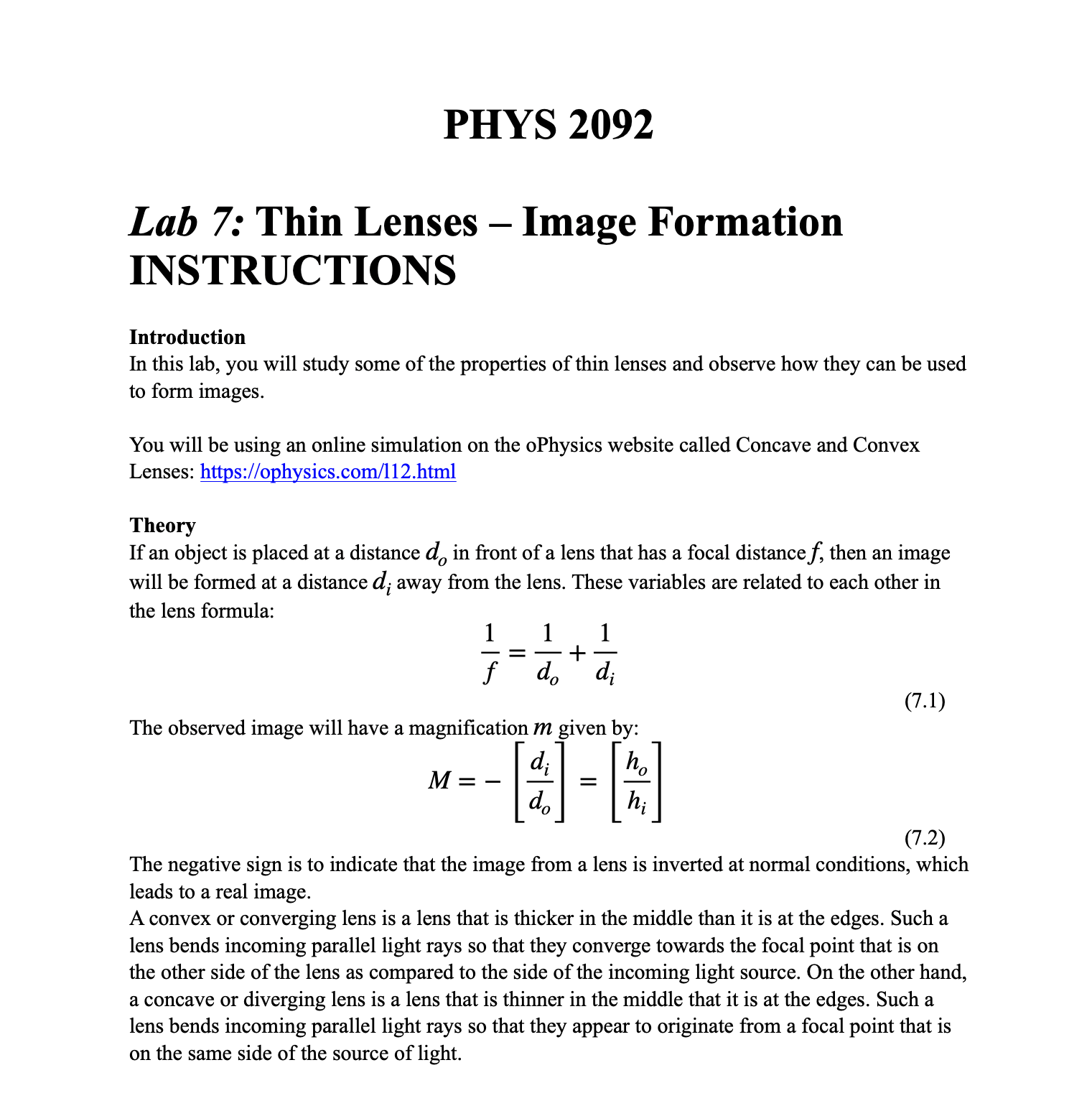
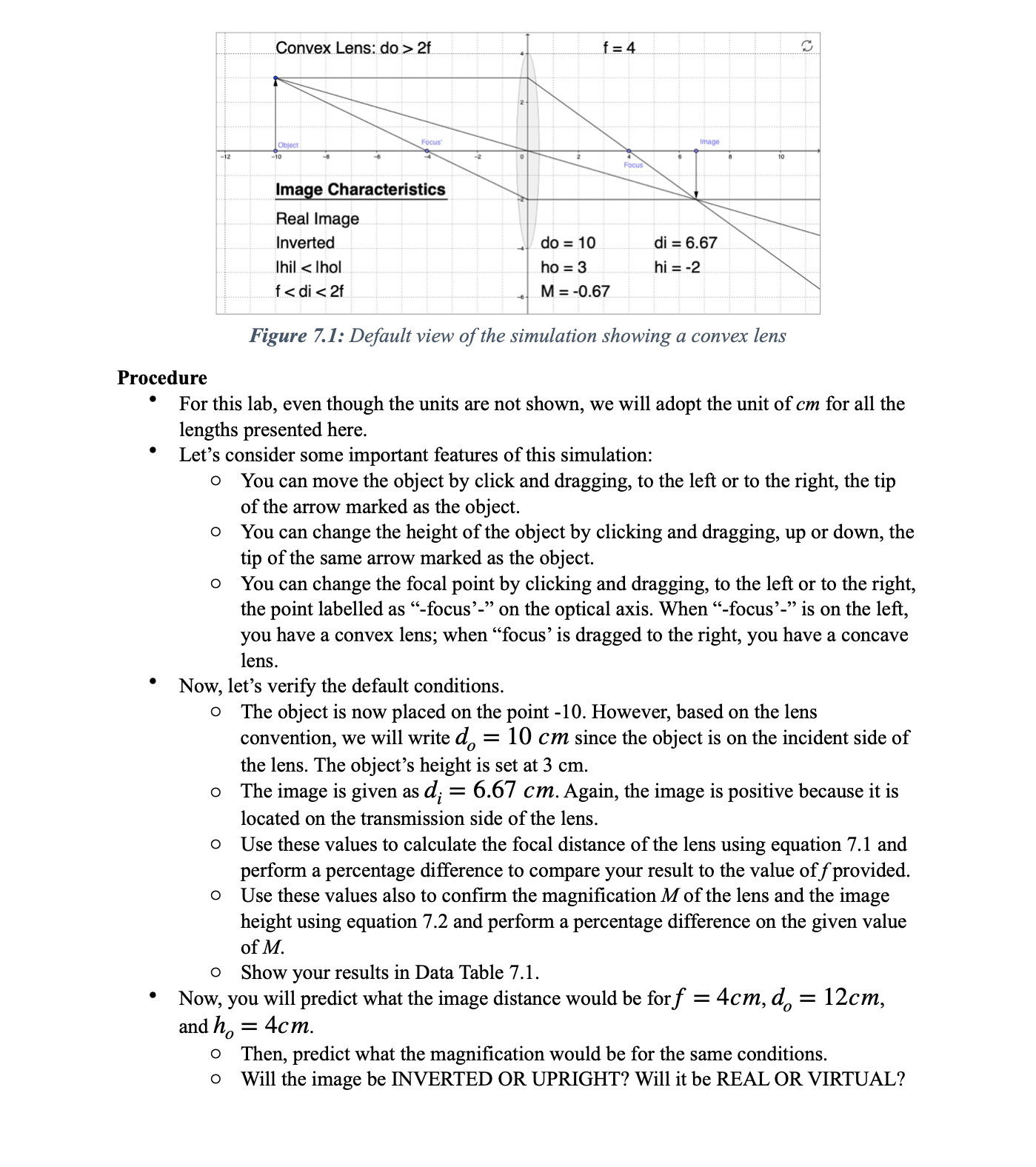
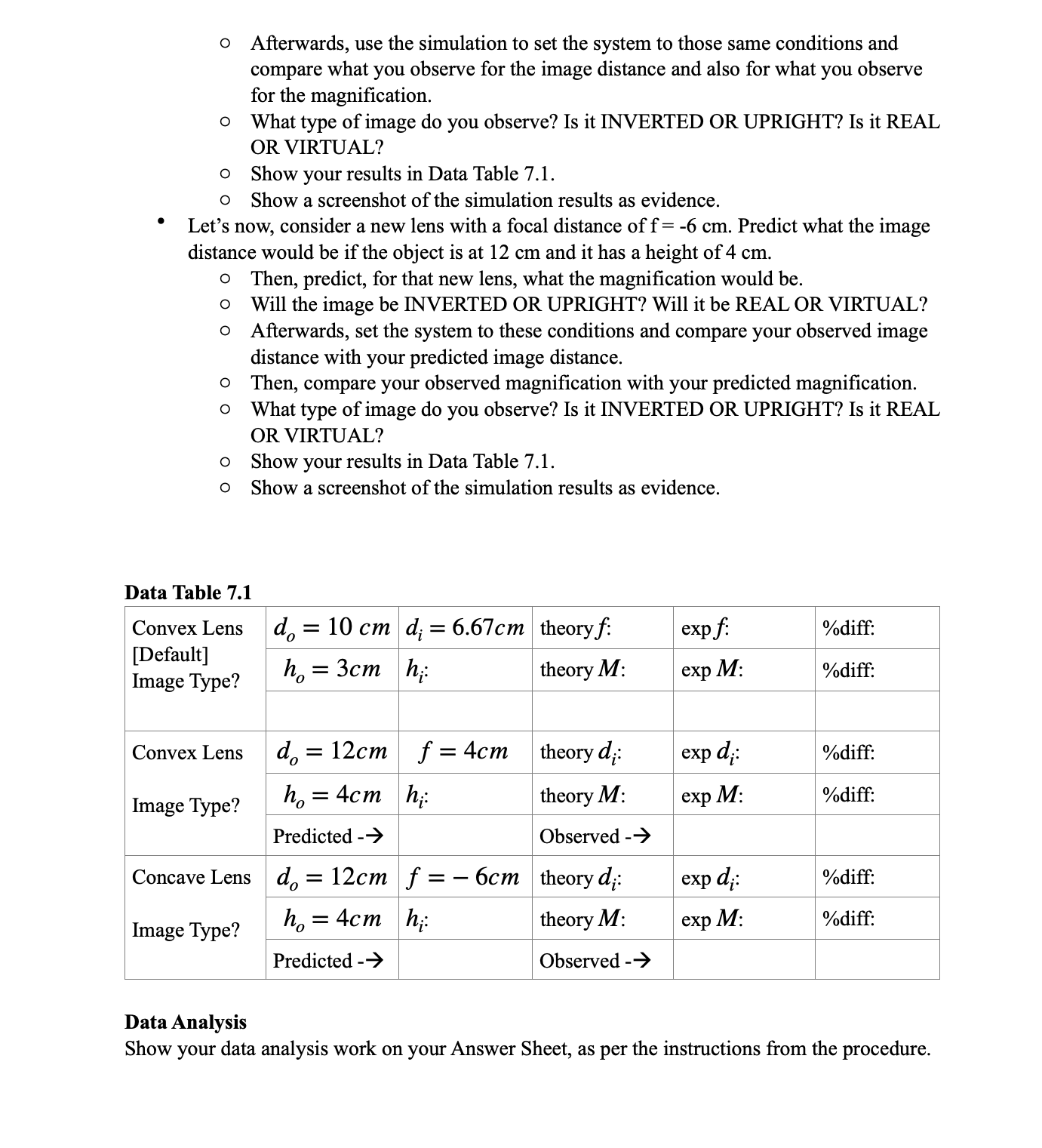
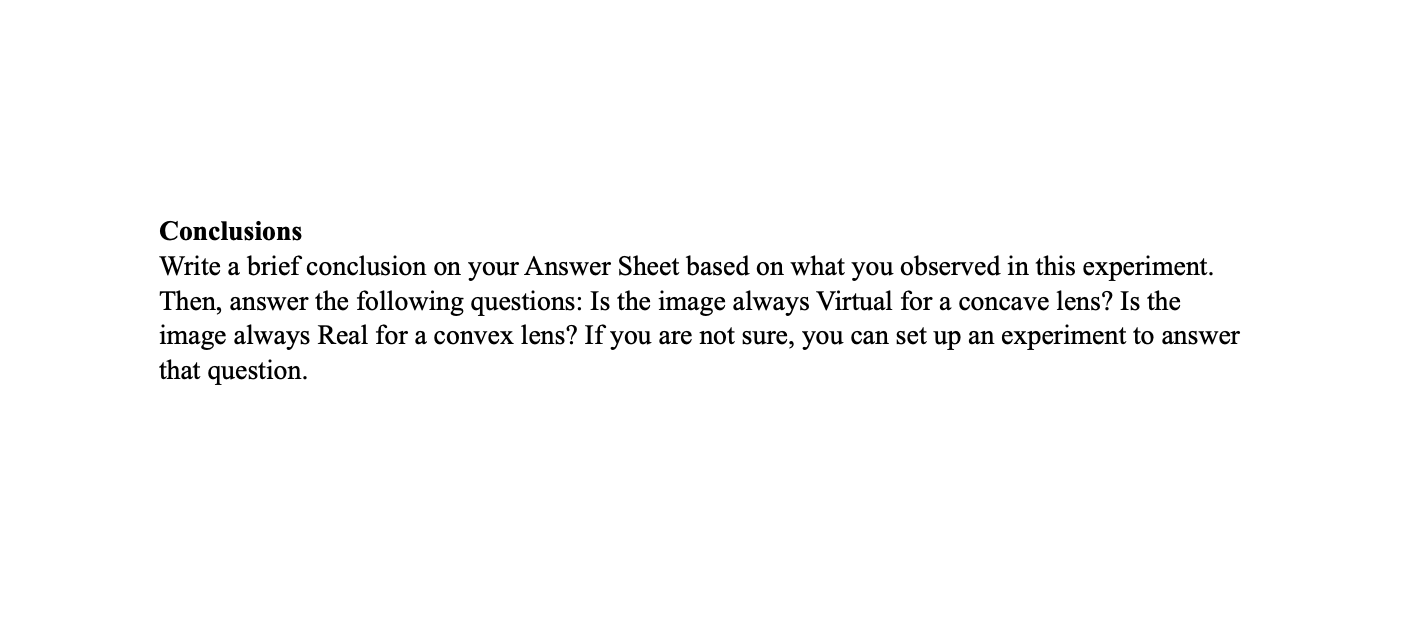
PHYS 2092 Lab 7: Thin Lenses Image Formation INSTRUCTIONS Introduction In this lab, you will study some of the properties of thin lenses and observe how they can be used to form images. You will be using an online simulation on the oPhysics website called Concave and Convex Lenses: httpszi/ophysicscom/l12.html Theory If an object is placed at a distance do in front of a lens that has a focal distancef, then an image will be formed at a distance di away from the lens. These variables are related to each other in the lens formula: 1 1 + 1 f do da (7.1) The observed image will have a magnication m given by: M _ _ i _ E do hi (7.2) The negative sign is to indicate that the image from a lens is inverted at normal conditions, which leads to a real image. A convex or converging lens is a lens that is thicker in the middle than it is at the edges. Such a lens bends incoming parallel light rays so that they converge towards the focal point that is on the other side of the lens as compared to the side of the incoming light source. On the other hand, a concave or diverging lens is a lens that is thinner in the middle that it is at the edges. Such a lens bends incoming parallel light rays so that they appear to originate from a focal point that is on the same side of the source of light. O Convex Lens: do > 2f f = 4 Na, \\: ' \\"\\:-HV""'--,. 7% " '\\\\ "~._ ' w- ._7_ \\\\\\ Image Characteristics ' - 533,,\" Real Image . \\:;""---.RH_1 Inverted do: 10 di :65? \\ " lhil Observed --> Concave Lens do = 12cm f = - 6cm theory di: exp d;: odiff: Image Type? ho = 4cm h;: theory M: exp M: %diff: Predicted -> Observed -> Data Analysis Show your data analysis work on your Answer Sheet, as per the instructions from the procedure.Conclusions Write a brief conclusion on your Answer Sheet based on what you observed in this experiment. Then, answer the following questions: Is the image always Virtual for a concave lens? Is the image always Real for a convex lens? If you are not sure, you can set up an experiment to answer that
Step by Step Solution
There are 3 Steps involved in it

Get step-by-step solutions from verified subject matter experts
 Study Help