Question: please I really need help.Read Did information systems cause Deutsche Bank to stumble? and respond to the following questions. List and describe the technologies used
please I really need help.Read Did information systems cause Deutsche Bank to stumble? and respond to the following questions.
- List and describe the technologies used in the case
- What was the role of information systems (IS) and information technology (IT) at Deutsche Bank (DB)?
- Was DB using IT and IS effectively? Discuss three reasons to support your answer.
-
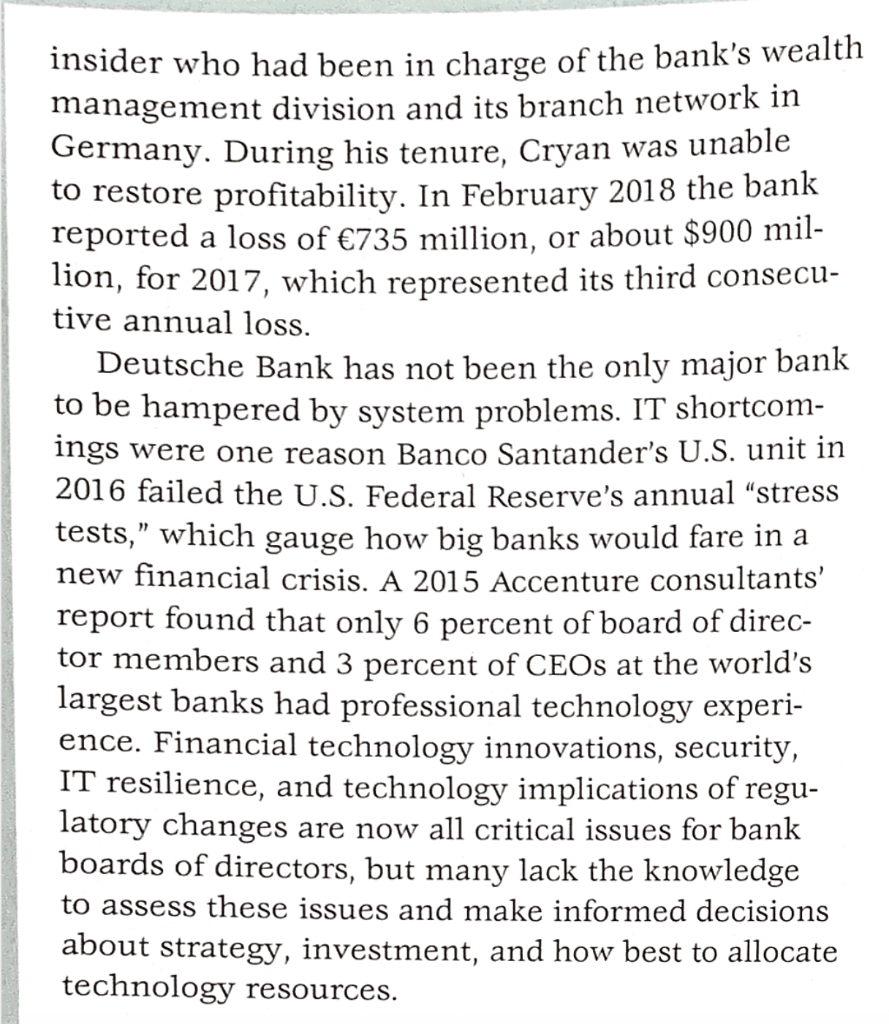
D Bank's subsequent efforts to end the system outage and led to the discovery and creation of new report- eutsche Bank AG, founded in 1870, is one asset classes for approximately five days. Deutsche of the world's top financial companies, with 2,425 branches worldwide. It offers a repeatedly exacerbated existing reporting problems range of financial products and services, including retail and commercial banking, foreign exchange, ing problems. and services for mergers and acquisitions. The For example, Deutsche Bank's swap data bank provides products for mortgages, consumer reported before and after the system outage finance, credit cards, life insurance, and corporate revealed persistent problems with the integrity pension plans; financing for international trade; of certain data fields, including numerous invalid and customized wealth management services for legal entity identifiers. (A legal entity identifier wealthy private clients. Deutsche Bank is also the [LEI) is an identification code to uniquely iden- largest bank in Germany, and plays a central role tify all legal entities that are parties to financial in German economic life. In many ways, Deutsche transactions.) The CFTC complaint alleged that Bank is the embodiment of the global financial a number of these reporting problems persist system. today, affecting market data that is made avail- Deutsche Bank has the world's largest portfolio able to the public as well as data that is used by of derivatives, valued at about $46 trillion. A finan the CFTC to evaluate systemic risk throughout the cial derivative is a contract between two or more The CFTC complaint also alleged parties whose value is dependent upon or derived that Deutsche Bank's system outage and subse- from one or more underlying assets, such as stocks, quent reporting problems occurred in part because bonds, commodities, currencies, and interest rates. Deutsche Bank failed to have an adequate business Although Deutsche Bank had survived the 2008 continuity and disaster recovery plan and other banking crisis, which was partly triggered by flawed appropriate supervisory systems in place. derivatives, it is now struggling with seismic changes In addition to incurring high costs associated with in the banking industry, including recent regulatory coping with regulators and paying fines, Deutsche change. The bank was forced to pay $7.2 billion to Bank was a very unwieldy and expensive bank to resolve U.S. regulator complaints about its sale of operate. U.S. regulators have identified Deutsche toxic mortgage securities that contributed to the 2008 Bank's antiquated technology as one reason why financial crisis. the bank was not always able to provide the correct In addition, the Commodity Futures Trading information for running its business properly and Commission (CFTC) charged that Deutsche Bank responding to regulators. Poor information systems submitted incomplete and untimely credit default may have even contributed to the 2008 financial cri- swap data, failed to properly supervise employees sis. Banks often had trouble untangling the complex responsible for swap data reporting, and lacked an financial products they had bought and sold to deter- swaps market of mergers and expansion. When these banks merged adequate business continuity and disaster recov mine their underlying value. ery plan. (A credit default swap is a type of credit Banks, including Deutsche Bank, are intensive insurance contract in which an insurer promises to users of information technology, and they rely on compensate an insured party (such as a bank] for technology to spot misconduct. If Deutsche Bank losses incurred when a debtor (such as a corpora was such an important player in the German and tion] defaults on a debt and that can be purchased world financial systems, why were its systems not up or sold by either party on the financial market. to the job? Credit default swaps are very complex financial It turns out that Deutsche Bank, like other leading instruments.) global financial companies, had undergone decades The CFTC complained that on April 16, 2016, Deutsche Bank's swap data reporting system expe or acquired other financial companies, they often rienced a system outage that prevented Deutsche did not make the requisite (and often far-reaching) Bank from reporting any swap data for multiple changes to integrate their information systems with those of their acquisitions. The effort and costs sources of profit and growth. Cryan noted that the required for this integration, including coordination bank's cost base was swollen by poor and ineffective across many management teams, were too great. So business processes, inadequate technology, and too the banks left many old systems in place to handle many tasks being handled manually. He has called the workload for each of their businesses. This cre for standardizing the bank's systems and procedures, ated what experts call spaghetti balls of overlapping eliminating legacy software, standardizing and and often incompatible technology platforms and enhancing data, and improving reporting. software programs. These antiquated legacy systems Cryan appointed technology specialist Kim were designed to handle large numbers of transac Hammonds as chief operating officer to oversee tions and sums of money, but they were not well reengineering the bank's information systems and suited to managing large bank operations. They often operations. Hammonds had been Deutsche Bank's did not allow information to be shared easily among global chief information officer and, before that, departments or provide senior management with a chief information officer at Boeing. Hammonds coherent overview of bank operations. observed that Deutsche Bank's information systems Deutsche Bank had more than 100 different book operated by trial and error, as if her former employer ing systems for trades in London alone and no com Boeing launched aircraft into the sky, watched them mon set of codes for identifying clients in each of crash, and then tried to learn from the mistakes. these systems. Each of these systems might use a In February 2015, Deutsche Bank announced a different number or code for identifying the same 10-year, multibillion-dollar deal with Hewlett-Packard client, so it would be extremely difficult or impos (HP) to standardize and simplify its IT infrastructure, sible to show how the same client was treated in all reduce costs, and create a more modern and agile of these systems. Individual teams and traders each technology platform for launching new products and had their own incompatible platforms. The bank services. Deutsche Bank would migrate to a cloud had employed a deliberate strategy of pitting teams computing infrastructure where it would run its against each other to spur them on, but this further information systems in HP's remote computer cen- encouraged the use of different systems because ters. HP would provide computing services, hosting, competing traders and teams were reluctant to share and storage. Deutsche Bank would still be in charge their data. Yet the bank ultimately had to reconcile of application development and information security the data from these disparate systems, often by hand, technologies, which it considers as proprietary and before trades could be processed and recorded. crucial for competitive differentiation. This situation has made it very difficult for banks to undertake ambitious technology projects for the systems that they need today or to comply with regulatory requirements. U.S. regulators criticized Deutsche Bank for its inability to provide essential information because of its antiquated technology. Regulators are demanding that financial institutions improve the way they manage risk. The banks are under pressure to make their aging computer systems comply, but the IT infrastructures at many traditional financial institutions are failing to keep up with these regulatory pressures or with changing consumer expectations. Deutsche Bank and its peers must also adapt to new innovative technology competitors such as Apple that are muscling into banking services. In July 2015, John Cryan became Deutsche Bank's CEO. He tried to reduce costs and improve efficiency, laying off thousands of employees. He focused on overhauling Deutsche Bank's fragmented, antiquated information systems, which are a major impediment to controlling costs and finding new Deutsche Bank is withdrawing from high-risk cli- ent relationships, improving its control framework, and automating manual reconciliations. To modern- ize its IT infrastructure, the bank is reducing the number of its individual operating systems that control the way a computer works from 45 to four, replacing scores of outdated computers, and replacing antiquated software applications. Thousands of appli- cations and functions will be shifted from Deutsche Bank's mainframes to HP's cloud computing services, Automating manual processes will promote efficiency and better control. These improvements are expected to reduce "run the bank" costs by 800 million euros. Eliminating 6,000 contractors will create total savings of 1 billion euros. Deutsche Bank has also opened four technology centers to work with financial tech- nology startups to improve its technology. Despite all of these efforts, Deutsche Bank has struggled to regain profitability and stability. In early April 2018 the bank's supervisory board replaced Cryan with Christian Sewing, a longtime insider who had been in charge of the bank's wealth management division and its branch network in Germany. During his tenure, Cryan was unable to restore profitability. In February 2018 the bank reported a loss of 735 million, or about $900 mil- lion, for 2017, which represented its third consecu- tive annual loss. Deutsche Bank has not been the only major bank to be hampered by system problems. IT shortcom- ings were one reason Banco Santander's U.S. unit in 2016 failed the U.S. Federal Reserve's annual stress tests, which gauge how big banks would fare in a new financial crisis. A 2015 Accenture consultants' report found that only 6 percent of board of direc- tor members and 3 percent of CEOs at the world's largest banks had professional technology experi- ence. Financial technology innovations, security, IT resilience, and technology implications of regu- latory changes are now all critical issues for bank boards of directors, but many lack the knowledge to assess these issues and make informed decisions about strategy, investment, and how best to allocate technology resources









 Study Help