







Question: Question 10 Let f(r) = sin(r) and let po be the starting value for Newton-Raphson iteration such that tan(Po) 2po- Then in this case
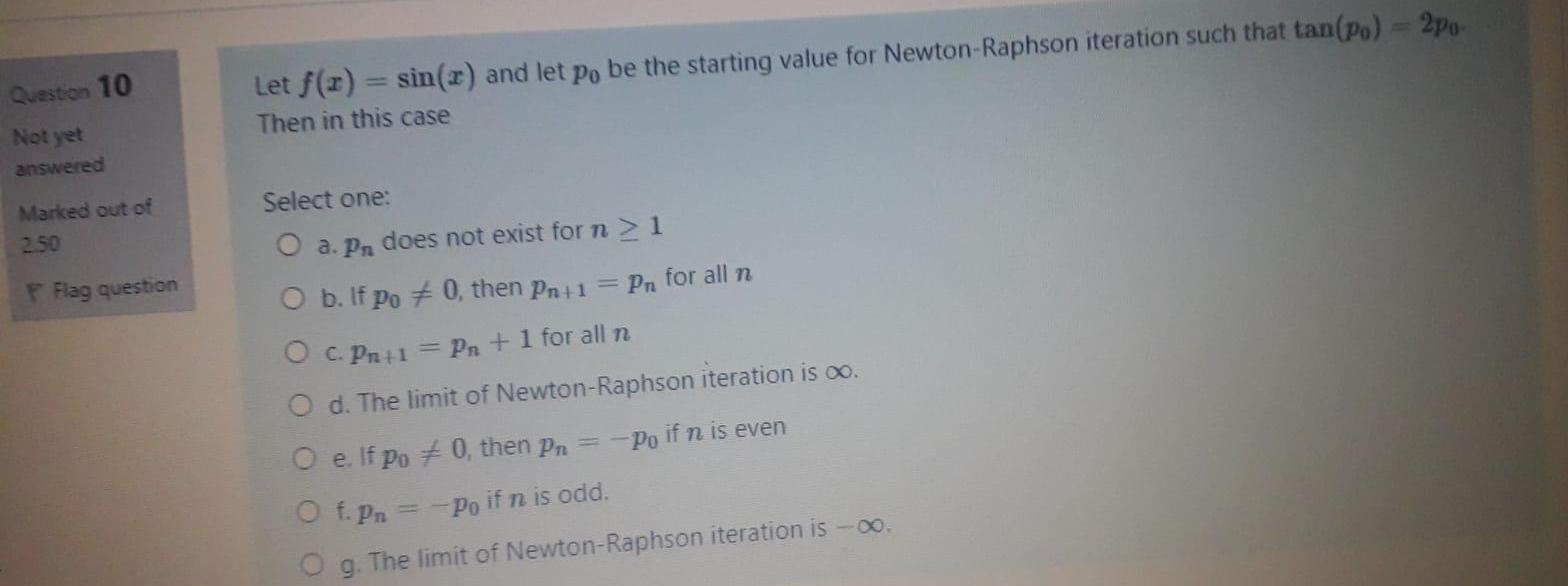


Question 10 Let f(r) = sin(r) and let po be the starting value for Newton-Raphson iteration such that tan(Po) 2po- Then in this case |3D Not yet answered Marked out of Select one: 2.50 O a. Pn does not exist for n> 1 P Flag question O b. If po # 0, then Pn+1 = Pn for all n O C. Pn+1 = Pn+1 for all n O d. The limit of Newton-Raphson iteration is oo. O e. If po # 0, then pn=-Po if n is even O f. Pn =-Po if n is odd. g. The limit of Newton-Raphson iteration is -0o. Dashboard / My Given the following data in the form (z, f(r)): (1.10, 1), (1.20, 3), (1.28, 0), (1.30, 5). Using Simpson's rule to approximate S f(r) da, we get Question 11 Not yet answered Marked out of 2.50 Select one: P Flag question O a. S f(x) d = 0.16 O b. f(z) dr 0.16 OcS f(x) da 0.2 O d. f(z) dr 0.6 O e S s(z) dz - 0.4 Of f f(z) dz 0.6 Windows Next pac Dashboard / My courses / NUMERICAL METHODS Section1 Lecture (20194 100412350 AAUP-JENIN)/ 25 September 1October Question 12 If the matrix of coefficients A in the linear system Az b is SDD, then %3D Not yet answered Select one: Marked out of O a. The solution of the system may not be unique. 2.50 O b. The Gauss-Seidel iteration will converge to the unique solution of the system for any starting vector (0), P Flag question O c. The Jacobi iteration may or may not converge to the unique solution of the system for any starting vector z(0), O d. A must be singular. Next page Previous page Windows Zoom tar the Final- lump to
Step by Step Solution
3.51 Rating (154 Votes )
There are 3 Steps involved in it

Get step-by-step solutions from verified subject matter experts
 Study Help