Question: Please identify one reason why a party could potentially avoid a contract based upon lack of real consent. Please use only 'Timothy v. Keetch'case example
Please identify one reason why a party could potentially avoid a contract based upon lack of real consent. Please use only 'Timothy v. Keetch'case example below. (4-6 sentences)
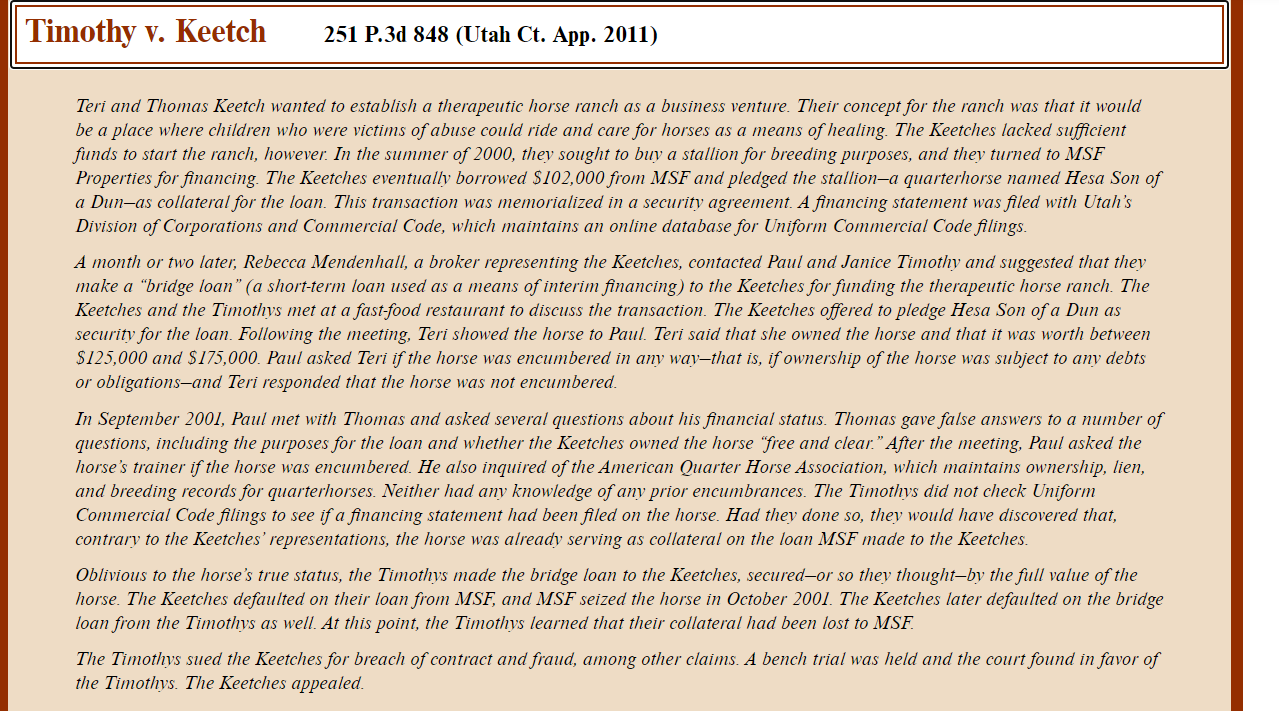
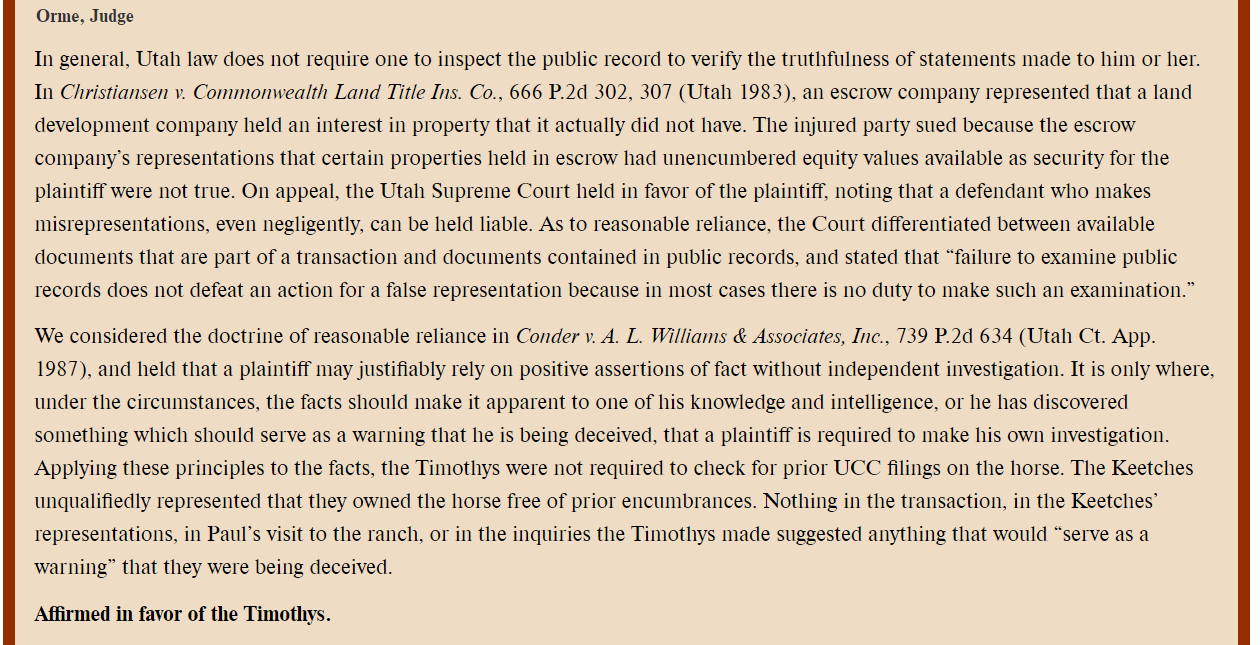
Timothy v. Keetch 251 P.3d 848 (Utah Ct. App. 2011) Teri and Thomas Keetch wanted to establish a therapeutic horse ranch as a business venture. Their concept for the ranch was that it would be a place where children who were victims of abuse could ride and care for horses as a means of healing. The Keetches lacked sufficient funds to start the ranch, however. In the summer of 2000, they sought to buy a stallion for breeding purposes, and they turned to MSF Properties for financing. The Keetches eventually borrowed $102,000 from MSF and pledged the stalliona quarterhorse named Hesa Son of a Dun-as collateral for the loan. This transaction was memorialized in a security agreement. A financing statement was filed with Utah's Division of Corporations and Commercial Code, which maintains an online database for Uniform Commercial Code filings. A month or two later, Rebecca Mendenhall, a broker representing the Keetches, contacted Paul and Janice Timothy and suggested that they make a "bridge loan (a short-term loan used as a means of interim financing) to the Keetches for funding the therapeutic horse ranch. The Keetches and the Timothys met at a fast-food restaurant to discuss the transaction. The Keetches offered to pledge Hesa Son of a Dun as security for the loan. Following the meeting, Teri showed the horse to Paul. Teri said that she owned the horse and that it was worth between $125,000 and $175,000. Paul asked Teri if the horse was encumbered in any waythat is, if ownership of the horse was subject to any debts or obligations-and Teri responded that the horse was not encumbered. In September 2001, Paul met with Thomas and asked several questions about his financial status. Thomas gave false answers to a number of questions, including the purposes for the loan and whether the Keetches owned the horse "free and clear. After the meeting, Paul asked the horse's trainer if the horse was encumbered. He also inquired of the American Quarter Horse Association, which maintains ownership, lien, and breeding records for quarterhorses. Neither had any knowledge of any prior encumbrances. The Timothys did not check Uniform Commercial Code filings to see if a financing statement had been filed on the horse. Had they done so, they would have discovered that, contrary to the Keetches' representations, the horse was already serving as collateral on the loan MSF made to the Keetches. Oblivious to the horse's true status, the Timothys made the bridge loan to the Keetches, secured-or so they thought-by the full value of the horse. The Keetches defaulted on their loan from MSF, and MSF seized the horse in October 2001. The Keetches later defaulted on the bridge loan from the Timothys as well. At this point, the Timothys learned that their collateral had been lost to MSF. The Timothys sued the Keetches for breach of contract and fraud, among other claims. A bench trial was held and the court found in favor of the Timothys. The Keetches appealed. Orme, Judge In general, Utah law does not require one to inspect the public record to verify the truthfulness of statements made to him or her. In Christiansen v. Commonwealth Land Title Ins. Co., 666 P.2d 302, 307 (Utah 1983), an escrow company represented that a land development company held an interest in property that it actually did not have. The injured party sued because the escrow company's representations that certain properties held in escrow had unencumbered equity values available as security for the plaintiff were not true. On appeal, the Utah Supreme Court held in favor of the plaintiff, noting that a defendant who makes misrepresentations, even negligently, can be held liable. As to reasonable reliance, the Court differentiated between available documents that are part of a transaction and documents contained in public records, and stated that failure to examine public records does not defeat an action for a false representation because in most cases there is no duty to make such an examination. We considered the doctrine of reasonable reliance in Conder v. A. L. Williams & Associates, Inc., 739 P.2d 634 (Utah Ct. App. 1987), and held that a plaintiff may justifiably rely on positive assertions of fact without independent investigation. It is only where, under the circumstances, the facts should make it apparent to one of his knowledge and intelligence, or he has discovered something which should serve as a warning that he is being deceived, that a plaintiff is required to make his own investigation. Applying these principles to the facts, the Timothys were not required to check for prior UCC filings on the horse. The Keetches unqualifiedly represented that they owned the horse free of prior encumbrances. Nothing in the transaction, in the Keetches' representations, in Paul's visit to the ranch, or in the inquiries the Timothys made suggested anything that would serve as a warning that they were being deceived. Affirmed in favor of the Timothys









 Study Help