







Question: Please, if possible, explain each step that was taken to arrive at the answer (1) A short course in Newtonian mechanics: Consider throwing a ball
Please, if possible, explain each step that was taken to arrive at the answer
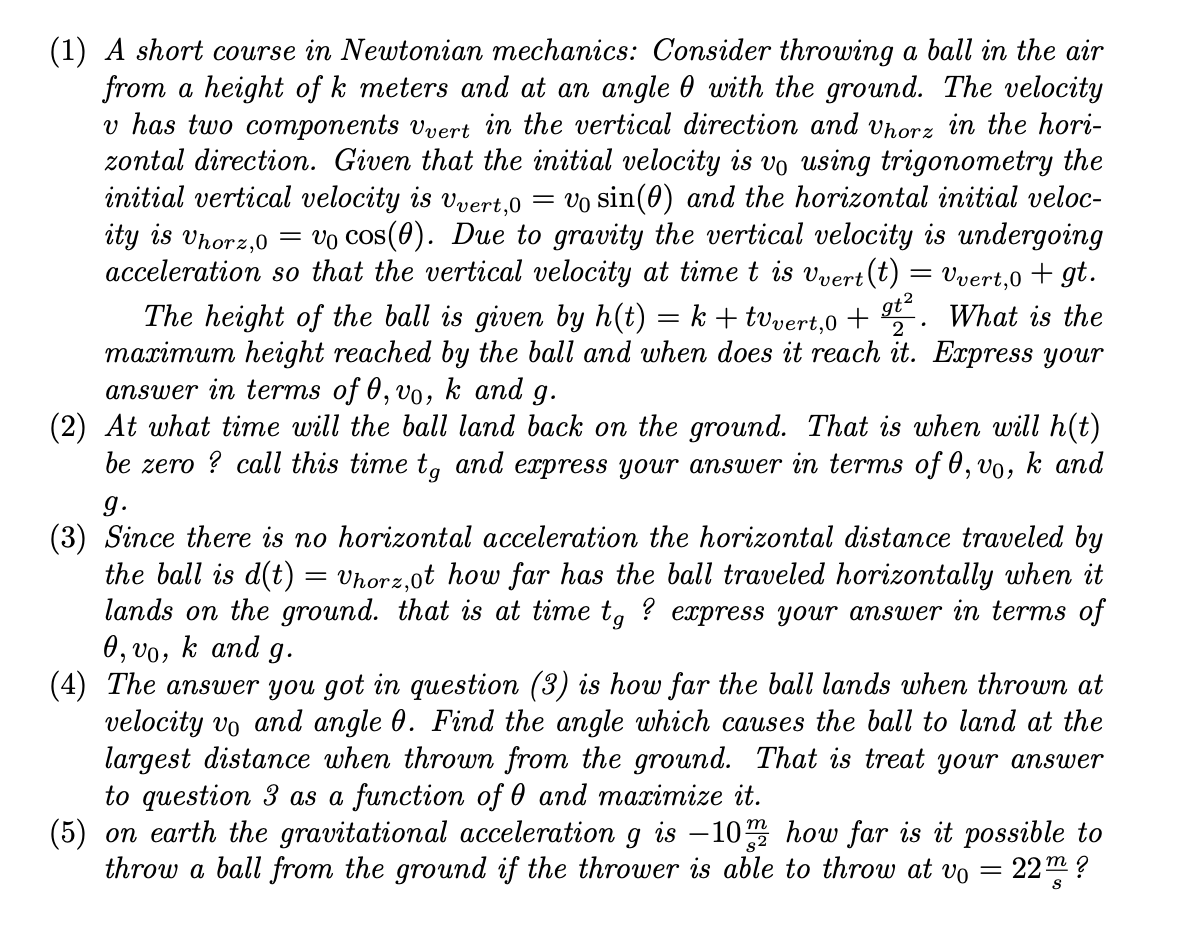
(1) A short course in Newtonian mechanics: Consider throwing a ball in the air from a height of 16 meters and at an angle 9 with the ground. The velocity v has two components vvm in the vertical direction and vhorz in the hori- zontal direction. Given that the initial velocity is v0 using trigonometry the initial vertical velocity is vvert = v0 sin(6) and the horizontal initial veloc- ity is vhorz = v0 (305(6). Due to gravity the vertical velocity is undergoing acceleration so that the vertical velocity at time t is vvert(t) = vvert + gt. The height of the ball is given by h(t) = k + tvverm + 'g. What is the mamimum height reached by the ball and when does it reach it. Express your answer in terms of 9,v0, k and g. (2) At what time will the ball land back on the ground. That is when will h(t) (3) (4) be zero .9 call this time t9 and empress your answer in terms of 6, v0, 16 and 9. Since there is no horizontal acceleration the horizontal distance traveled by the ball is d(t) = vhompt how far has the ball traveled horizontally when it lands on the ground. that is at time t9 ? express your answer in terms of 6mg, 16 and g. The answer you got in question (3) is how far the ball lands when thrown at velocity v0 and angle 6'. Find the angle which causes the ball to land at the largest distance when thrown from the ground. That is treat your answer to question 3 as a function of 6 and maximize it. on earth the gravitational acceleration g is 10% how far is it possible to throw a ball from the ground if the thrower is able to throw at v0 = 22%
Step by Step Solution
There are 3 Steps involved in it

Get step-by-step solutions from verified subject matter experts
 Study Help