







Question: please if someone can answer the 2 questions So, there were solid reasons for Jeffries to maintain A&F's current marketing practices. Targeting a broader customer
please if someone can answer the 2 questions 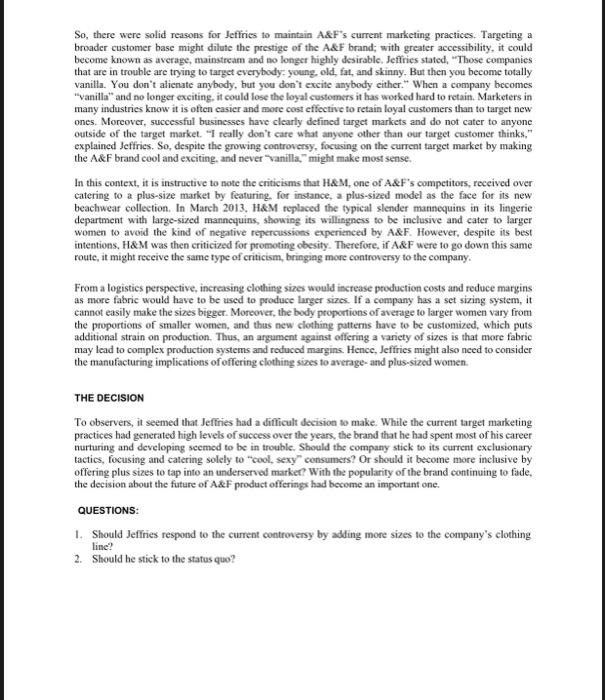
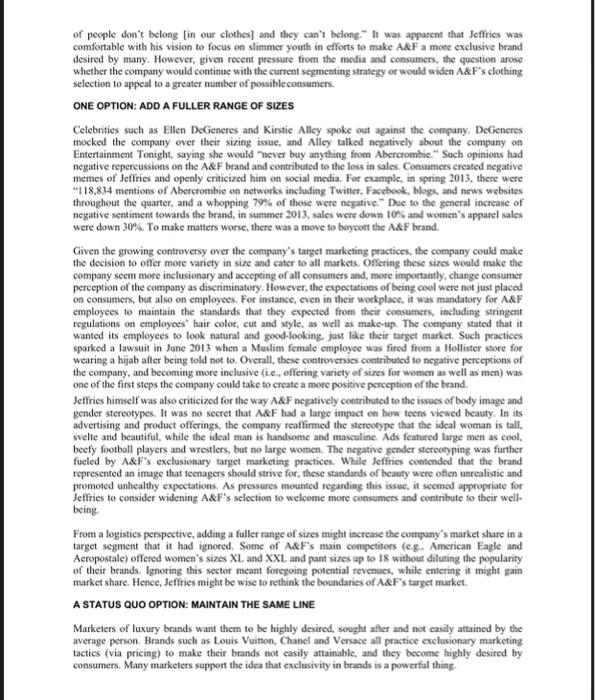
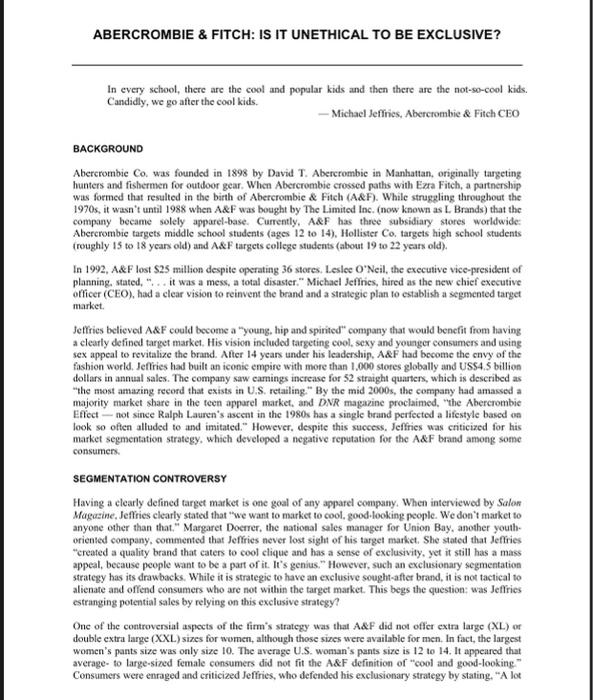
So, there were solid reasons for Jeffries to maintain A&F's current marketing practices. Targeting a broader customer base might dilute the prestige of the A&F brand, with greater accessibility, it could become known as average, mainstream and no longer highly desirable. Jeffries stated, "Those companies that are in trouble are trying to target everybody, young, old, fat, and skinny. But then you become totally vanilla. You don't alienate anybody, but you don't excite anybody either. When a company becomes "vanilla" and no longer exciting. it could lose the loyal customers it has worked hard to retain. Marketers in many industries know it is often casier and more cost effective to retain loyal customers than to target new ones. Moreover, successful businesses have clearly defined target markets and do not cater to anyone outside of the target market. "I really don't care what anyone other than our target customer thinks." explained Jeffries. So, despite the growing controversy, focusing on the current target market by making the A&F brand cool and exciting, and never "vanilla, "might make most sense. In this context, it is instructive to note the criticisms that H&M, one of A&F's competitors, received over catering to a plus-size market by featuring, for instance, a plus-sized model as the face for its new beachwear collection. In March 2013. H&M replaced the typical slender mannequins in its lingerie department with large-sized mannequins, showing its willingness to be inclusive and cater to larger women to avoid the kind of negative repercussions experienced by A&F. However, despite its best intentions, H&M was then criticized for promoting obesity. Therefore, if A&F were to go down this same route, it might receive the same type of criticism, bringing more controversy to the company. From a logistics perspective, increasing clothing sizes would increase production costs and reduce margins as more fabric would have to be used to produce larger sizes. If a company has a set sizing system, it cannot easily make the sizes bigger. Moreover, the body proportions of average to larger women vary from the proportions of smaller women, and thus new clothing patterns have to be customized, which puts additional strain on production. Thus, an argument against offering a variety of sizes is that more fabric may lead to complex production systems and reduced margins. Hence, Jeffries might also need to consider the manufacturing implications of offering clothing sizes to average- and plus-sized women. THE DECISION To observers, it seemed that Jeffries had a difficult decision to make. While the current target marketing practices had generated high levels of success over the years, the brand that he had spent most of his career nurturing and developing seemed to be in trouble. Should the company stick to its current exclusionary tactics, focusing and catering solely to cool, sexy" consumers? Or should it become more inclusive by offering plus sizes to tap into an underserved market? With the popularity of the brand continuing to fade, the decision about the future of A&F product offerings had become an important one. QUESTIONS: 1. Should Jeffries respond to the current controversy by adding more sizes to the company's clothing line? 2. Should he stick to the status quo? of people don't belong (in our clothes) and they can't belong. It was apparent that Jeffries was comfortable with his vision to focus on slimmer youth in efforts to make A&F a more exclusive brand desired by many. However, given recent pressure from the media and consumers, the question arose whether the company would continue with the current segmenting strategy or would widen A&F's clothing selection to appeal to a greater number of possible consumers. ONE OPTION: ADD A FULLER RANGE OF SIZES Celebrities such as Ellen DeGeneres and Kirstie Alley spoke out against the company. DeGeneres mocked the company over their sizing issue, and Alley talked negatively about the company on Entertainment Tonight, saying she would never buy anything from Abercrombie." Such opinions had negative repercussions on the A&F brand and contributed to the loss in sales. Consumers created negative memes of Jeffries and openly criticized him on social media. For example, in spring 2013, there were "118,834 mentions of Abercrombie on networks including Twitter, Facebook, blogs, and news websites throughout the quarter, and a whopping 79% of those were negative. Due to the general increase of negative sentiment towards the brand, in summer 2013, sales were down 10% and women's apparel sales were down 30%. To make matters worse, there was a move to boycott the A&F brand. Given the growing controversy over the company's target marketing practices, the company could make the decision to offer more variety in size and cater to all markets. Offering these sites would make the company seem more inclusionary and accepting of all consumers and more importantly, change consumer perception of the company as discriminatory. However, the expectations of being cool were not just placed on consumers, but also on employees. For instance, even in their workplace, it was mandatory for A&F employees to maintain the standards that they expected from their consumers, including stringent regulations on employees hair color, cut and style, as well as make-up. The company stated that it wanted its employees to look natural and good-looking.just like their target market. Such practices sparked a lawsuit in June 2013 when a Muslim female employee was fired from a Hollister store for wearing a hijab after being told not to. Overall, these controversies contributed to negative perceptions of the company, and becoming more inclusive (i.c., offering variety of sizes for women as well as men) was one of the first steps the company could take to create a more positive perception of the brand. Jeffries himself was also criticized for the way A&F negatively contributed to the issues of body image and gender sterootypes. It was no secret that A&F had a large impact on how teens viewed beauty. In its advertising and product offerings, the company reaffirmed the stereotype that the ideal woman is tall, svelte and beautiful, while the ideal man is handsome and masculine Ads featured large men as cool, beefy football players and wrestlers, but no large women. The negative gender stereotyping was further fueled by A&F's exclusionary target marketing practices. While Jeffries contended that the brand represented an image that teenagers should strive for these standards of beauty were often unrealistic and promoted unhealthy expectations. As pressures mounted regarding this issue, it seemed appropriate for Jeffries to consider widening A&F's selection to welcome more consumers and contribute to their well- being From a logistics perspective, adding a fuller range of sizes might increase the company's market share in a target segment that it had ignored. Some of A&F's main competitors (c.8. American Eagle and Aeropostale) offered women's sizes XL and XXL and pant sizes up to 18 without diluting the popularity of their brands. Ignoring this sector meant foregoing potential revenues, while entering it might gain market share. Hence, Jeffries might be wise to rethink the boundaries of A&F's target market. A STATUS QUO OPTION: MAINTAIN THE SAME LINE Marketers of luxury brands want them to be highly desired, sought after and not casily attained by the average person Brands such as Louis Vuitton, Chanel and Versace all practice exclusionary marketing tactics (via pricing) to make their brands not easily attainable, and they become highly desired by consumers. Many marketers support the idea that exclusivity in brands is a powerful thing, ABERCROMBIE & FITCH: IS IT UNETHICAL TO BE EXCLUSIVE? In every school, there are the cool and popular kids and then there are the not-so-cool kids. Candidly, we go after the cool kids. -- Michael Jeffries, Abercrombie & Fitch CEO BACKGROUND Abercrombie Co. was founded in 1898 by David T. Abercrombie in Manhattan, originally targeting hunters and fishermen for outdoor gear. When Abercrombie crossed paths with Ezra Fitch, a partnership was formed that resulted in the birth of Abercrombie & Fitch (A&F). While struggling throughout the 1970s, it wasn't until 1988 when A&F was bought by The Limited Inc. (now known as L Brands) that the company became solely apparel-base. Currently, A&F has three subsidiary stores worldwide: Abercrombie targets middle school students (ages 12 to 14). Hollister Co. targets high school students troughly 15 to 18 years old) and A&F targets college students (about 19 to 22 years old). In 1992, A&F lost S25 million despite operating 36 stores. Leslee O'Neil, the executive vice-president of planning, stated, "... it was a mess, a total disaster." Michael Jeffries, hired as the new chief executive officer (CEO), had a clear vision to reinvent the brand and a strategic plan to establish a segmented target market Jeffries believed A&F could become a "young, hip and spirited company that would benefit from having a clearly defined target market. His vision included targeting cool, sexy and younger consumers and using sex appeal to revitalize the brand. After 14 years under his leadership. A&F had become the envy of the fashion world, Jeffries had built an iconic empire with more than 1.000 stores globally and US$4.5 billion dollars in annual sales. The company saw camings increase for 52 straight quarters, which is described as the most amazing record that exists in U.S. retailing." By the mid 2000s, the company had amassed a majority market share in the teen apparel market, and DNR magazine proclaimed, "the Abercrombie Effect - not since Ralph Lauren's ascent in the 1980s has a single brand perfected a lifestyle based on look so often alluded to and imitated. However, despite this success. Jeffries was criticized for his market segmentation strategy, which developed a negative reputation for the A&F brand among some consumers. SEGMENTATION CONTROVERSY Having a clearly defined target market is one goal of any apparel company. When interviewed by Salon Magazine, Jeffries clearly stated that we want to market to cool.good-looking people. We don't market to anyone other than that." Margaret Doerrer, the national sales manager for Union Bay, another youth oriented company, commented that Jeffries never lost sight of his target market . She stated that Jeffries "created a quality brand that caters to cool clique and has a sense of exclusivity, yet it still has a mass appeal, because people want to be a part of it. It's genius." However, such an exclusionary segmentation strategy has its drawbacks. While it is strategic to have an exclusive sought-after brand, it is not tactical to alienate and offend consumers who are not within the target market. This begs the question: Was Jeffries estranging potential sales by relying on this exclusive strategy? One of the controversial aspects of the firm's strategy was that A&F did not offer extra large (XL) double extra large (XXL) sizes for women, although those sizes were available for men. In fact, the largest women's pants size was only size 10. The average U.S. woman's pants size is 12 to 14. It appeared that average- to large-sized female consumers did not fit the A&F definition of cool and good-looking." Consumers were enraged and criticized Jeffries, who defended his exclusionary strategy by stating. "A lot
Step by Step Solution
There are 3 Steps involved in it
1 Expert Approved Answer
Step: 1 Unlock

Question Has Been Solved by an Expert!
Get step-by-step solutions from verified subject matter experts
Step: 2 Unlock
Step: 3 Unlock
 Study Help