Question: please if you can answer it very important al du 1:38 PM @ 43% E Back Sumative 3 UAE lagle.docx Facts of the Case 1.
please if you can answer it very important
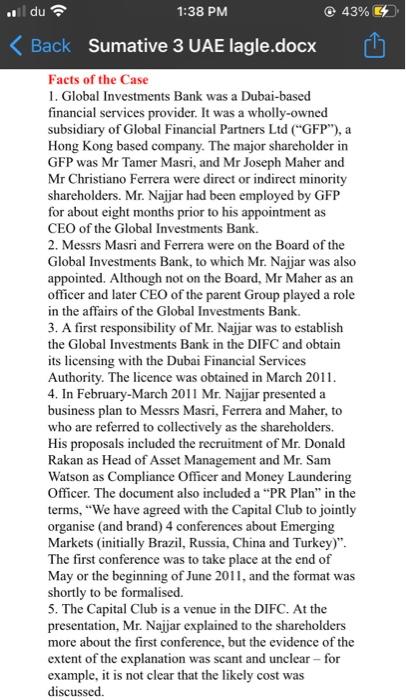
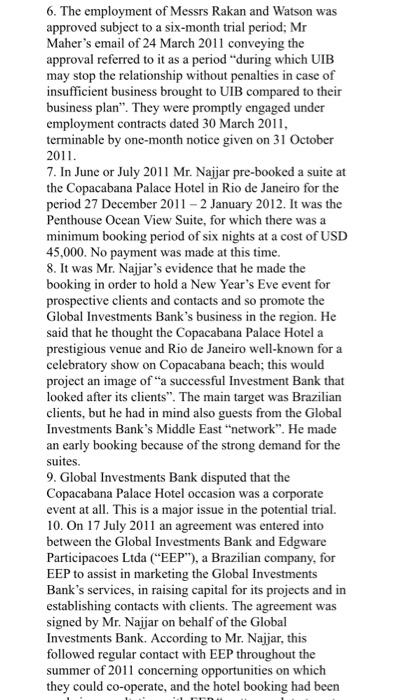
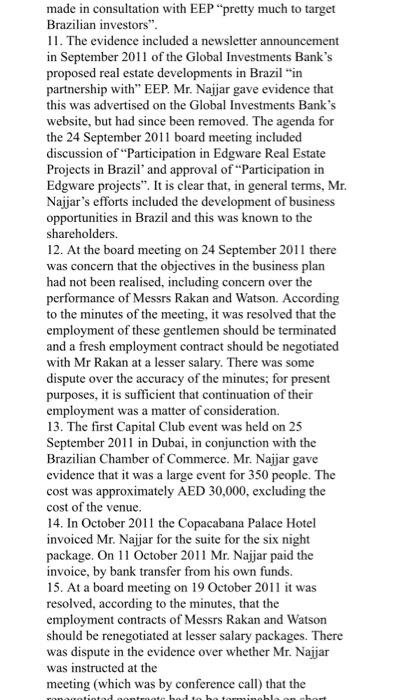
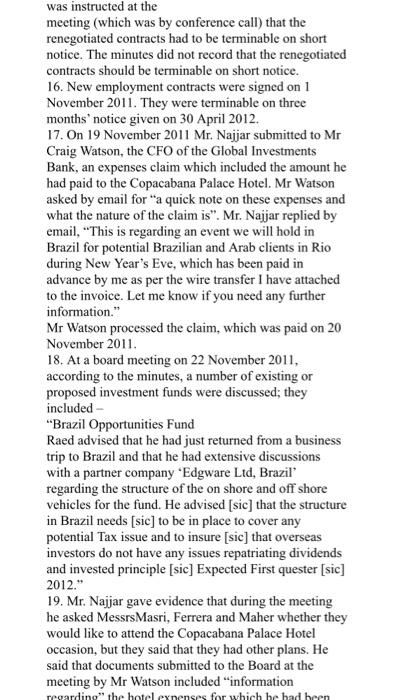
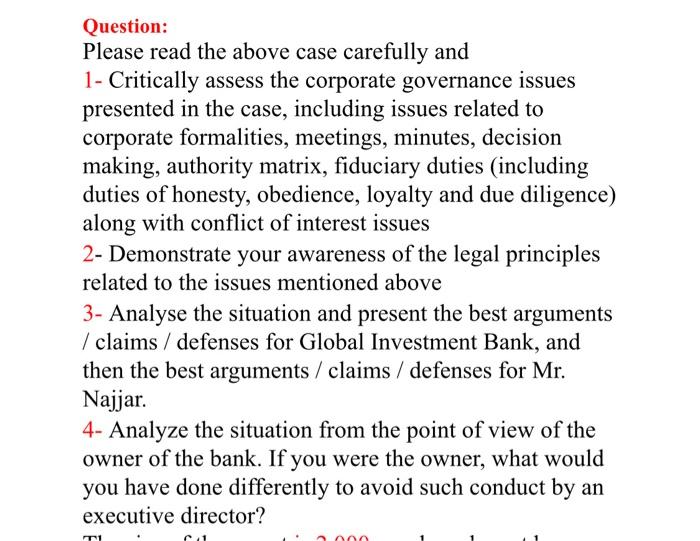
al du 1:38 PM @ 43% E Back Sumative 3 UAE lagle.docx Facts of the Case 1. Global Investments Bank was a Dubai-based financial services provider. It was a wholly-owned subsidiary of Global Financial Partners Ltd ("GFP), a Hong Kong based company. The major shareholder in GFP was Mr Tamer Masri, and Mr Joseph Maher and Mr Christiano Ferrera were direct or indirect minority shareholders. Mr. Najjar had been employed by GFP for about eight months prior to his appointment as CEO of the Global Investments Bank. 2. Messrs Masri and Ferrera were on the Board of the Global Investments Bank, to which Mr. Najjar was also appointed. Although not on the Board, Mr Maher as an officer and later CEO of the parent Group played a role in the affairs of the Global Investments Bank. 3. A first responsibility of Mr. Najjar was to establish the Global Investments Bank in the DIFC and obtain its licensing with the Dubai Financial Services Authority. The licence was obtained in March 2011. 4. In February March 2011 Mr. Najjar presented a business plan to Messrs Masri, Ferrera and Maher, to who are referred to collectively as the shareholders. His proposals included the recruitment of Mr. Donald Rakan as Head of Asset Management and Mr. Sam Watson as Compliance Officer and Money Laundering Officer. The document also included a "PR Plan" in the terms, We have agreed with the Capital Club to jointly organise (and brand) 4 conferences about Emerging Markets initially Brazil, Russia, China and Turkey)". The first conference was to take place at the end of May or the beginning of June 2011, and the format was shortly to be formalised. 5. The Capital Club is a venue in the DIFC. At the presentation, Mr. Najjar explained to the shareholders more about the first conference, but the evidence of the extent of the explanation was scant and unclear - for example, it is not clear that the likely cost was discussed. 6. The employment of Messrs Rakan and Watson was approved subject to a six-month trial period; Mr Maher's email of 24 March 2011 conveying the approval referred to it as a period during which UIB may stop the relationship without penalties in case of insufficient business brought to UIB compared to their business plan. They were promptly engaged under employment contracts dated 30 March 2011, terminable by one-month notice given on 31 October 2011. 7. In June or July 2011 Mr. Najjar pre-booked a suite at the Copacabana Palace Hotel in Rio de Janeiro for the period 27 December 2011 - 2 January 2012. It was the Penthouse Ocean View Suite, for which there was a minimum booking period of six nights at a cost of USD 45,000. No payment was made at this time. 8. It was Mr. Najjar's evidence that he made the booking in order to hold a New Year's Eve event for prospective clients and contacts and so promote the Global Investments Bank's business in the region. He said that he thought the Copacabana Palace Hotel a prestigious venue and Rio de Janeiro well-known for a celebratory show on Copacabana beach; this would project an image of a successful Investment Bank that looked after its clients". The main target was Brazilian clients, but he had in mind also guests from the Global Investments Bank's Middle East "network. He made an early booking because of the strong demand for the suites. 9. Global Investments Bank disputed that the Copacabana Palace Hotel occasion was a corporate event at all. This is a major issue in the potential trial. 10. On 17 July 2011 an agreement was entered into between the Global Investments Bank and Edgware Participacoes Ltda (EEP"), a Brazilian company, for EEP to assist in marketing the Global Investments Bank's services, in raising capital for its projects and in establishing contacts with clients. The agreement was signed by Mr. Najjar on behalf of the Global Investments Bank. According to Mr. Najjar, this followed regular contact with EEP throughout the summer of 2011 concerning opportunities on which they could co-operate, and the hotel booking had been made in consultation with EEP"pretty much to target Brazilian investors". 11. The evidence included a newsletter announcement in September 2011 of the Global Investments Bank's proposed real estate developments in Brazil "in partnership with" EEP. Mr. Najjar gave evidence that this was advertised on the Global Investments Bank's website, but had since been removed. The agenda for the 24 September 2011 board meeting included discussion of Participation in Edgware Real Estate Projects in Brazil and approval of Participation in Edgware projects". It is clear that, in general terms, Mr. Najjar's efforts included the development of business opportunities in Brazil and this was known to the shareholders. 12. At the board meeting on 24 September 2011 there was concern that the objectives in the business plan had not been realised, including concern over the performance of Messrs Rakan and Watson. According to the minutes of the meeting, it was resolved that the employment of these gentlemen should be terminated and a fresh employment contract should be negotiated with Mr Rakan at a lesser salary. There was some dispute over the accuracy of the minutes; for present purposes, it is sufficient that continuation of their employment was a matter of consideration. 13. The first Capital Club event was held on 25 September 2011 in Dubai, in conjunction with the Brazilian Chamber of Commerce. Mr. Najjar gave evidence that it was a large event for 350 people. The cost was approximately AED 30,000, excluding the cost of the venue. 14. In October 2011 the Copacabana Palace Hotel invoiced Mr. Najjar for the suite for the six night package. On 11 October 2011 Mr. Najjar paid the invoice, by bank transfer from his own funds. 15. At a board meeting on 19 October 2011 it was resolved, according to the minutes, that the employment contracts of Messrs Rakan and Watson should be renegotiated at lesser salary packages. There was dispute in the evidence over whether Mr. Najjar was instructed at the meeting which was by conference call) that the formin was instructed at the meeting (which was by conference call) that the renegotiated contracts had to be terminable on short notice. The minutes did not record that the renegotiated contracts should be terminable on short notice. 16. New employment contracts were signed on 1 November 2011. They were terminable on three months' notice given on 30 April 2012. 17. On 19 November 2011 Mr. Najjar submitted to Mr Craig Watson, the CFO of the Global Investments Bank, an expenses claim which included the amount he had paid to the Copacabana Palace Hotel. Mr Watson asked by email for a quick note on these expenses and what the nature of the claim is. Mr. Najjar replied by email, This is regarding an event we will hold in Brazil for potential Brazilian and Arab clients in Rio during New Year's Eve, which has been paid in advance by me as per the wire transfer I have attached to the invoice. Let me know if you need any further information." Mr Watson processed the claim, which was paid on 20 November 2011. 18. At a board meeting on 22 November 2011, according to the minutes, a number of existing or proposed investment funds were discussed, they included - "Brazil Opportunities Fund Raed advised that he had just returned from a business trip to Brazil and that he had extensive discussions with a partner company 'Edgware Ltd, Brazil regarding the structure of the on shore and offshore vehicles for the fund. He advised [sic] that the structure in Brazil needs [sic] to be in place to cover any potential Tax issue and to insure [sic] that overseas investors do not have any issues repatriating dividends and invested principle [sic] Expected First quester [sic] 2012." 19. Mr. Najjar gave evidence that during the meeting he asked Messrs Masri, Ferrera and Maher whether they would like to attend the Copacabana Palace Hotel occasion, but they said that they had other plans. He said that documents submitted to the Board at the meeting by Mr Watson included information regarding the hotel expenses for which he had been regarding the hotel expenses for which he had been reimbursed. No document so submitted seems to have been in evidence. Mr. Najjar said that there was no comment about the holding of the event. 20. This also was disputed. Mr Maher said that there was no mention of the event at the meeting. Mr Masri said the same, and gave evidence that at the September meeting Mr. Najjar asked if he would be interested in attending a reception he usually booked" in Brazil on New Year's Eve and to which he invited lots of people he knew", which Mr Masri declined; he told Mr. Najjar that the Global Investments Bank was Sharia compliant and should not host an event at which alcohol was consumed. Mr Ferrera also denied any mention of the event. 21. There was other evidence of knowledge of the Copacabana Palace Hotel occasion within the Global Investments Bank. Mr Watson' evidence included that at a November meeting of the Executive Committee Mr. Najjar said in passing that he planned to hold an event in Rio de Janeiro in conjunction with EEP and they were "inviting mutual clients or contacts that they were looking to do business with. When he approved the payment he thought the event was consistent with the dealings with EEP and approaching Brazil as a key market. He was not seriously challenged on this in cross-examination. Mr Rakan gave evidence that the event was mentioned in about November 2011. and Mr Watson gave evidence that he knew of an event in Brazil and thought he knew the cost. 22. Some of this evidence was not expressed with certainty, and none extended to knowing details of the proposed event. It seems clear that Mr. Najjar was required to operate the Global Investments Bank in a Sharia compliant manner, but he gave evidence that the rule against alcohol was broken. 23. On 22 December 2011 Mr. Najjar travelled to Brazil. He went first to a family home some distance from Rio de Janeiro. On 27 December 2011 he went to the hotel. He was accompanied by his wife and infant child. They stayed in the suite until 4 January 2012. This was two nights beyond the booking; Mr. Najjar paid for the extra two nights. 24 On 28 December 2011 Mr Naiar gave the hotel 24. On 28 December 2011 Mr. Najjar gave the hotel the names of guests for the event, as received from Mr Marinho earlier that day. Apart from Mr and Mrs Marinho, there were five couples. None had been on Mr. Marinho's list sent on 16 December 2011. Mr. Najjar described who the guests were in his evidence; in short, he regarded them as contacts or sources of contacts for developing real estate opportunities in Brazil, and they were previously unknown to him. The change from the previously listed guests was not explored in the evidence, but there was no challenge in cross-examination to Mr. Najjar's description. 25. On New Year's Eve, the Copacabana Palace Hotel provided a dinner for fourteen people in the suite. 26. On 19 January 2012, back in Dubai, Mr. Najjar submitted to Mr. Watson an expenses claim which included USD 6,913.91 for expenses in Brazil. The expenses claim gave only the descriptions "Meals and Entertainment" and "Taxi/Transport", similarly to other expenses claimed in the same document, but was accompanied by a copy of an invoice from the hotel. The invoice was addressed to the Global Investments Bank, and referred to "New Year Event United Bank. The invoice seems to have been for the costs of the dinner; Mr. Najjar said that other expenses for the wider stay in the hotel were paid by him. This does not seem to fit with the expenses claim, but was not explored in the evidence. 27. Mr. Watson processed the claim, and USD 6,913.91 was paid to Mr. Najjar. 28. On 25 January 2012 Mr. Najjar was called to a meeting with the shareholders and the Global Investments Bank's lawyer. He was told that his employment was terminated. 29. Mr. Najjar subsequently received a confirmatory letter dated 25 January 2012, signed by Mr. Masri, which gave five reasons for the termination. Only two were relevant for this case and this background is limited accordingly); as to those, the letter said - "The purpose of this letter is to confirm the outcome of our meeting this morning. As we discussed, your contract of employment with UIB is being terminated with immediate effect for the following reasons: our meeting this morning. As we discussed, your contract of employment with UIB is being terminated with immediate effect for the following reasons: 1. You concluded contractual arrangements with Mr. Rakan and Mr. Watson which were in breach of the clear instructions to you as to the conditions on which they were to be employed. You subsequently failed to disclose to the board or the Group CEO the changes you had agreed, which were material and which expose UIB to potential liabilities which the board was expressly keen to avoid. In particular, Mr. Maher's email of 24 March 2011 approved the recruitment of Messrs Rakan and Watson on the condition that they be engaged for a six month trial period during the course of which UIB may terminate the relationship without penalty if they generated insufficient business compared to their business plan. I was dismayed to discover, upon reviewing copies of the contracts of employment this week, that these instructions were ignored. 3. You have authorised payment by UIB of certain expenses which appear to be of a personal, rather than a corporate nature. These include: (a) the payment of USD 45,000 in November 2011 in favour of Copacabana Palace, for the period of 27 December to 2 January during which time you were on vacation in Brazil; (b) a reimbursement to you to cover "meals and entertainment" in the sum of USD 6,213.25 whilst you were on vacation in Brazil; and (c) a payment of USD 840 to Jeff Byers on 18 December in settlement of an invoice for a New Year's Party invitations. We are examining other expense claims you have submitted. None of these claims appear to have any business connection and I am dismayed that you saw fit to use company funds to pay such a sizeable invoice for the Copacabana Palace without first seeking approval. In the extremely unlikely event that this was a corporate event it would represent a clear breach of the repeated instructions from the board about the appropriate level of corporate expenditure." 30. Mr. Najjar's employment was for four years, Executive Officer in a similar business. 31. Clause 5.3 provided that Mr. Najjar will be reimbursed for expenses properly incurred on behalf of the Employer, subject to compliance with guidelines clearly defined in the Employer's [sic] expenses policy... 32. By Clause 12.4, Mr. Najjar could be dismissed without notice "for any gross misconduct, and also for specified misbehaviour". The misbehaviour ranged in severity, for example absence from work without legitimate reason for more than five continuous days, or conviction of a crime involving honour, honesty or public morals. Question: Please read the above case carefully and 1- Critically assess the corporate governance issues presented in the case, including issues related to corporate formalities, meetings, minutes, decision making, authority matrix, fiduciary duties (including duties of honesty, obedience, loyalty and due diligence) along with conflict of interest issues 2- Demonstrate your awareness of the legal principles related to the issues mentioned above 3- Analyse the situation and present the best arguments / claims / defenses for Global Investment Bank, and then the best arguments / claims / defenses for Mr. Najjar. 4- Analyze the situation from the point of view of the owner of the bank. If you were the owner, what would you have done differently to avoid such conduct by an executive director? T1 al du 1:38 PM @ 43% E Back Sumative 3 UAE lagle.docx Facts of the Case 1. Global Investments Bank was a Dubai-based financial services provider. It was a wholly-owned subsidiary of Global Financial Partners Ltd ("GFP), a Hong Kong based company. The major shareholder in GFP was Mr Tamer Masri, and Mr Joseph Maher and Mr Christiano Ferrera were direct or indirect minority shareholders. Mr. Najjar had been employed by GFP for about eight months prior to his appointment as CEO of the Global Investments Bank. 2. Messrs Masri and Ferrera were on the Board of the Global Investments Bank, to which Mr. Najjar was also appointed. Although not on the Board, Mr Maher as an officer and later CEO of the parent Group played a role in the affairs of the Global Investments Bank. 3. A first responsibility of Mr. Najjar was to establish the Global Investments Bank in the DIFC and obtain its licensing with the Dubai Financial Services Authority. The licence was obtained in March 2011. 4. In February March 2011 Mr. Najjar presented a business plan to Messrs Masri, Ferrera and Maher, to who are referred to collectively as the shareholders. His proposals included the recruitment of Mr. Donald Rakan as Head of Asset Management and Mr. Sam Watson as Compliance Officer and Money Laundering Officer. The document also included a "PR Plan" in the terms, We have agreed with the Capital Club to jointly organise (and brand) 4 conferences about Emerging Markets initially Brazil, Russia, China and Turkey)". The first conference was to take place at the end of May or the beginning of June 2011, and the format was shortly to be formalised. 5. The Capital Club is a venue in the DIFC. At the presentation, Mr. Najjar explained to the shareholders more about the first conference, but the evidence of the extent of the explanation was scant and unclear - for example, it is not clear that the likely cost was discussed. 6. The employment of Messrs Rakan and Watson was approved subject to a six-month trial period; Mr Maher's email of 24 March 2011 conveying the approval referred to it as a period during which UIB may stop the relationship without penalties in case of insufficient business brought to UIB compared to their business plan. They were promptly engaged under employment contracts dated 30 March 2011, terminable by one-month notice given on 31 October 2011. 7. In June or July 2011 Mr. Najjar pre-booked a suite at the Copacabana Palace Hotel in Rio de Janeiro for the period 27 December 2011 - 2 January 2012. It was the Penthouse Ocean View Suite, for which there was a minimum booking period of six nights at a cost of USD 45,000. No payment was made at this time. 8. It was Mr. Najjar's evidence that he made the booking in order to hold a New Year's Eve event for prospective clients and contacts and so promote the Global Investments Bank's business in the region. He said that he thought the Copacabana Palace Hotel a prestigious venue and Rio de Janeiro well-known for a celebratory show on Copacabana beach; this would project an image of a successful Investment Bank that looked after its clients". The main target was Brazilian clients, but he had in mind also guests from the Global Investments Bank's Middle East "network. He made an early booking because of the strong demand for the suites. 9. Global Investments Bank disputed that the Copacabana Palace Hotel occasion was a corporate event at all. This is a major issue in the potential trial. 10. On 17 July 2011 an agreement was entered into between the Global Investments Bank and Edgware Participacoes Ltda (EEP"), a Brazilian company, for EEP to assist in marketing the Global Investments Bank's services, in raising capital for its projects and in establishing contacts with clients. The agreement was signed by Mr. Najjar on behalf of the Global Investments Bank. According to Mr. Najjar, this followed regular contact with EEP throughout the summer of 2011 concerning opportunities on which they could co-operate, and the hotel booking had been made in consultation with EEP"pretty much to target Brazilian investors". 11. The evidence included a newsletter announcement in September 2011 of the Global Investments Bank's proposed real estate developments in Brazil "in partnership with" EEP. Mr. Najjar gave evidence that this was advertised on the Global Investments Bank's website, but had since been removed. The agenda for the 24 September 2011 board meeting included discussion of Participation in Edgware Real Estate Projects in Brazil and approval of Participation in Edgware projects". It is clear that, in general terms, Mr. Najjar's efforts included the development of business opportunities in Brazil and this was known to the shareholders. 12. At the board meeting on 24 September 2011 there was concern that the objectives in the business plan had not been realised, including concern over the performance of Messrs Rakan and Watson. According to the minutes of the meeting, it was resolved that the employment of these gentlemen should be terminated and a fresh employment contract should be negotiated with Mr Rakan at a lesser salary. There was some dispute over the accuracy of the minutes; for present purposes, it is sufficient that continuation of their employment was a matter of consideration. 13. The first Capital Club event was held on 25 September 2011 in Dubai, in conjunction with the Brazilian Chamber of Commerce. Mr. Najjar gave evidence that it was a large event for 350 people. The cost was approximately AED 30,000, excluding the cost of the venue. 14. In October 2011 the Copacabana Palace Hotel invoiced Mr. Najjar for the suite for the six night package. On 11 October 2011 Mr. Najjar paid the invoice, by bank transfer from his own funds. 15. At a board meeting on 19 October 2011 it was resolved, according to the minutes, that the employment contracts of Messrs Rakan and Watson should be renegotiated at lesser salary packages. There was dispute in the evidence over whether Mr. Najjar was instructed at the meeting which was by conference call) that the formin was instructed at the meeting (which was by conference call) that the renegotiated contracts had to be terminable on short notice. The minutes did not record that the renegotiated contracts should be terminable on short notice. 16. New employment contracts were signed on 1 November 2011. They were terminable on three months' notice given on 30 April 2012. 17. On 19 November 2011 Mr. Najjar submitted to Mr Craig Watson, the CFO of the Global Investments Bank, an expenses claim which included the amount he had paid to the Copacabana Palace Hotel. Mr Watson asked by email for a quick note on these expenses and what the nature of the claim is. Mr. Najjar replied by email, This is regarding an event we will hold in Brazil for potential Brazilian and Arab clients in Rio during New Year's Eve, which has been paid in advance by me as per the wire transfer I have attached to the invoice. Let me know if you need any further information." Mr Watson processed the claim, which was paid on 20 November 2011. 18. At a board meeting on 22 November 2011, according to the minutes, a number of existing or proposed investment funds were discussed, they included - "Brazil Opportunities Fund Raed advised that he had just returned from a business trip to Brazil and that he had extensive discussions with a partner company 'Edgware Ltd, Brazil regarding the structure of the on shore and offshore vehicles for the fund. He advised [sic] that the structure in Brazil needs [sic] to be in place to cover any potential Tax issue and to insure [sic] that overseas investors do not have any issues repatriating dividends and invested principle [sic] Expected First quester [sic] 2012." 19. Mr. Najjar gave evidence that during the meeting he asked Messrs Masri, Ferrera and Maher whether they would like to attend the Copacabana Palace Hotel occasion, but they said that they had other plans. He said that documents submitted to the Board at the meeting by Mr Watson included information regarding the hotel expenses for which he had been regarding the hotel expenses for which he had been reimbursed. No document so submitted seems to have been in evidence. Mr. Najjar said that there was no comment about the holding of the event. 20. This also was disputed. Mr Maher said that there was no mention of the event at the meeting. Mr Masri said the same, and gave evidence that at the September meeting Mr. Najjar asked if he would be interested in attending a reception he usually booked" in Brazil on New Year's Eve and to which he invited lots of people he knew", which Mr Masri declined; he told Mr. Najjar that the Global Investments Bank was Sharia compliant and should not host an event at which alcohol was consumed. Mr Ferrera also denied any mention of the event. 21. There was other evidence of knowledge of the Copacabana Palace Hotel occasion within the Global Investments Bank. Mr Watson' evidence included that at a November meeting of the Executive Committee Mr. Najjar said in passing that he planned to hold an event in Rio de Janeiro in conjunction with EEP and they were "inviting mutual clients or contacts that they were looking to do business with. When he approved the payment he thought the event was consistent with the dealings with EEP and approaching Brazil as a key market. He was not seriously challenged on this in cross-examination. Mr Rakan gave evidence that the event was mentioned in about November 2011. and Mr Watson gave evidence that he knew of an event in Brazil and thought he knew the cost. 22. Some of this evidence was not expressed with certainty, and none extended to knowing details of the proposed event. It seems clear that Mr. Najjar was required to operate the Global Investments Bank in a Sharia compliant manner, but he gave evidence that the rule against alcohol was broken. 23. On 22 December 2011 Mr. Najjar travelled to Brazil. He went first to a family home some distance from Rio de Janeiro. On 27 December 2011 he went to the hotel. He was accompanied by his wife and infant child. They stayed in the suite until 4 January 2012. This was two nights beyond the booking; Mr. Najjar paid for the extra two nights. 24 On 28 December 2011 Mr Naiar gave the hotel 24. On 28 December 2011 Mr. Najjar gave the hotel the names of guests for the event, as received from Mr Marinho earlier that day. Apart from Mr and Mrs Marinho, there were five couples. None had been on Mr. Marinho's list sent on 16 December 2011. Mr. Najjar described who the guests were in his evidence; in short, he regarded them as contacts or sources of contacts for developing real estate opportunities in Brazil, and they were previously unknown to him. The change from the previously listed guests was not explored in the evidence, but there was no challenge in cross-examination to Mr. Najjar's description. 25. On New Year's Eve, the Copacabana Palace Hotel provided a dinner for fourteen people in the suite. 26. On 19 January 2012, back in Dubai, Mr. Najjar submitted to Mr. Watson an expenses claim which included USD 6,913.91 for expenses in Brazil. The expenses claim gave only the descriptions "Meals and Entertainment" and "Taxi/Transport", similarly to other expenses claimed in the same document, but was accompanied by a copy of an invoice from the hotel. The invoice was addressed to the Global Investments Bank, and referred to "New Year Event United Bank. The invoice seems to have been for the costs of the dinner; Mr. Najjar said that other expenses for the wider stay in the hotel were paid by him. This does not seem to fit with the expenses claim, but was not explored in the evidence. 27. Mr. Watson processed the claim, and USD 6,913.91 was paid to Mr. Najjar. 28. On 25 January 2012 Mr. Najjar was called to a meeting with the shareholders and the Global Investments Bank's lawyer. He was told that his employment was terminated. 29. Mr. Najjar subsequently received a confirmatory letter dated 25 January 2012, signed by Mr. Masri, which gave five reasons for the termination. Only two were relevant for this case and this background is limited accordingly); as to those, the letter said - "The purpose of this letter is to confirm the outcome of our meeting this morning. As we discussed, your contract of employment with UIB is being terminated with immediate effect for the following reasons: our meeting this morning. As we discussed, your contract of employment with UIB is being terminated with immediate effect for the following reasons: 1. You concluded contractual arrangements with Mr. Rakan and Mr. Watson which were in breach of the clear instructions to you as to the conditions on which they were to be employed. You subsequently failed to disclose to the board or the Group CEO the changes you had agreed, which were material and which expose UIB to potential liabilities which the board was expressly keen to avoid. In particular, Mr. Maher's email of 24 March 2011 approved the recruitment of Messrs Rakan and Watson on the condition that they be engaged for a six month trial period during the course of which UIB may terminate the relationship without penalty if they generated insufficient business compared to their business plan. I was dismayed to discover, upon reviewing copies of the contracts of employment this week, that these instructions were ignored. 3. You have authorised payment by UIB of certain expenses which appear to be of a personal, rather than a corporate nature. These include: (a) the payment of USD 45,000 in November 2011 in favour of Copacabana Palace, for the period of 27 December to 2 January during which time you were on vacation in Brazil; (b) a reimbursement to you to cover "meals and entertainment" in the sum of USD 6,213.25 whilst you were on vacation in Brazil; and (c) a payment of USD 840 to Jeff Byers on 18 December in settlement of an invoice for a New Year's Party invitations. We are examining other expense claims you have submitted. None of these claims appear to have any business connection and I am dismayed that you saw fit to use company funds to pay such a sizeable invoice for the Copacabana Palace without first seeking approval. In the extremely unlikely event that this was a corporate event it would represent a clear breach of the repeated instructions from the board about the appropriate level of corporate expenditure." 30. Mr. Najjar's employment was for four years, Executive Officer in a similar business. 31. Clause 5.3 provided that Mr. Najjar will be reimbursed for expenses properly incurred on behalf of the Employer, subject to compliance with guidelines clearly defined in the Employer's [sic] expenses policy... 32. By Clause 12.4, Mr. Najjar could be dismissed without notice "for any gross misconduct, and also for specified misbehaviour". The misbehaviour ranged in severity, for example absence from work without legitimate reason for more than five continuous days, or conviction of a crime involving honour, honesty or public morals. Question: Please read the above case carefully and 1- Critically assess the corporate governance issues presented in the case, including issues related to corporate formalities, meetings, minutes, decision making, authority matrix, fiduciary duties (including duties of honesty, obedience, loyalty and due diligence) along with conflict of interest issues 2- Demonstrate your awareness of the legal principles related to the issues mentioned above 3- Analyse the situation and present the best arguments / claims / defenses for Global Investment Bank, and then the best arguments / claims / defenses for Mr. Najjar. 4- Analyze the situation from the point of view of the owner of the bank. If you were the owner, what would you have done differently to avoid such conduct by an executive director? T1









 Study Help