







Question: Please Im not understanding what the question is asking for problem E. and problem F. Only Exercise 4.5 The New Zealand government consists of the
 Please Im not understanding what the question is asking for problem E. and problem F. Only
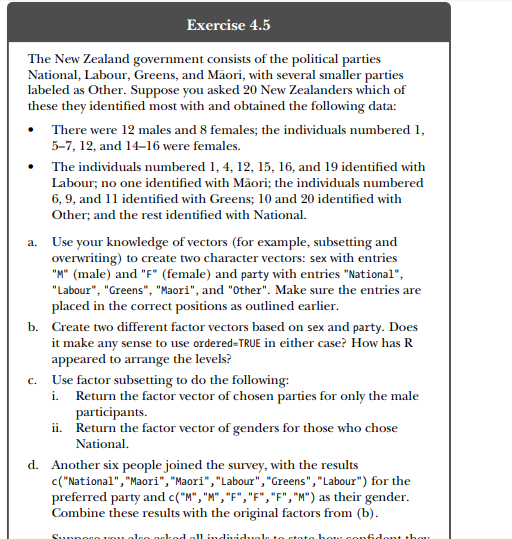
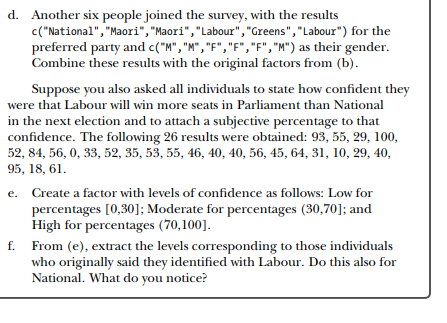
Exercise 4.5 The New Zealand government consists of the political parties National, Labour, Greens, and Maori, with several smaller parties labeled as Other. Suppose you these they identified most with and obtained the following data: . There were 12 males and 8 females; the individuals numbered 1, asked 20 New Zealanders which of 5-7, 12, and 14-16 were females. . The individuals numbered 1. 4. 12, 15. 16, and 19 identified with Labour; no one identified with Maori; the individuals numbered 6, 9, and 1 identified with Greens; 10 and 20 identified with Other; and the rest identified with National a. Use your knowledge of vectors (for example, subsetting and overwriting) to create two character vectors: sex with entries "M" (male) and "F" (female) and party with entries "National", "Labour", "Greens", "Maori", and "Other". Make sure the entries are placed in the correct positions Create two different factor vectors based on sex and party. Does it make any sense to use ordered-TRUE in either case? How has R appeared to arrange the levels? Use factor subsetting to do the following: i. Return the factor vector of chosen parties for only the male as outlined earlier b. c. paricipants ii. Return the factor vector of genders for those who chose National d. Another six people joined the survey, with the results c("National", "Maori","Maori", "Labour","Greens", "Labour") for the preferred party and c ("M","M", "F", "F", "F","M") as their gender Combine these results with the original factors from (b) Exercise 4.5 The New Zealand government consists of the political parties National, Labour, Greens, and Maori, with several smaller parties labeled as Other. Suppose you these they identified most with and obtained the following data: . There were 12 males and 8 females; the individuals numbered 1, asked 20 New Zealanders which of 5-7, 12, and 14-16 were females. . The individuals numbered 1. 4. 12, 15. 16, and 19 identified with Labour; no one identified with Maori; the individuals numbered 6, 9, and 1 identified with Greens; 10 and 20 identified with Other; and the rest identified with National a. Use your knowledge of vectors (for example, subsetting and overwriting) to create two character vectors: sex with entries "M" (male) and "F" (female) and party with entries "National", "Labour", "Greens", "Maori", and "Other". Make sure the entries are placed in the correct positions Create two different factor vectors based on sex and party. Does it make any sense to use ordered-TRUE in either case? How has R appeared to arrange the levels? Use factor subsetting to do the following: i. Return the factor vector of chosen parties for only the male as outlined earlier b. c. paricipants ii. Return the factor vector of genders for those who chose National d. Another six people joined the survey, with the results c("National", "Maori","Maori", "Labour","Greens", "Labour") for the preferred party and c ("M","M", "F", "F", "F","M") as their gender Combine these results with the original factors from (b)
Step by Step Solution
There are 3 Steps involved in it

Get step-by-step solutions from verified subject matter experts
 Study Help