







Question: Please implement a function that processes your input signals f and h, such that the equivalent of a linear convolution is performed in the frequency
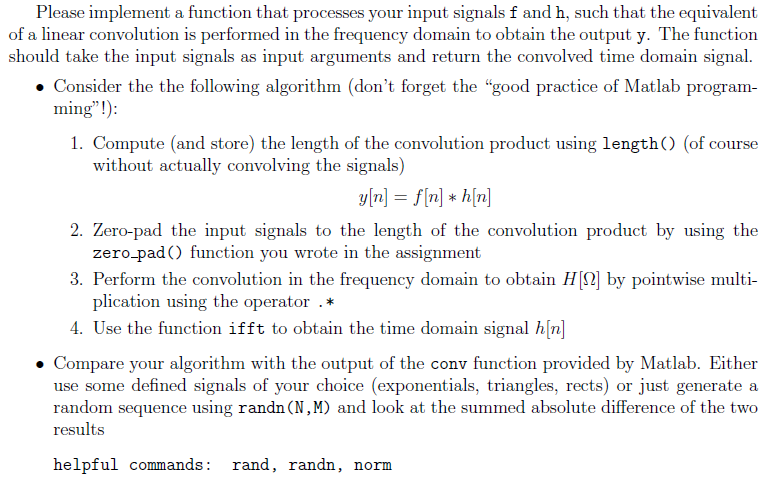
Please implement a function that processes your input signals f and h, such that the equivalent of a linear convolution is performed in the frequency domain to obtain the output y. The function should take the input signals as input arguments and return the convolved time domain signal. Consider the the following algorithm (don't forget the "good practice of Matlab progranm ming 1. Compute (and store) the length of the convolution product using length) (of course without actually convolving the signals) y[n] = f[n] * h[n] 2. Zero-pad the input signals to the length of the convolution product by using the zero pad) function you wrote in the assignment 3. Perform the convolution in the frequency domain to obtain H by pointwise multi- plication using the operator . * 4. Use the function ifft to obtain the time domain signal hn . Compare your algorithm with the output of the conv function provided by Matlab. Either use some defined signals of your choice (exponentials, triangles, rects) or just generate a random sequence using randn(N,M) and look at the summed absolute difference of the two results helpful commands: rand, randn, norm Please implement a function that processes your input signals f and h, such that the equivalent of a linear convolution is performed in the frequency domain to obtain the output y. The function should take the input signals as input arguments and return the convolved time domain signal. Consider the the following algorithm (don't forget the "good practice of Matlab progranm ming 1. Compute (and store) the length of the convolution product using length) (of course without actually convolving the signals) y[n] = f[n] * h[n] 2. Zero-pad the input signals to the length of the convolution product by using the zero pad) function you wrote in the assignment 3. Perform the convolution in the frequency domain to obtain H by pointwise multi- plication using the operator . * 4. Use the function ifft to obtain the time domain signal hn . Compare your algorithm with the output of the conv function provided by Matlab. Either use some defined signals of your choice (exponentials, triangles, rects) or just generate a random sequence using randn(N,M) and look at the summed absolute difference of the two results helpful commands: rand, randn, norm
Step by Step Solution
There are 3 Steps involved in it

Get step-by-step solutions from verified subject matter experts
 Study Help