







Question: Please include formulas, thank you. A B D E F G H 3 DATA: 4 Company accounting year starts January 1 5 General Account January
Please include formulas, thank you.
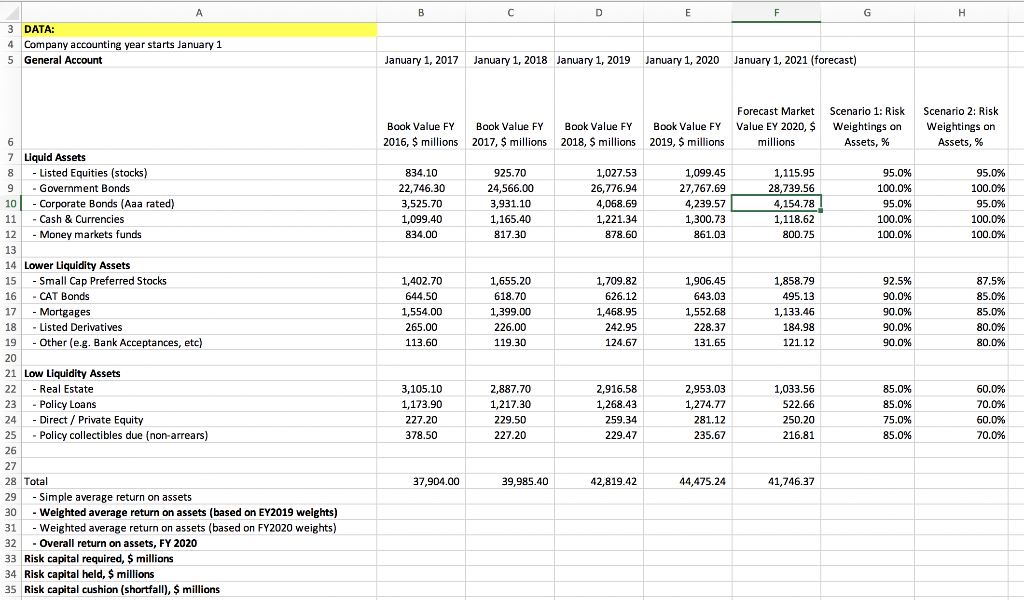
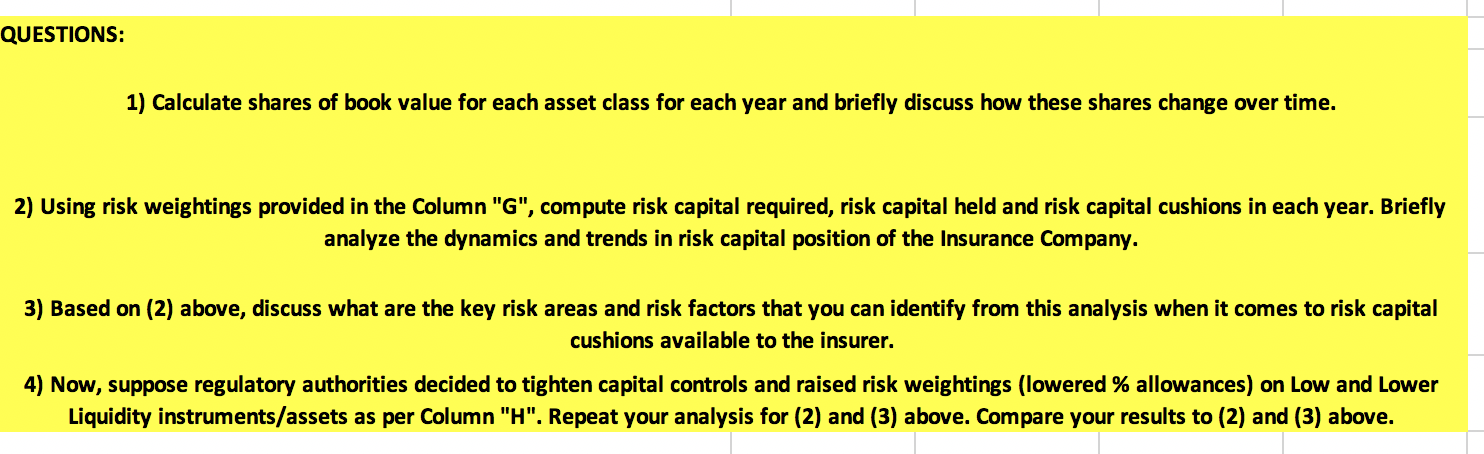
A B D E F G H 3 DATA: 4 Company accounting year starts January 1 5 General Account January 1, 2017 January 1, 2018 January 1, 2019 January 1, 2020 January 1, 2020 January 1, 2021 (forecast) Book Value FY Book Value FY 2016, $ millions 2017, $ millions Book Value FY 2018, $ millions Book Value FY 2019, $ millions Forecast Market Value EY 2020, $ millions Scenario 1: Risk Weightings on Assets, % Scenario 2: Risk Weightings on Assets, % 834.10 22,746.30 3,525.70 1,099.40 834.00 925.70 24,566.00 3,931.10 1,165,40 817.30 1,027.53 26,776.94 4,068.69 1,221.34 878.60 1,099.45 27,767.69 4,239.57 1,300.73 861.03 1,115.95 28,739.56 4,154.78 1,118.62 800.75 95.0% 100.0% 95.0% 100.0% 100.0% 95.0% 100.0% 95.0% 100.0% 100.0% 1,402.70 644.50 1,554.00 265.00 113.60 1,655.20 618.70 1,399.00 226.00 119.30 1,709.82 626.12 1,468.95 242.95 124.67 1,906.45 643.03 1,552.68 228.37 131.65 1,858.79 495.13 1,133.46 184.98 121.12 92.5% 90.0% 90.0% 90.0% 90.0% 87.5% 85.0% 85.0% 80.0% 80.0% 6 7 Liquid Assets 8 Listed Equities (stocks) 9 Government Bonds 10 - Corporate Bonds (Aaa rated) 11 Cash & Currencies 12 - Money markets funds 13 14 Lower Liquidity Assets 15 - Small Cap Preferred Stocks 16 - CAT Bonds 11 17 - Mortgages 18 40 - Listed Derivatives 19 Other (e.g. Bank Acceptances, etc) 20 21 Low Liquidity Assets 22 Real Estate 23 - Policy Loans 24 - Direct / Private Equity 25 - Policy collectibles due (non-arrears) 26 27 28 Total 29 - Simple average return on assets 30 - Weighted average return on assets (based on EY2019 weights) 31 - Weighted average return on assets (based on FY2020 weights) 32 Overall return on assets, FY 2020 33 Risk capital required, $ millions 34 Risk capital held, $ millions 35 Risk capital cushion (shortfall), $ millions 3,105.10 1,173.90 227.20 378.50 2,887.70 1,217.30 229.50 227.20 2,916.58 1,268.43 259.34 229.47 2,953.03 1,274.77 281.12 235.67 1,033.56 522.66 250.20 216.81 85.0% 85.0% 75.0% 85.0% 60.0% 70.0% 60.0% 70.0% 37,904.00 39,985.40 42,819.42 44,475.24 41,746.37 QUESTIONS: 1) Calculate shares of book value for each asset class for each year and briefly discuss how these shares change over time. 2) Using risk weightings provided in the Column "G", compute risk capital required, risk capital held and risk capital cushions in each year. Briefly analyze the dynamics and trends in risk capital position of the Insurance Company. 3) Based on (2) above, discuss what are the key risk areas and risk factors that you can identify from this analysis when it comes to risk capital cushions available to the insurer. 4) Now, suppose regulatory authorities decided to tighten capital controls and raised risk weightings (lowered % allowances) on Low and Lower Liquidity instruments/assets as per Column "H". Repeat your analysis for (2) and (3) above. Compare your results to (2) and (3) above. A B D E F G H 3 DATA: 4 Company accounting year starts January 1 5 General Account January 1, 2017 January 1, 2018 January 1, 2019 January 1, 2020 January 1, 2020 January 1, 2021 (forecast) Book Value FY Book Value FY 2016, $ millions 2017, $ millions Book Value FY 2018, $ millions Book Value FY 2019, $ millions Forecast Market Value EY 2020, $ millions Scenario 1: Risk Weightings on Assets, % Scenario 2: Risk Weightings on Assets, % 834.10 22,746.30 3,525.70 1,099.40 834.00 925.70 24,566.00 3,931.10 1,165,40 817.30 1,027.53 26,776.94 4,068.69 1,221.34 878.60 1,099.45 27,767.69 4,239.57 1,300.73 861.03 1,115.95 28,739.56 4,154.78 1,118.62 800.75 95.0% 100.0% 95.0% 100.0% 100.0% 95.0% 100.0% 95.0% 100.0% 100.0% 1,402.70 644.50 1,554.00 265.00 113.60 1,655.20 618.70 1,399.00 226.00 119.30 1,709.82 626.12 1,468.95 242.95 124.67 1,906.45 643.03 1,552.68 228.37 131.65 1,858.79 495.13 1,133.46 184.98 121.12 92.5% 90.0% 90.0% 90.0% 90.0% 87.5% 85.0% 85.0% 80.0% 80.0% 6 7 Liquid Assets 8 Listed Equities (stocks) 9 Government Bonds 10 - Corporate Bonds (Aaa rated) 11 Cash & Currencies 12 - Money markets funds 13 14 Lower Liquidity Assets 15 - Small Cap Preferred Stocks 16 - CAT Bonds 11 17 - Mortgages 18 40 - Listed Derivatives 19 Other (e.g. Bank Acceptances, etc) 20 21 Low Liquidity Assets 22 Real Estate 23 - Policy Loans 24 - Direct / Private Equity 25 - Policy collectibles due (non-arrears) 26 27 28 Total 29 - Simple average return on assets 30 - Weighted average return on assets (based on EY2019 weights) 31 - Weighted average return on assets (based on FY2020 weights) 32 Overall return on assets, FY 2020 33 Risk capital required, $ millions 34 Risk capital held, $ millions 35 Risk capital cushion (shortfall), $ millions 3,105.10 1,173.90 227.20 378.50 2,887.70 1,217.30 229.50 227.20 2,916.58 1,268.43 259.34 229.47 2,953.03 1,274.77 281.12 235.67 1,033.56 522.66 250.20 216.81 85.0% 85.0% 75.0% 85.0% 60.0% 70.0% 60.0% 70.0% 37,904.00 39,985.40 42,819.42 44,475.24 41,746.37 QUESTIONS: 1) Calculate shares of book value for each asset class for each year and briefly discuss how these shares change over time. 2) Using risk weightings provided in the Column "G", compute risk capital required, risk capital held and risk capital cushions in each year. Briefly analyze the dynamics and trends in risk capital position of the Insurance Company. 3) Based on (2) above, discuss what are the key risk areas and risk factors that you can identify from this analysis when it comes to risk capital cushions available to the insurer. 4) Now, suppose regulatory authorities decided to tighten capital controls and raised risk weightings (lowered % allowances) on Low and Lower Liquidity instruments/assets as per Column "H". Repeat your analysis for (2) and (3) above. Compare your results to (2) and (3) above
Step by Step Solution
There are 3 Steps involved in it

Get step-by-step solutions from verified subject matter experts
 Study Help