





Question: please include screenshot of the code in addtiton copyable code source and out of the code please. if possible explantation is appreciated step by step.
please include screenshot of the code in addtiton copyable code source and out of the code please. if possible explantation is appreciated step by step.

please include screenshot of the code in addtiton
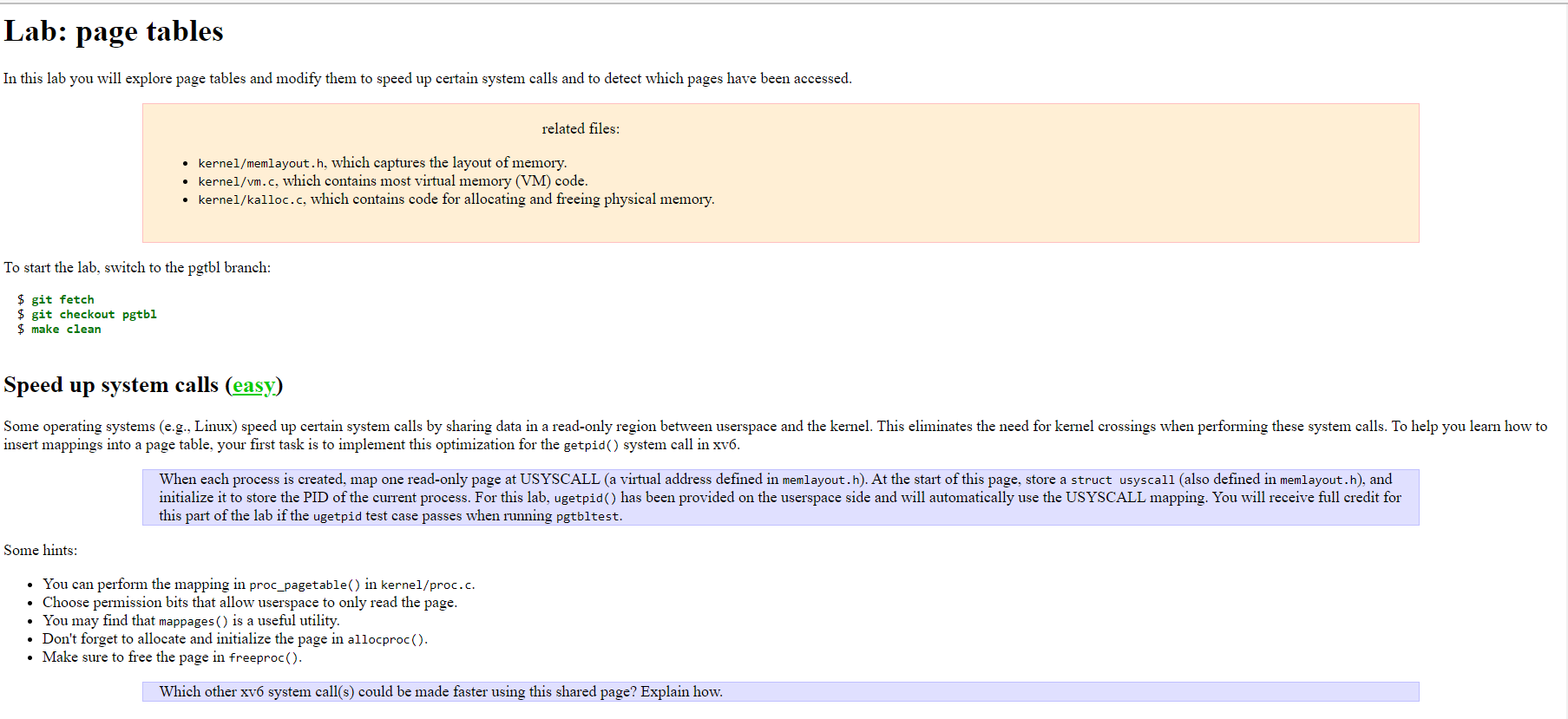
Lab: page tables In this lab you will explore page tables and modify them to speed up certain system calls and to detect which pages have been accessed. related files: . kernel/memlayout.h, which captures the layout of memory. . kernel/vm. c, which contains most virtual memory (VM) code. kernel/kalloc. c, which contains code for allocating and freeing physical memory. To start the lab, switch to the petbl branch: $ git fetch $ git checkout petbl $ make clean Speed up system calls (easy) Some operating systems (e.g., Linux) speed up certain system calls by sharing data in a read-only region between userspace and the kernel. This eliminates the need for kernel crossings when performing these system calls. To help you learn how to insert mappings into a page table, your first task is to implement this optimization for the getpid( ) system call in xv6. When each process is created, map one read-only page at USYSCALL (a virtual address defined in memlayout. h). At the start of this page, store a struct usyscall (also defined in memlayout. h), and initialize it to store the PID of the current process. For this lab, ugetpid( ) has been provided on the userspace side and will automatically use the USYSCALL mapping. You will receive full credit for this part of the lab if the ugetpid test case passes when running petbltest. Some hints: . You can perform the mapping in proc_pagetable() in kernel/proc. c. Choose permission bits that allow userspace to only read the page. . You may find that mappages ( ) is a useful utility. . Don't forget to allocate and initialize the page in allocproc(). . Make sure to free the page in freeproc(). Which other xv6 system call(s) could be made faster using this shared page? Explain how

Step by Step Solution

There are 3 Steps involved in it

1 Expert Approved Answer
Step: 1 Unlock blur-text-image

Question Has Been Solved by an Expert!

Get step-by-step solutions from verified subject matter experts

Step: 2 Unlock
Step: 3 Unlock

Students Have Also Explored These Related Programming Questions!