







Question: Please include steps and formula used In practice, a common way to value a share of stock when a company pays dividends is to value
Please include steps and formula used
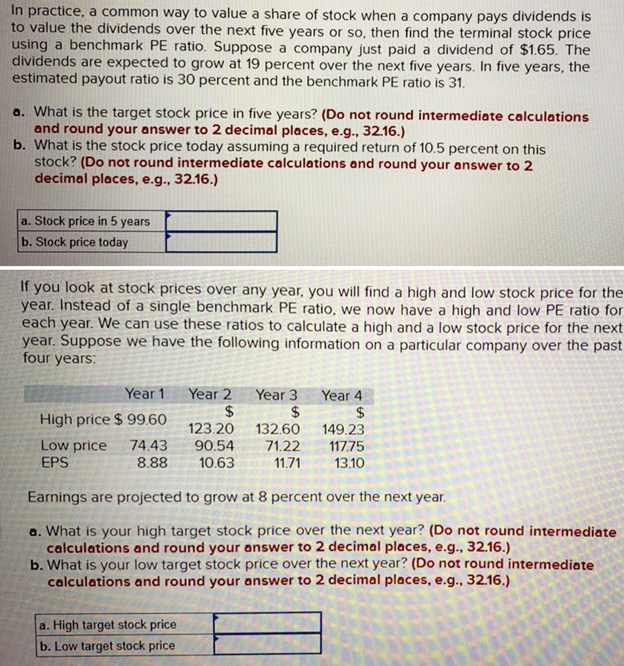
In practice, a common way to value a share of stock when a company pays dividends is to value the dividends over the next five years or so, then find the terminal stock price using a benchmark PE ratio. Suppose a company just paid a dividend of $1.65. The dividends are expected to grow at 19 percent over the next five years. In five years, the estimated payout ratio is 30 percent and the benchmark PE ratio is 31. a. What is the target stock price in five years? (Do not round intermediate calculations and round your answer to 2 decimal places, e.g., 32.16.) b. What is the stock price today assuming a required return of 10.5 percent on this stock? (Do not round intermediate calculations and round your answer to 2 decimal places, e.g., 32.16.) a. Stock price in 5 years b. Stock price today If you look at stock prices over any year, you will find a high and low stock price for the year. Instead of a single benchmark PE ratio, we now have a high and low PE ratio for each year. We can use these ratios to calculate a high and a low stock price for the next year. Suppose we have the following information on a particular company over the past four years: Year 1 Year 2 Year 3 Year 4 $ $ $ High price $ 99.60 123.20 132.60 149.23 Low price 74.43 90.54 71.22 117.75 EPS 8.88 10.63 11.71 13.10 Earnings are projected to grow at 8 percent over the next year. a. What is your high target stock price over the next year? (Do not round intermediate calculations and round your answer to 2 decimal places, e.g., 32.16.) b. What is your low target stock price over the next year? (Do not round intermediate calculations and round your answer to 2 decimal places, e.g., 32.16.) a. High target stock price b. Low target stock price
Step by Step Solution
There are 3 Steps involved in it

Get step-by-step solutions from verified subject matter experts
 Study Help