







Question: Please include the excel formulas for each cell needed in order to solve the problem. Thank you. Billingham Packaging is considering expanding its production capacity
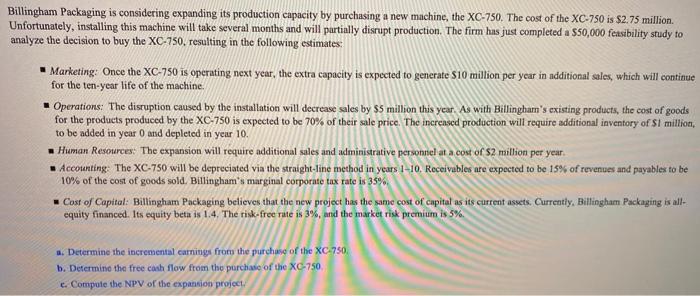
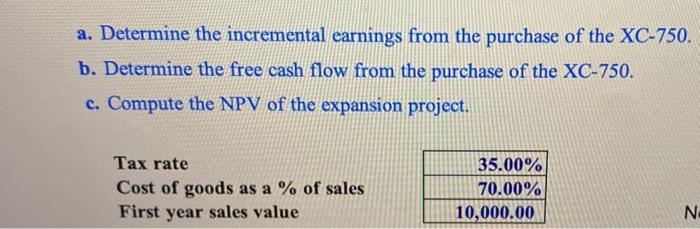
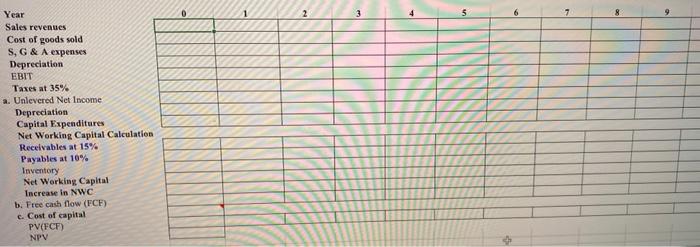
Billingham Packaging is considering expanding its production capacity by purchasing a new machine, the XC-750. The cost of the XC-750 is $2.75 million. Unfortunately, installing this machine will take several months and will partially disrupt production. The firm has just completed a $50,000 feasibility study to analyze the decision to buy the XC-750, resulting in the following estimates Marketing: Once the XC-750 is operating next year, the extra capacity is expected to generate $10 million per year in additional sales, which will continue for the ten-year life of the machine. * Operations: The disruption caused by the installation will decrease sales by $5 million this year. As with Billingham's existing products, the cost of goods for the products produced by the XC-750 is expected to be 70% of their sale price. The increased production will require additional inventory of S1 million, to be added in year and depleted in year 10. Human Resources: The expansion will require additional sales and administrative personnel at a cost of $2 million per year. Accounting: The XC-750 will be depreciated via the straight-line method in years 1-10. Receivables are expected to be 15% of revenues and payables to be 10% of the cost of goods sold. Billingham's marginal corporate tax rate is 35% Cost of Capital: Billingham Packaging believes that the new project has the same cost of capital as its current assets. Currently, Billingham Packaging is all equity financed. Its equity beta is 1.4. The risk-free rate is 3%, and the market risk premium is 5% a. Determine the incremental camnings from the purchase of the XC 750 b. Determine the free cash flow from the purchase of the XC-750 c. Compare the NPV of the expansion project: a. Determine the incremental earnings from the purchase of the XC-750. b. Determine the free cash flow from the purchase of the XC-750. c. Compute the NPV of the expansion project. Tax rate Cost of goods as a % of sales First year sales value 35.00% 70.00% 10,000.00 N. 7 8 9 Year Sales revenues Cost of goods sold S, G & A expenses Depreciation EBIT Taxes at 35% a. Unlevered Net Income Depreciation Capital Expenditures Net Working Capital Calculation Receivables at 15% Payables at 10% Inventory Net Working Capital Increase in NWC b. Free cash flow (FCF) c. Cost of capital PV(FCF) NPV Billingham Packaging is considering expanding its production capacity by purchasing a new machine, the XC-750. The cost of the XC-750 is $2.75 million. Unfortunately, installing this machine will take several months and will partially disrupt production. The firm has just completed a $50,000 feasibility study to analyze the decision to buy the XC-750, resulting in the following estimates Marketing: Once the XC-750 is operating next year, the extra capacity is expected to generate $10 million per year in additional sales, which will continue for the ten-year life of the machine. * Operations: The disruption caused by the installation will decrease sales by $5 million this year. As with Billingham's existing products, the cost of goods for the products produced by the XC-750 is expected to be 70% of their sale price. The increased production will require additional inventory of S1 million, to be added in year and depleted in year 10. Human Resources: The expansion will require additional sales and administrative personnel at a cost of $2 million per year. Accounting: The XC-750 will be depreciated via the straight-line method in years 1-10. Receivables are expected to be 15% of revenues and payables to be 10% of the cost of goods sold. Billingham's marginal corporate tax rate is 35% Cost of Capital: Billingham Packaging believes that the new project has the same cost of capital as its current assets. Currently, Billingham Packaging is all equity financed. Its equity beta is 1.4. The risk-free rate is 3%, and the market risk premium is 5% a. Determine the incremental camnings from the purchase of the XC 750 b. Determine the free cash flow from the purchase of the XC-750 c. Compare the NPV of the expansion project: a. Determine the incremental earnings from the purchase of the XC-750. b. Determine the free cash flow from the purchase of the XC-750. c. Compute the NPV of the expansion project. Tax rate Cost of goods as a % of sales First year sales value 35.00% 70.00% 10,000.00 N. 7 8 9 Year Sales revenues Cost of goods sold S, G & A expenses Depreciation EBIT Taxes at 35% a. Unlevered Net Income Depreciation Capital Expenditures Net Working Capital Calculation Receivables at 15% Payables at 10% Inventory Net Working Capital Increase in NWC b. Free cash flow (FCF) c. Cost of capital PV(FCF) NPV
Step by Step Solution
There are 3 Steps involved in it

Get step-by-step solutions from verified subject matter experts
 Study Help