







Question: Please just answer No. 3 QUESTION and provide me the brief summary to this case study. (Provide evidence based on the case study). I will
Please just answer No. 3 QUESTION and provide me the brief summary to this case study. (Provide evidence based on the case study).
I will give you a like after! Thank you.
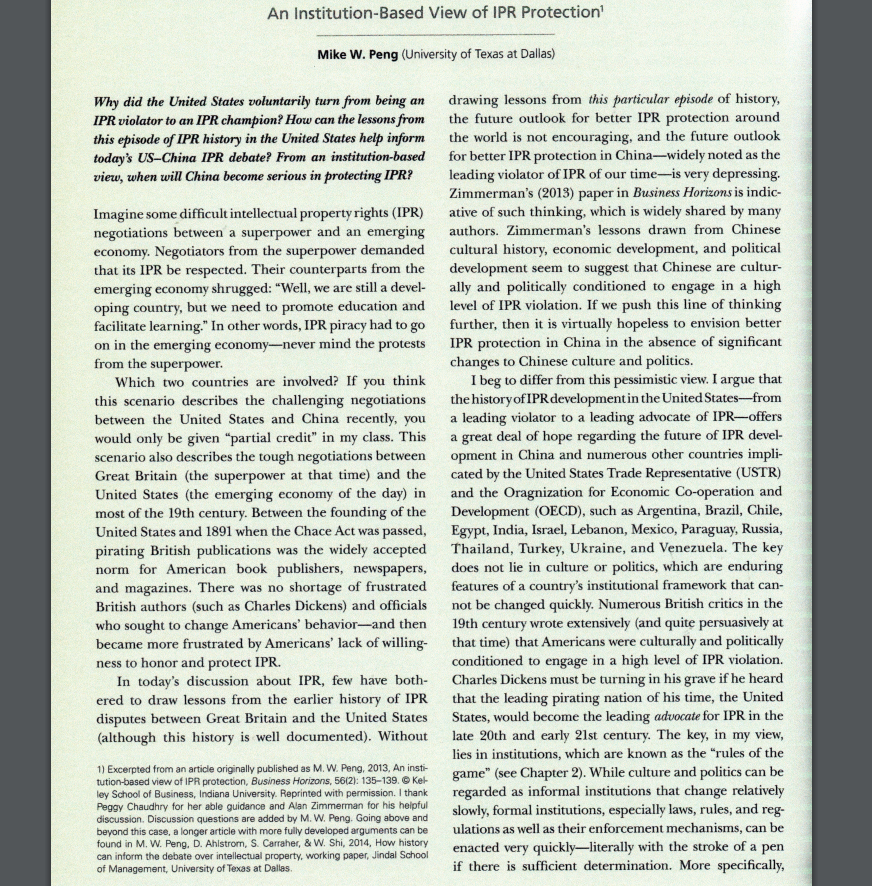
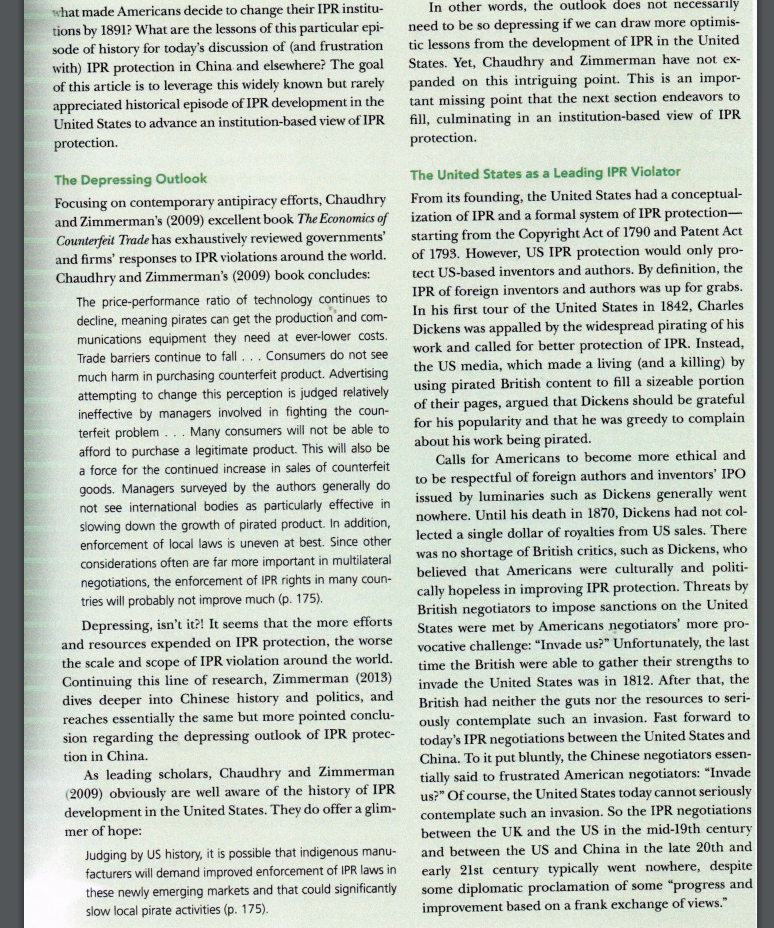
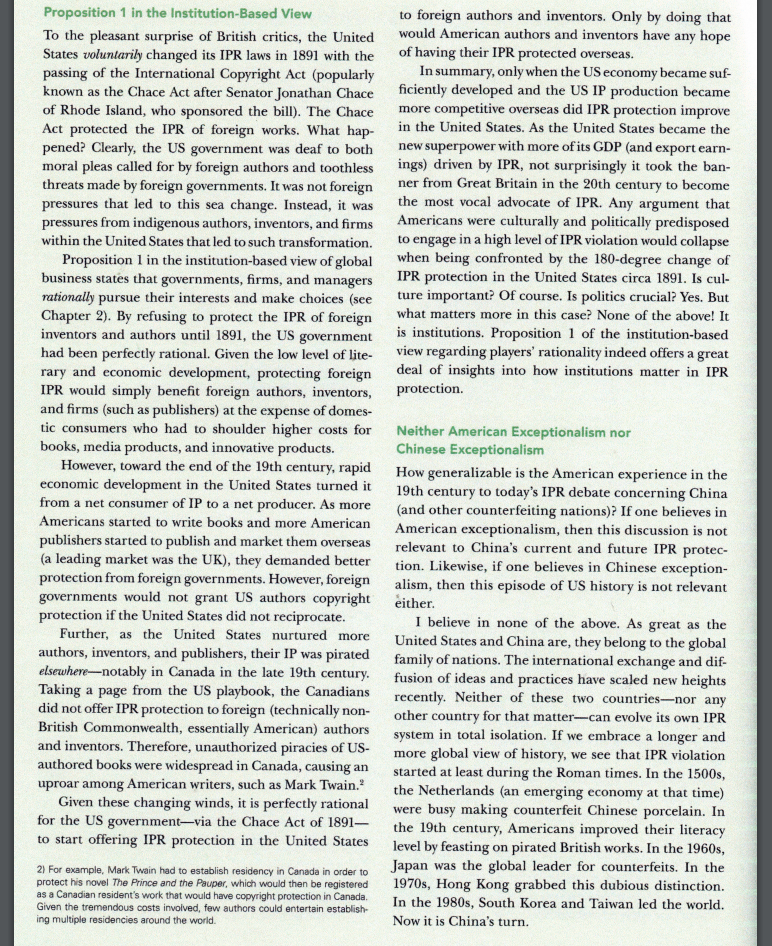
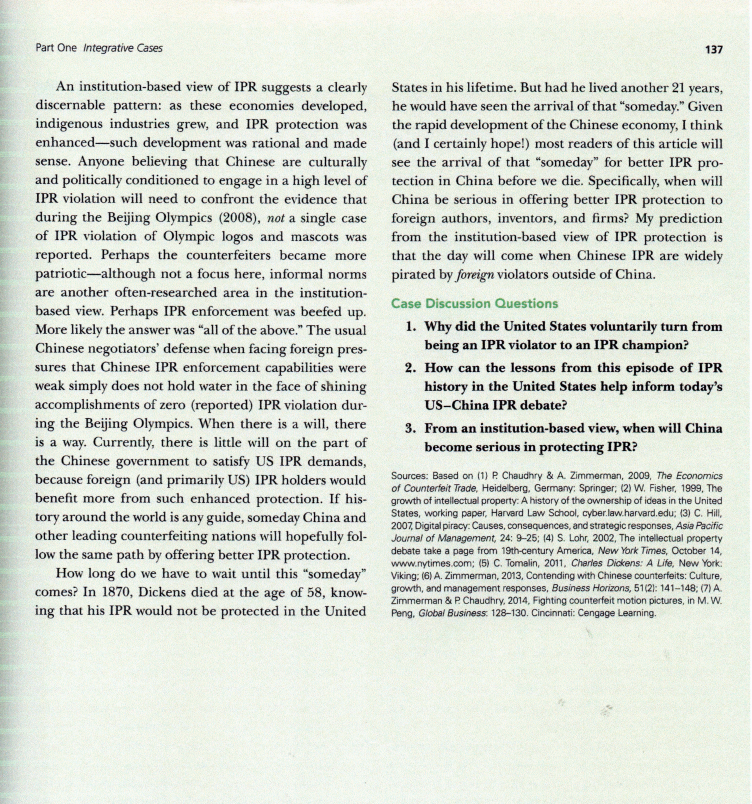
An Institution-Based View of IPR Protection Mike W. Peng (University of Texas at Dallas) Why did the United States voluntarily turn from being an drawing lessons from this particular episode of history, IPR violator to an IPR champion? How can the lessons from the future outlook for better IPR protection around this episode of IPR history in the United States help inform the world is not encouraging, and the future outlook today's US-China IPR debate? From an institution-based for better IPR protection in China-widely noted as the view, when will China become serious in protecting IPR? leading violator of IPR of our time-is very depressing. Zimmerman's (2013) paper in Business Horizons is indic- Imagine some difficult intellectual property rights (IPR) ative of such thinking, which is widely shared by many negotiations between a superpower and an emerging authors. Zimmerman's lessons drawn from Chinese economy. Negotiators from the superpower demanded cultural history, economic development, and political that its IPR be respected. Their counterparts from the development seem to suggest that Chinese are cultur- emerging economy shrugged: "Well, we are still a devel- ally and politically conditioned to engage in a high oping country, but we need to promote education and level of IPR violation. If we push this line of thinking facilitate learning." In other words, IPR piracy had to go further, then it is virtually hopeless to envision better on in the emerging economy-never mind the protests IPR protection in China in the absence of significant from the superpower. changes to Chinese culture and politics. Which two countries are involved? If you think I beg to differ from this pessimistic view. I argue that this scenario describes the challenging negotiations the history of IPR development in the United States--from between the United States and China recently, you a leading violator to a leading advocate of IPR-offers would only be given "partial credit" in my class. This a great deal of hope regarding the future of IPR devel- scenario also describes the tough negotiations between opment in China and numerous other countries impli- Great Britain (the superpower at that time) and the cated by the United States Trade Representative (USTR) United States (the emerging economy of the day) in and the Oragnization for Economic Co-operation and most of the 19th century. Between the founding of the Development (OECD), such as Argentina, Brazil, Chile, United States and 1891 when the Chace Act was passed, Egypt, India, Israel, Lebanon, Mexico, Paraguay, Russia, pirating British publications was the widely accepted Thailand, Turkey, Ukraine, and Venezuela. The key norm for American book publishers, newspapers, does not lie in culture or politics, which are enduring and magazines. There was no shortage of frustrated features of a country's institutional framework that can- British authors (such as Charles Dickens) and officials not be changed quickly. Numerous British critics in the who sought to change Americans' behavior-and then 19th century wrote extensively (and quite persuasively at became more frustrated by Americans' lack of willing- that time) that Americans were culturally and politically ness to honor and protect IPR. conditioned to engage in a high level of IPR violation. In today's discussion about IPR, few have both- Charles Dickens must be turning in his grave if he heard ered to draw lessons from the earlier history of IPR that the leading pirating nation of his time, the United disputes between Great Britain and the United States States, would become the leading advocate for IPR in the (although this history is well documented). Without late 20th and early 21st century. The key, in my view, lies in institutions, which are known as the "rules of the 1) Excerpted from an article originally published as M. W. Peng, 2013, An insti- tution-based view of IPR protection, Business Horizons, 56(2): 135-139. Ket game" (see Chapter 2). While culture and politics can be ley School of Business, Indiana University. Reprinted with permission. I thank regarded as informal institutions that change relatively Peggy Chaudhry for her able guidance and Alan Zimmerman for his helpful discussion. Discussion questions are added by M. W. Peng, Going above and slowly, formal institutions, especially laws, rules, and reg- beyond this case, a longer article with more fully developed arguments can be ulations as well as their enforcement mechanisms, can be found in M. W. Peng, D. Ahlstrom, S. Carraher, & W. Shi, 2014, How history can inform the debate over intellectual property, working paper, Jindal School enacted very quickly-literally with the stroke of a pen of Management, University of Texas at Dallas if there is sufficient determination. More specifically, what made Americans decide to change their IPR institu- In other words, the outlook does not necessarily tions by 1891? What are the lessons of this particular epi- need to be so depressing if we can draw more optimis- sode of history for today's discussion of (and frustration tic lessons from the development of IPR in the United with) IPR protection in China and elsewhere? The goal States. Yet, Chaudhry and Zimmerman have not ex- of this article is to leverage this widely known but rarely panded on this intriguing point. This is an impor- appreciated historical episode of IPR development in the tant missing point that the next section endeavors to United States to advance an institution-based view of IPR fill, culminating in an institution-based view of IPR protection. protection. The Depressing Outlook Focusing on contemporary antipiracy efforts, Chaudhry and Zimmerman's (2009) excellent book The Economics of Counterfeit Trade has exhaustively reviewed governments' and firms' responses to IPR violations around the world. Chaudhry and Zimmerman's (2009) book concludes: The price-performance ratio of technology continues to decline, meaning pirates can get the production and com- munications equipment they need at ever-lower costs. Trade barriers continue to fall ... Consumers do not see much harm in purchasing counterfeit product. Advertising attempting to change this perception is judged relatively ineffective by managers involved in fighting the coun- terfeit problem ... Many consumers will not be able to afford to purchase a legitimate product. This will also be a force for the continued increase in sales of counterfeit goods. Managers surveyed by the authors generally do not see international bodies as particularly effective in slowing down the growth of pirated product. In addition, enforcement of local laws is uneven at best. Since other considerations often are far more important in multilateral negotiations, the enforcement of IPR rights in many coun- tries will probably not improve much (p. 175). Depressing, isn't it?! It seems that the more efforts and resources expended on IPR protection, the worse the scale and scope of IPR violation around the world. Continuing this line of research, Zimmerman (2013) dives deeper into Chinese history and politics, and reaches essentially the same but more pointed conclu- sion regarding the depressing outlook of IPR protec- tion in China. As leading scholars, Chaudhry and Zimmerman (2009) obviously are well aware of the history of IPR development in the United States. They do offer a glim- mer of hope: Judging by US history, it is possible that indigenous manu- facturers will demand improved enforcement of IPR laws in these newly emerging markets and that could significantly slow local pirate activities (p. 175). The United States as a Leading IPR Violator From its founding, the United States had a conceptual- ization of IPR and a formal system of IPR protection- starting from the Copyright Act of 1790 and Patent Act of 1793. However, US IPR protection would only pro- tect US-based inventors and authors. By definition, the IPR of foreign inventors and authors was up for grabs. In his first tour of the United States in 1842, Charles Dickens was appalled by the widespread pirating of his work and called for better protection of IPR. Instead, the US media, which made a living (and a killing) by using pirated British content to fill a sizeable portion of their pages, argued that Dickens should be grateful for his popularity and that he was greedy to complain about his work being pirated. Calls for Americans to become more ethical and to be respectful of foreign authors and inventors' IPO issued by luminaries such as Dickens generally went nowhere. Until his death in 1870, Dickens had not col- lected a single dollar of royalties from US sales. There was no shortage of British critics, such as Dickens, who believed that Americans were culturally and politi- cally hopeless in improving IPR protection. Threats by British negotiators to impose sanctions on the United States were met by Americans negotiators' more pro- vocative challenge: "Invade us?" Unfortunately, the last time the British were able to gather their strengths to invade the United States was in 1812. After that, the British had neither the guts nor the resources to seri- ously contemplate such an invasion. Fast forward to today's IPR negotiations between the United States and China. To it put bluntly, the Chinese negotiators essen- tially said to frustrated American negotiators: "Invade us?" Of course, the United States today cannot seriously contemplate such an invasion. So the IPR negotiations between the UK and the US in the mid-19th century and between the US and China in the late 20th and early 21st century typically went nowhere, despite some diplomatic proclamation of some "progress and improvement based on a frank exchange of views." Proposition 1 in the Institution-Based View to foreign authors and inventors. Only by doing that To the pleasant surprise of British critics, the United would American authors and inventors have any hope States voluntarily changed its IPR laws in 1891 with the of having their IPR protected overseas. passing of the International Copyright Act (popularly In summary, only when the US economy became suf- known as the Chace Act after Senator Jonathan Chace ficiently developed and the US IP production became of Rhode Island, who sponsored the bill). The Chace more competitive overseas did IPR protection improve Act protected the IPR of foreign works. What hap- in the United States. As the United States became the pened? Clearly, the US government was deaf to both new superpower with more of its GDP and export earn- moral pleas called for by foreign authors and toothlessings) driven by IPR, not surprisingly it took the ban- threats made by foreign governments. It was not foreign ner from Great Britain in the 20th century to become pressures that led to this sea change. Instead, it was the most vocal advocate of IPR. Any argument that pressures from indigenous authors, inventors, and firms Americans were culturally and politically predisposed within the United States that led to such transformation. to engage in a high level of IPR violation would collapse Proposition 1 in the institution-based view of global when being confronted by the 180-degree change of business states that governments, firms, and managers IPR protection in the United States circa 1891. Is cul- rationally pursue their interests and make choices (see ture important? Of course. Is politics crucial? Yes. But Chapter 2). By refusing to protect the IPR of foreign what matters more in this case? None of the above! It inventors and authors until 1891, the US government is institutions. Proposition 1 of the institution-based had been perfectly rational. Given the low level of lite- view regarding players' rationality indeed offers a great rary and economic development, protecting foreign deal of insights into how institutions matter in IPR IPR would simply benefit foreign authors, inventors, protection. and firms (such as publishers) at the expense of domes- tic consumers who had to shoulder higher costs for Neither American Exceptionalism nor books, media products, and innovative products. Chinese Exceptionalism However, toward the end of the 19th century, rapid How generalizable is the American experience in the economic development in the United States turned it 19th century to today's IPR debate concerning China from a net consumer of IP to a net producer. As more (and other counterfeiting nations)? If one believes in Americans started to write books and more American American exceptionalism, then this discussion is not publishers started to publish and market them overseas relevant to China's current and future IPR protec- (a leading market was the UK), they demanded better tion. Likewise, if one believes in Chinese exception- protection from foreign governments. However, foreign alism, then this episode of US history is not relevant governments would not grant US authors copyright either. protection if the United States did not reciprocate. I believe in none of the above. As great as the Further, as the United States nurtured more United States and China are, they belong to the global authors, inventors, and publishers, their IP was pirated family of nations. The international exchange and dif- elsewhere--notably in Canada in the late 19th century. fusion of ideas and practices have scaled new heights Taking a page from the US playbook, the Canadians recently. Neither of these two countries--nor any did not offer IPR protection to foreign (technically non- other country for that matter-can evolve its own IPR British Commonwealth, essentially American) authors system in total isolation. If we embrace a longer and and inventors. Therefore, unauthorized piracies of US- more global view of history, we see that IPR violation authored books were widespread in Canada, causing an started at least during the Roman times. In the 1500s, uproar among American writers, such as Mark Twain. the Netherlands (an emerging economy at that time) Given these changing winds, it is perfectly rational were busy making counterfeit Chinese porcelain. In for the US government-via the Chace Act of 1891- the 19th century, Americans improved their literacy to start offering IPR protection in the United States level by feasting on pirated British works. In the 1960s, 2) For example, Mark Twain had to establish residency in Canada in order to Japan was the global leader for counterfeits. In the protect his novel The Prince and the Pauper, which would then be registered 1970s, Hong Kong grabbed this dubious distinction. as a Canadian resident's work that would have copyright protection in Canada Given the tremendous costs involved, few authors could entertain establish- In the 1980s, South Korea and Taiwan led the world. ing multiple residencies around the world. Now it is China's turn. Part One Integrative Cases 137 An institution-based view of IPR suggests a clearly discernable pattern: as these economies developed, indigenous industries grew, and IPR protection was enhanced-such development was rational and made sense. Anyone believing that Chinese are culturally and politically conditioned to engage in a high level of IPR violation will need to confront the evidence that during the Beijing Olympics (2008), not a single case of IPR violation of Olympic logos and mascots was reported. Perhaps the counterfeiters became more patriotic-although not a focus here, informal norms are another often-researched area in the institution- based view. Perhaps IPR enforcement was beefed up. More likely the answer was "all of the above." The usual Chinese negotiators' defense when facing foreign pres- sures that Chinese IPR enforcement capabilities were weak simply does not hold water in the face of shining accomplishments of zero (reported) IPR violation dur- ing the Beijing Olympics. When there is a will, there is a way. Currently, there is little will on the part of the Chinese government to satisfy US IPR demands, because foreign and primarily US) IPR holders would benefit more from such enhanced protection. If his- tory around the world is any guide, someday China and other leading counterfeiting nations will hopefully fol- low the same path by offering better IPR protection. How long do we have to wait until this "someday" comes? In 1870, Dickens died at the age of 58, know- ing that his IPR would not be protected in the United States in his lifetime. But had he lived another 21 years, he would have seen the arrival of that "someday." Given the rapid development of the Chinese economy, I think (and I certainly hope!) most readers of this article will see the arrival of that "someday" for better IPR pro- tection in China before we die. Specifically, when will China be serious in offering better IPR protection to foreign authors, inventors, and firms? My prediction from the institution-based view of IPR protection is that the day will come when Chinese IPR are widely pirated by foreign violators outside of China. Case Discussion Questions 1. Why did the United States voluntarily turn from being an IPR violator to an IPR champion? 2. How can the lessons from this episode of IPR history in the United States help inform today's US-China IPR debate? 3. From an institution-based view, when will China become serious in protecting IPR? Sources: Based on (1) P. Chaudhry & A Zimmerman, 2009, The Economics of Counterfeit Trade, Heidelberg, Germany: Springer, (2) W. Fisher, 1999. The growth of intellectual property: A history of the ownership of ideas in the United States, working paper, Harvard Law School, cyber.law.harvard.edu; (3) C. Hill, 2007 Digital piracy: Causes, consequences, and strategic responses, Asia Pacific Journal of Management, 24: 9-25; (4) S. Lohr, 2002. The intellectual property debate take a page from 19th-century America, New York Times, October 14, www.nytimes.com; (5) C. Tomalin, 2011, Charles Dickens: A Life, New York: Viking: (6) A. Zimmerman, 2013, Contending with Chinese counterfeits: Culture, growth, and management responses, Business Horizons, 51(21: 141-148: (7) A. Zimmerman & P. Chaudhry, 2014, Fighting counterfeit motion pictures, in M. W. Peng, Global Business: 128-130. Cincinnati: Cengage LearningStep by Step Solution
There are 3 Steps involved in it
1 Expert Approved Answer
Step: 1 Unlock

Question Has Been Solved by an Expert!
Get step-by-step solutions from verified subject matter experts
Step: 2 Unlock
Step: 3 Unlock
 Study Help