







Question: please just do things to consider 5 For this experiment, we will use Thin-Layer chromatography(TLC) system as you have learned how to use TLC in
please just do things to consider 5
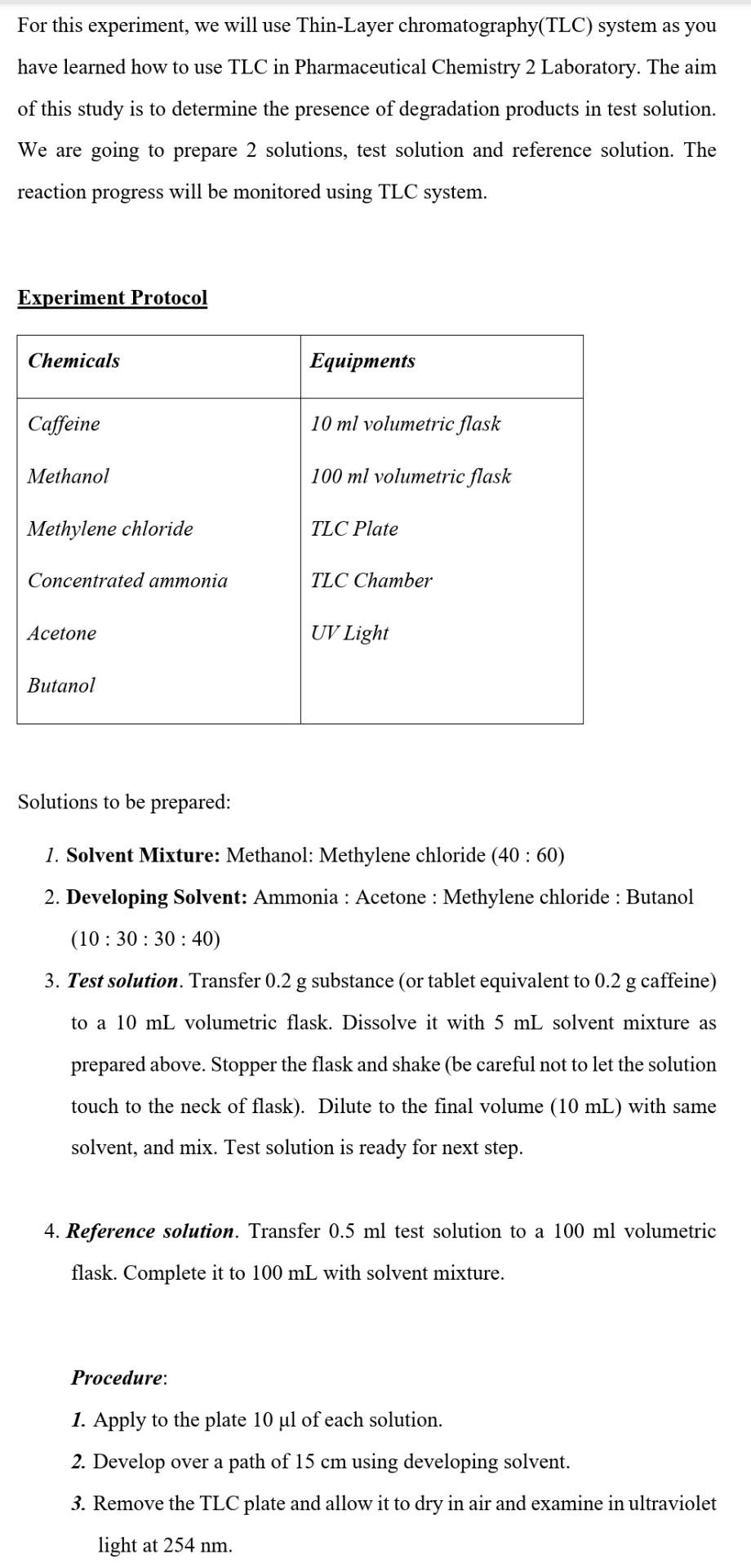
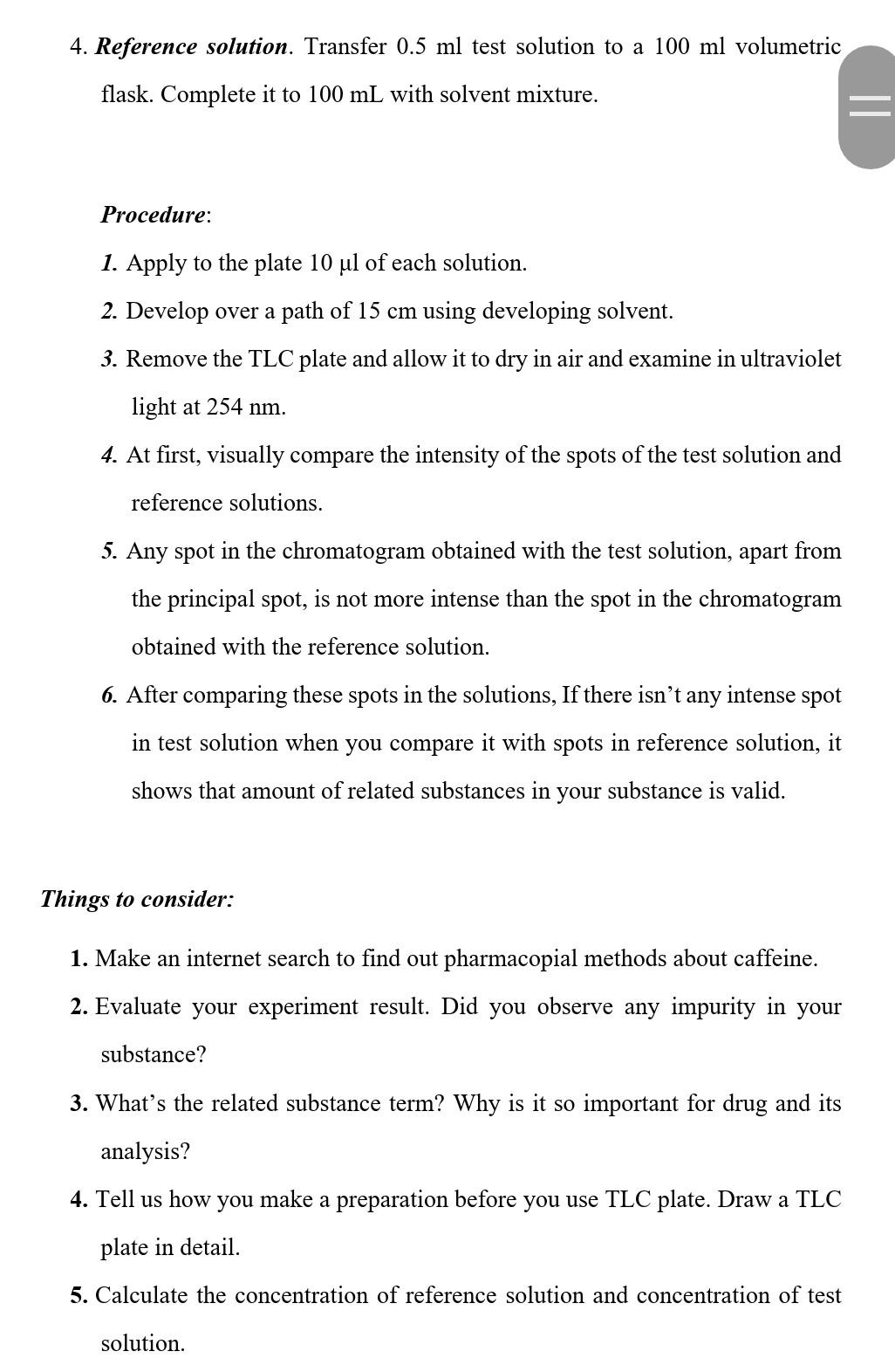
For this experiment, we will use Thin-Layer chromatography(TLC) system as you have learned how to use TLC in Pharmaceutical Chemistry 2 Laboratory. The aim of this study is to determine the presence of degradation products in test solution. We are going to prepare 2 solutions, test solution and reference solution. The reaction progress will be monitored using TLC system. Experiment Protocol Chemicals Equipments Caffeine 10 ml volumetric flask Methanol 100 ml volumetric flask Methylene chloride TLC Plate Concentrated ammonia TLC Chamber Acetone UV Light Butanol Solutions to be prepared: 1. Solvent Mixture: Methanol: Methylene chloride (40 : 60) 2. Developing Solvent: Ammonia : Acetone : Methylene chloride : Butanol (10: 30: 30:40) 3. Test solution. Transfer 0.2 g substance (or tablet equivalent to 0.2 g caffeine) to a 10 mL volumetric flask. Dissolve it with 5 mL solvent mixture as prepared above. Stopper the flask and shake (be careful not to let the solution touch to the neck of flask). Dilute to the final volume (10 mL) with same solvent, and mix. Test solution is ready for next step. 4. Reference solution. Transfer 0.5 ml test solution to a 100 ml volumetric flask. Complete it to 100 mL with solvent mixture. Procedure: 1. Apply to the plate 10 ul of each solution. 2. Develop over a path of 15 cm using developing solvent. 3. Remove the TLC plate and allow it to dry in air and examine in ultraviolet light at 254 nm. 4. Reference solution. Transfer 0.5 ml test solution to a 100 ml volumetric flask. Complete it to 100 mL with solvent mixture. Procedure: 1. Apply to the plate 10 ul of each solution. 2. Develop over a path of 15 cm using developing solvent. 3. Remove the TLC plate and allow it to dry in air and examine in ultraviolet light at 254 nm. 4. At first, visually compare the intensity of the spots of the test solution and reference solutions. 5. Any spot in the chromatogram obtained with the test solution, apart from the principal spot, is not more intense than the spot in the chromatogram obtained with the reference solution. 6. After comparing these spots in the solutions, If there isn't any intense spot in test solution when you compare it with spots in reference solution, it shows that amount of related substances in your substance is valid. Things to consider: 1. Make an internet search to find out pharmacopial methods about caffeine. 2. Evaluate your experiment result. Did you observe any impurity in your substance? 3. What's the related substance term? Why is it so important for drug and its analysis? 4. Tell us how you make a preparation before you use TLC plate. Draw a TLC plate in detail. 5. Calculate the concentration of reference solution and concentration of test solution
Step by Step Solution
There are 3 Steps involved in it

Get step-by-step solutions from verified subject matter experts
 Study Help