







Question: please keep the answer be clear A word about molarity and has units of moles per liter mol/L) Ebbing/Gammon, Section 4.7% Molarity is a measure
please keep the answer be clear
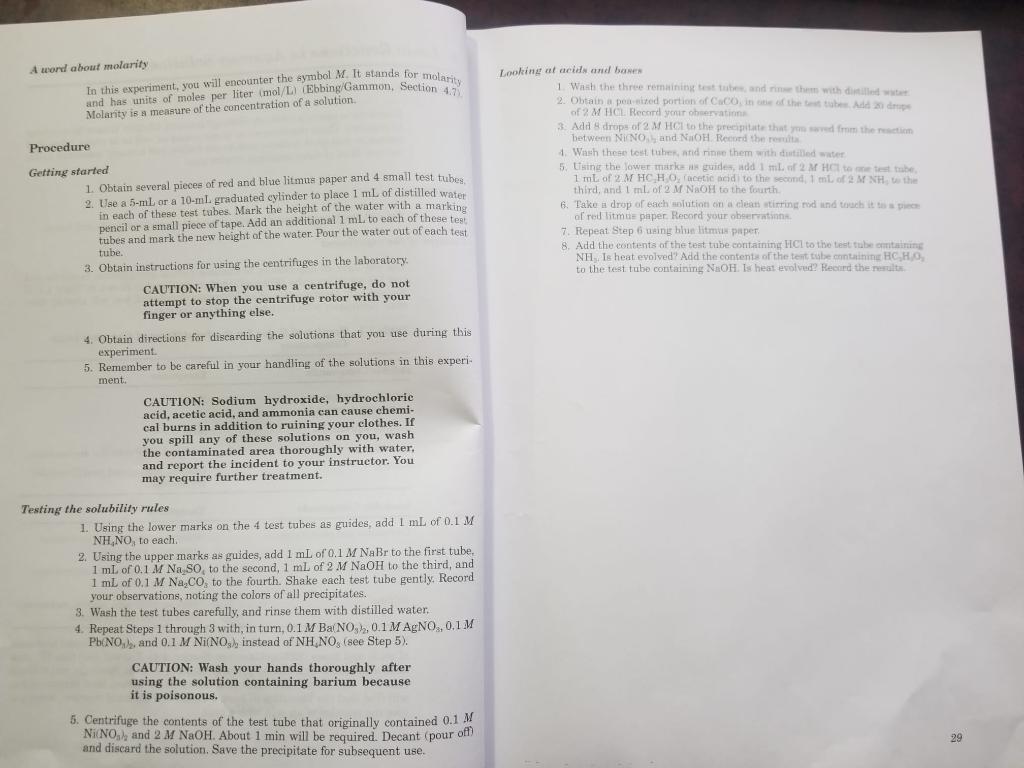
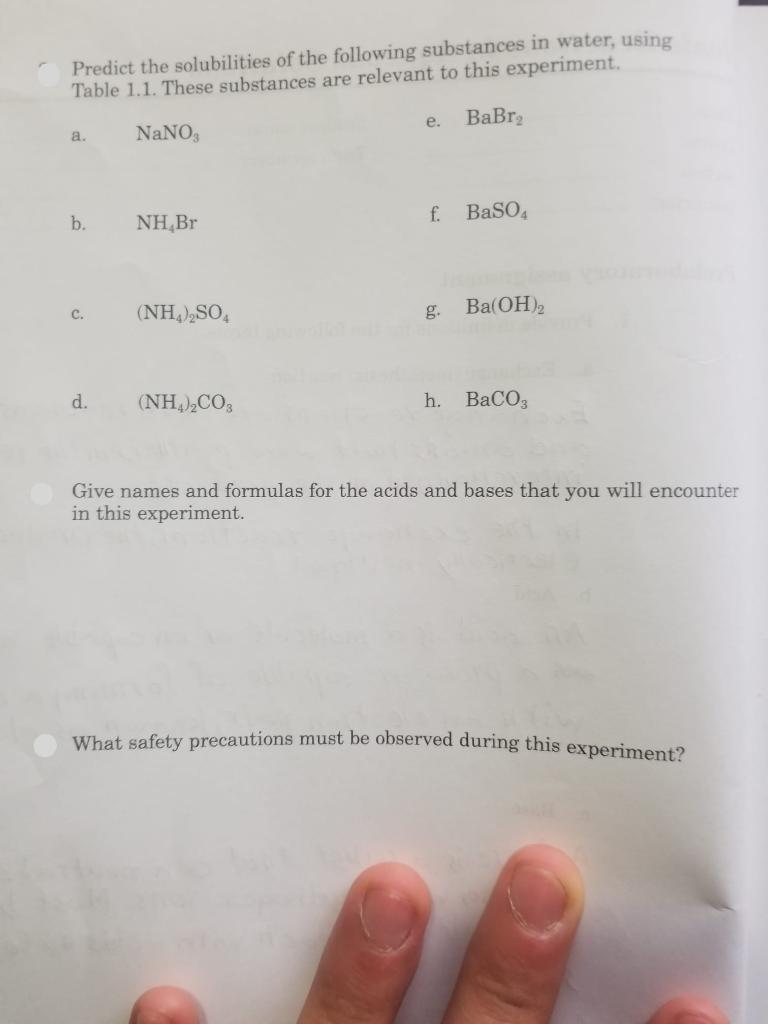
A word about molarity and has units of moles per liter mol/L) Ebbing/Gammon, Section 4.7% Molarity is a measure of the concentration of a solution Looking at acids and bones 1. Wash the three remainint test tube and them with distille 2. Obtain a penized portion of C.CO, in to the Add of 2 M HCL Record your hervations 3. drops of 2 M HCl to the between inondoh precipitata that you saved from the reaction 1. Wash these tost ther, and rinse them with distilled water 5. Using the lower marks is suides, add 1 mL of 2 M H to test tube 1 ml of 2 M HC Hacetic acid to the second, 1 mL of 2 MNH the third, and I mL of 2 M NaOH to the fourth 6. Take a drop of each solution on a clean stirring rod and touch it to the of red litmus paper Record your observations 7. Repeat Step 6 being blue litmus paper, 8. Add the contents of the test tube containing HCl to the test tabe otining NH. Is heat evolved? Add the contents of the tent tabe containing HC,H,O, to the test tube containing NaOH. Is heat evolved? Record the resulta Procedure Getting started 1. Obtain several pieces of red and blue litmus paper and 4 small test tubes 2. Use a 5-ml or a 10-ml graduated cylinder to place 1 mL of distilled water in each of these test tabes. Mark the height of the water with a marking pencil or a small piece of tape. Add an additional 1 ml to each of these ter tubes and mark the new height of the water. Pour the water out of each test tube. 3. Obtain instructions for using the centrifuges in the laboratory CAUTION: When you use a centrifuge, do not attempt to stop the centrifuge rotor with your finger or anything else. 4. Obtain directions for discarding the solutions that you use during this experiment. 5. Remember to be careful in your handling of the solutions in this experi- ment CAUTION: Sodium hydroxide, hydrochlorie acid, acetic acid, and ammonia can cause chemi- cal burns in addition to ruining your clothes. If you spill any of these solutions on you, wash the contaminated area thoroughly with water, and report the incident to your instructor. You may require further treatment. Testing the solubility rules 1. Using the lower marks on the 4 test tubes as guides, add 1 mL of 0.1 M NH.NO, to each 2. Using the upper marks as guides, add 1 mL of 0.1 M NaBr to the first tube. 1 ml of 0.1 M Na SOto the second, 1 mL of 2 M NaOH to the third, and 1 ml of 0.1 M Na.Co, to the fourth. Shake each test tube gently. Record your observations, noting the colors of all precipitates. 3. Wash the test tubes carefully, and rinse them with distilled water, 4. Repeat Steps 1 through 3 with, in turn, 0.1 M Ba(NO. 2, 0.1 M AgNO,0,1 M Pb(NO), and 0.1 M Ni(NO3), instead of NH.NO, (see Step 5). CAUTION: Wash your hands thoroughly after using the solution containing barium because it is poisonous. 5. Centrifuge the contents of the test tube that originally contained 0.1 M Ni(NO), and 2 M NaOH. About 1 min will be required. Decant pour off) and discard the solution. Save the precipitate for subsequent use. 29 Predict the solubilities of the following substances in water, using Table 1.1. These substances are relevant to this experiment, e. BaBr a. NaNO f. b. NH Br BaSO C. (NH),SO g. Ba(OH)2 d. (NH4)2CO3 h. BaCO3 Give names and formulas for the acids and bases that you will encounter in this experiment. What safety precautions must be observed during this experiment
Step by Step Solution
There are 3 Steps involved in it

Get step-by-step solutions from verified subject matter experts
 Study Help