Question: Please label and answer all questions. Dont answer question 3. ONLY 1-2 FULL DETAIL CASE 10.2 Susan G. Komen Foundation In 2012, the Susan G.
Please label and answer all questions. Dont answer question 3. ONLY 1-2 FULL DETAIL
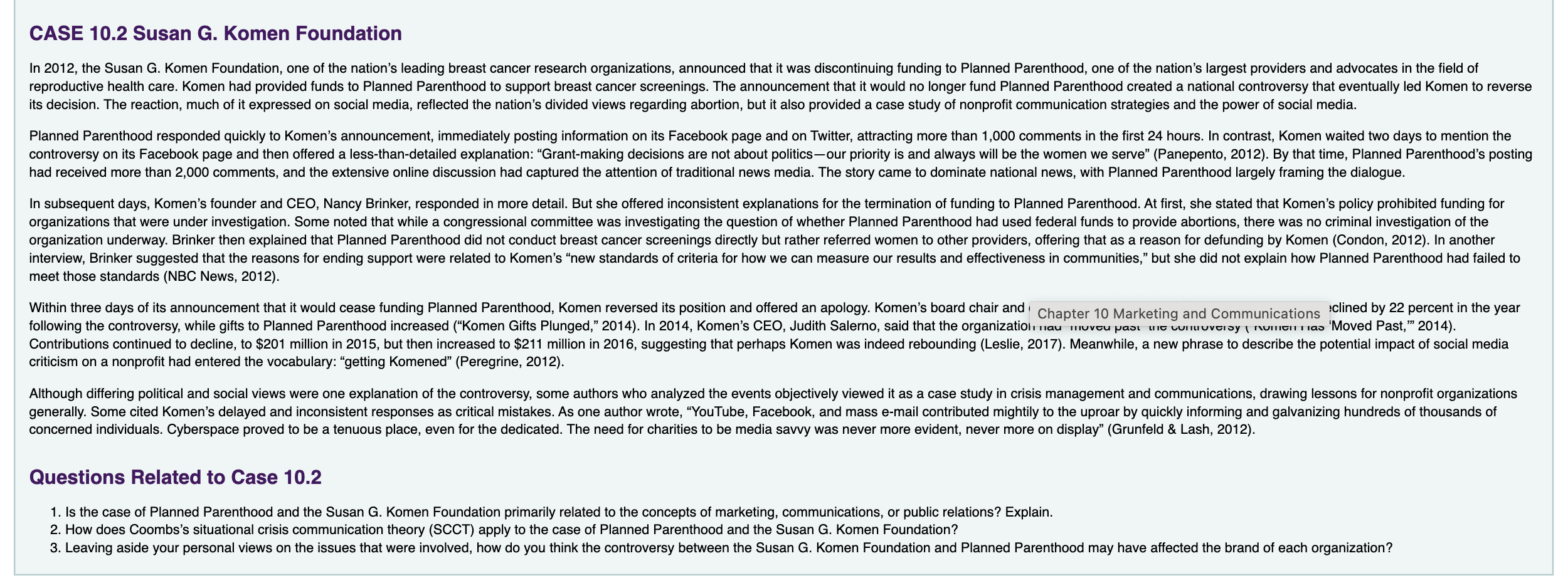
CASE 10.2 Susan G. Komen Foundation In 2012, the Susan G. Komen Foundation, one of the nation's leading breast cancer research organizations, announced that it was discontinuing funding to Planned Parenthood, one of the nation's largest providers and advocates in the field of reproductive health care. Komen had provided funds to Planned Parenthood to support breast cancer screenings. The announcement that it would no longer fund Planned Parenthood created a national controversy that eventually led Komen to reverse its decision. The reaction, much of it expressed on social media, reflected the nation's divided views regarding abortion, but it also provided a case study of nonprofit communication strategies and the power of social media. Planned Parenthood responded quickly to Komen's announcement, immediately posting information on its Facebook page and on Twitter, attracting more than 1,000 comments in the first 24 hours. In contrast, Komen waited two days to mention the controversy on its Facebook page and then offered a less-than-detailed explanation: "Grant-making decisions are not about politics-our priority is and always will be the women we serve" (Panepento, 2012). By that time, Planned Parenthood's posting had received more than 2,000 comments, and the extensive online discussion had captured the attention of traditional news media. The story came to dominate national news, with Planned Parenthood largely framing the dialogue. In subsequent days, Komen's founder and CEO, Nancy Brinker, responded in more detail. But she offered inconsistent explanations for the termination of funding to Planned Parenthood. At first, she stated that Komen's policy prohibited funding for organizations that were under investigation. Some noted that while a congressional committee was investigating the question of whether Planned Parenthood had used federal funds to provide abortions, there was no criminal investigation of the organization underway. Brinker then explained that Planned Parenthood did not conduct breast cancer screenings directly but rather referred women to other providers, offering that as a reason for defunding by Komen (Condon, 2012). In another interview, Brinker suggested that the reasons for ending support were related to Komen's "new standards of criteria for how we can measure our results and effectiveness in communities," but she did not explain how Planned Parenthood had failed to meet those standards (NBC News, 2012). Within three days of its announcement that it would cease funding Planned Parenthood, Komen reversed its position and offered an apology. Komen's board chair and Chapter 10 Marketing and Communications clined by 22 percent in the year following the controversy, while gifts to Planned Parenthood increased ("Komen Gifts Plunged," 2014). In 2014, Komen's CEO, Judith Salerno, said that the organization au veu pass the convery month as Moved Past," 2014). Contributions continued to decline, to $201 million in 2015, but then increased to $211 million in 2016, suggesting that perhaps Komen was indeed rebounding (Leslie, 2017). Meanwhile, a new phrase to describe the potential impact of social media criticism on a nonprofit had entered the vocabulary: "getting Komened" (Peregrine, 2012). Although differing political and social views were one explanation of the controversy, some authors who analyzed the events objectively viewed it as a case study in crisis management and communications, drawing lessons for nonprofit organizations generally. Some cited Komen's delayed and inconsistent responses as critical mistakes. As one author wrote, "YouTube, Facebook, and mass e-mail contributed mightily to the uproar by quickly informing and galvanizing hundreds of thousands of concerned individuals. Cyberspace proved to be a tenuous place, even for the dedicated. The need for charities to be media savvy was never more evident, never more on display" (Grunfeld & Lash, 2012). Questions Related to Case 10.2 1. Is the case of Planned Parenthood and the Susan G. Komen Foundation primarily related to the concepts of marketing, communications, or public relations? Explain. 2. How does Coombs's situational crisis communication theory (SCCT) apply to the case of Planned Parenthood and the Susan G. Komen Foundation? 3. Leaving aside your personal views on the issues that were involved, how do you think the controversy between the Susan G. Komen Foundation and Planned Parenthood may have affected the brand of each organization









 Study Help