







Question: please list reference . Discussions List View Topic 4-1 Discussion: Good Faith Available after Saturday, July 20, 2019 11:59 PM EDT. Subscribe Read Case 27-2,
please list reference .
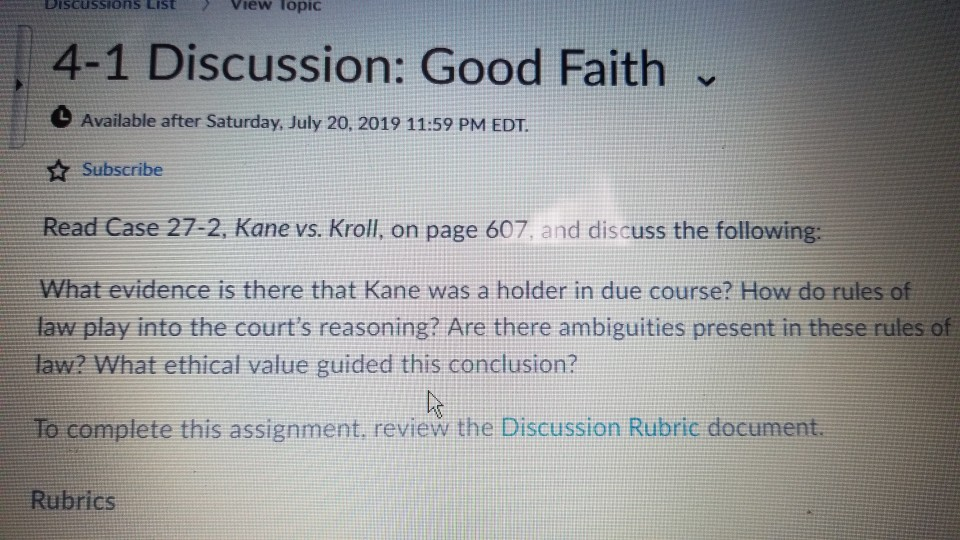
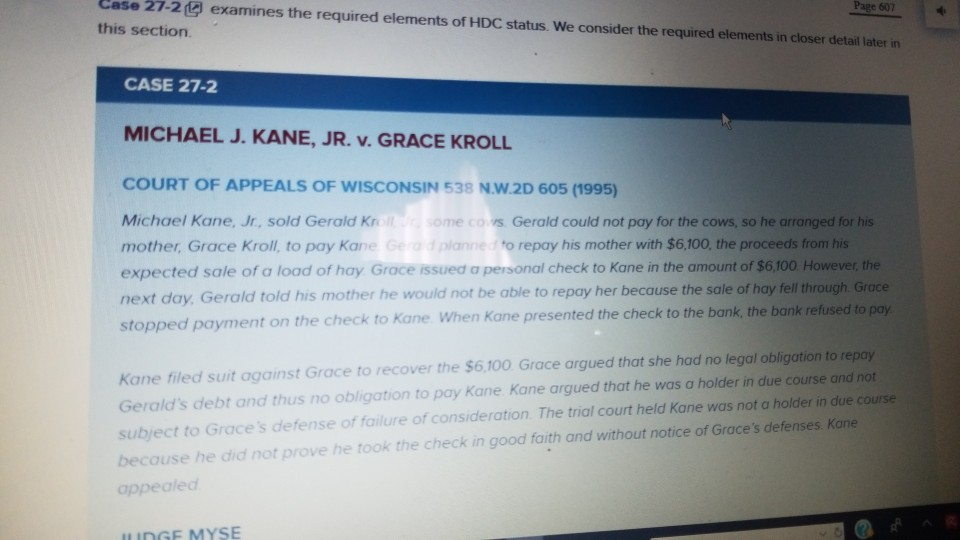
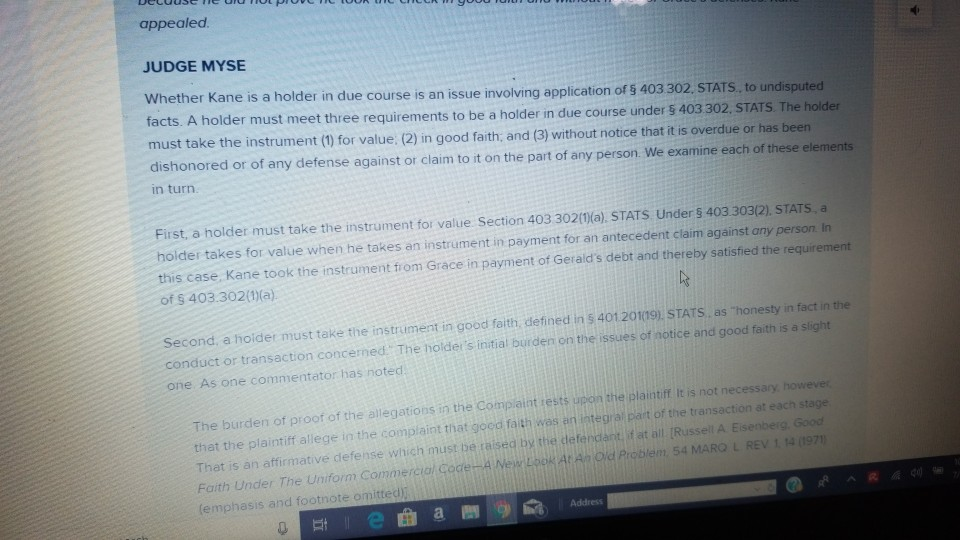
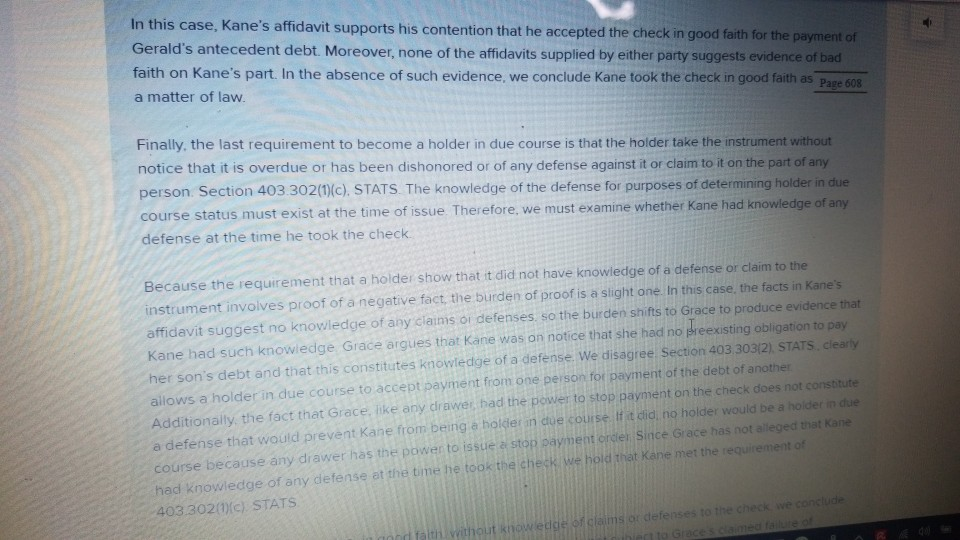
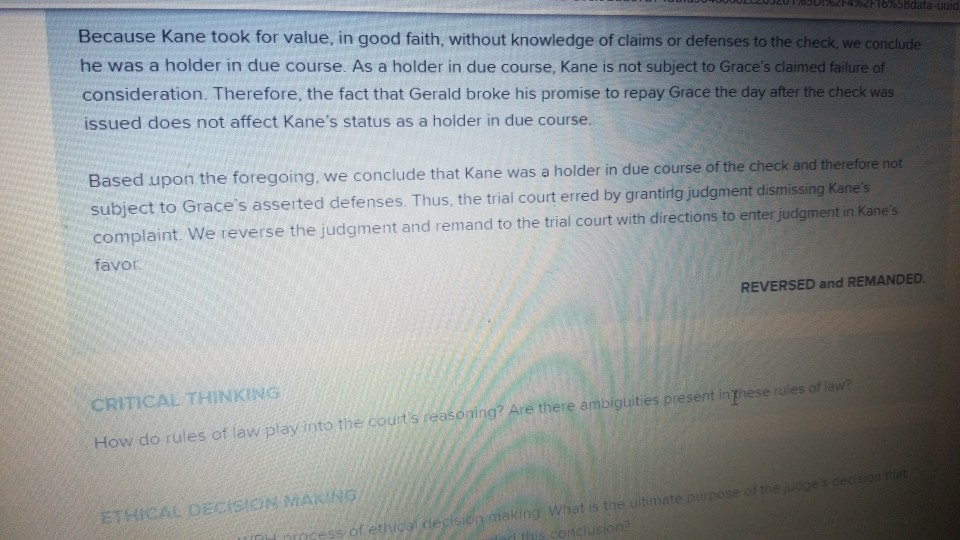
Discussions List View Topic 4-1 Discussion: Good Faith Available after Saturday, July 20, 2019 11:59 PM EDT. Subscribe Read Case 27-2, Kane vs. Kroll, on page 607, and discuss the following: What evidence is there that Kane was a holder in due course? How do rules of law play into the court's reasoning? Are there ambiguities present in these rules of law? What ethical value guided this conclusion? To complete this assignment. review the Discussion Rubric document, Rubrics Page 607 Case 27-24 examines the required elements of HDC status. We consider the required elements in closer detail later in this section CASE 27-2 MICHAEL J. KANE, JR. V. GRACE KROLL COURT OF APPEALS OF WISCONSIN 538 N.W.2D 605 (1995) Michael Kane, Jr., sold Gerald Krot omecos Gerald could not pay for the cows, so he arranged for his mother Grace Kroll, to pay Kane Ge p lanne to repay his mother with $6,100, the proceeds from his expected sale of a load of hay Grace issued a personal check to Kane in the amount of $6100 However, the next day. Gerald told his mother he would not be able to repay her because the sale of hay fell through Grace stopped payment on the check to Kane When Kane presented the check to the bank, the bank refused to pay Kane filed suit against Grace to recover the $6.100 Grace argued that she had no legal obligation to repay Gerald's debt and thus no obligation to pay Kane Kane argued that he was a holder in due course and not subject to Grace's defense of failure of consideration. The trial court held Kane was not a holder in due course because he did not prove he took the check in good faith and without notice of Grace's defenses. Kane appealed HIDGE MYSE DELUUSENCUIU MIUL PIUVCHIUUR WIL CHLUAI YUUU JUUNIU MIUIUUL appealed. JUDGE MYSE Whether Kane is a holder in due course is an issue involving application of S 403 302, STATS to undisputed facts. A holder must meet three requirements to be a holder in due course under 5 403 302. STATS The holder must take the instrument (1) for value. (2) in good faith; and (3) without notice that it is overdue or has been dishonored or of any defense against or claim to it on the part of any person. We examine each of these elements in turn First, a holder must take the instrument for value Section 403 302(1)(a), STATS Under $ 403.303(2), STATS, a holder takes for value when he takes an instrument in payment for an antecedent claim against any person in this case, Kane took the instrument from Grace in payment of Gerald's debt and thereby satisfied the requirement of $ 403.302(1)(a) Second, a hoider must take the instrument in good faith defined in 5 401.201(19), STATS as "honesty in fact in the conduct or transaction concerned The holder's initial burden on the issues of notice and good faith is a slight one As one commentator has noted The burden of proof of the allegations in the Complaint tests upon the plaintiff it is not necessary, however that the plaintiff allege in the complaint that good faith was an integral part of the transaction at each stage REV 1 1497 That is an affirmative defense which must be raised by the defendant fat all. [Russell A. Eisenberg. Good Faith Under The Uniform Commercial Code A New Look At An Old Problem 54 MARO (emphasis and footnote omitted m Address a e 05 e In this case, Kane's affidavit supports his contention that he accepted the check in good faith for the payment of Gerald's antecedent debt. Moreover, none of the affidavits supplied by either party suggests evidence of bad faith on Kane's part. In the absence of such evidence, we conclude Kane took the check in good faith as Page 608 a matter of law. Finally, the last requirement to become a holder in due course is that the holder take the instrument without notice that it is overdue or has been dishonored or of any defense against it or claim to it on the part of any person. Section 403.302(1)(c). STATS. The knowledge of the defense for purposes of determining holder in due course status must exist at the time of issue. Therefore, we must examine whether Kane had knowledge of any defense at the time he took the check Because the requirement that a holder show that it did not have knowledge of a defense or claim to the instrument involves proof of a negative fact, the burden of proof is a slight one. In this case, the facts in Kane's affidavit suggest no knowledge of any claims or defenses, so the burden shifts to Grace to produce evidence that Kane had such knowledge Grace argues that Kane was on notice that she had no preexisting obligation to pay her son's debt and that this constitutes knowledge of a defense. We disagree Section 403 303(2), STATS. clearly allows a holder in due course to accept payment from one person for payment of the debt of another Additionally, the fact that Grace like any drawer, had the power to stop payment on the check does not constitute a defense that would prevent kane from being a holder in due course. If it did no holder would be a holder in due Course because any diawer has the power to issue a ston payment onder Since Grace has noted had knowledge of any defense at the time he took the check we hold that kane met the requiremento 403 302010). STATS alth without knowled or claims or defenses to the check we conti G amedaile OUUULULU2017030!%24%2F16%5Bdata-uuid Because Kane took for value, in good faith, without knowledge of claims or defenses to the check, we conclude he was a holder in due course. As a holder in due course, Kane is not subject to Grace's claimed failure of consideration. Therefore, the fact that Gerald broke his promise to repay Grace the day after the check was issued does not affect Kane's status as a holder in due course. Based upon the foregoing, we conclude that kane was a holder in due course of the check and therefore not subject to Grace's asserted defenses. Thus, the trial court erred by granting judgment dismissing Kane's complaint. We reverse the judgment and remand to the trial court with directions to enter judgment in Kanes favor. REVERSED and REMANDED. CRITICAL THINKING How do rules of law play into the court's reasoning? Are there ambiguities present in these rules of law ETHICAL DECISION MAKING incess of ethical decision making. What is the ultimate purpose of the page der der this conclusion Discussions List View Topic 4-1 Discussion: Good Faith Available after Saturday, July 20, 2019 11:59 PM EDT. Subscribe Read Case 27-2, Kane vs. Kroll, on page 607, and discuss the following: What evidence is there that Kane was a holder in due course? How do rules of law play into the court's reasoning? Are there ambiguities present in these rules of law? What ethical value guided this conclusion? To complete this assignment. review the Discussion Rubric document, Rubrics Page 607 Case 27-24 examines the required elements of HDC status. We consider the required elements in closer detail later in this section CASE 27-2 MICHAEL J. KANE, JR. V. GRACE KROLL COURT OF APPEALS OF WISCONSIN 538 N.W.2D 605 (1995) Michael Kane, Jr., sold Gerald Krot omecos Gerald could not pay for the cows, so he arranged for his mother Grace Kroll, to pay Kane Ge p lanne to repay his mother with $6,100, the proceeds from his expected sale of a load of hay Grace issued a personal check to Kane in the amount of $6100 However, the next day. Gerald told his mother he would not be able to repay her because the sale of hay fell through Grace stopped payment on the check to Kane When Kane presented the check to the bank, the bank refused to pay Kane filed suit against Grace to recover the $6.100 Grace argued that she had no legal obligation to repay Gerald's debt and thus no obligation to pay Kane Kane argued that he was a holder in due course and not subject to Grace's defense of failure of consideration. The trial court held Kane was not a holder in due course because he did not prove he took the check in good faith and without notice of Grace's defenses. Kane appealed HIDGE MYSE DELUUSENCUIU MIUL PIUVCHIUUR WIL CHLUAI YUUU JUUNIU MIUIUUL appealed. JUDGE MYSE Whether Kane is a holder in due course is an issue involving application of S 403 302, STATS to undisputed facts. A holder must meet three requirements to be a holder in due course under 5 403 302. STATS The holder must take the instrument (1) for value. (2) in good faith; and (3) without notice that it is overdue or has been dishonored or of any defense against or claim to it on the part of any person. We examine each of these elements in turn First, a holder must take the instrument for value Section 403 302(1)(a), STATS Under $ 403.303(2), STATS, a holder takes for value when he takes an instrument in payment for an antecedent claim against any person in this case, Kane took the instrument from Grace in payment of Gerald's debt and thereby satisfied the requirement of $ 403.302(1)(a) Second, a hoider must take the instrument in good faith defined in 5 401.201(19), STATS as "honesty in fact in the conduct or transaction concerned The holder's initial burden on the issues of notice and good faith is a slight one As one commentator has noted The burden of proof of the allegations in the Complaint tests upon the plaintiff it is not necessary, however that the plaintiff allege in the complaint that good faith was an integral part of the transaction at each stage REV 1 1497 That is an affirmative defense which must be raised by the defendant fat all. [Russell A. Eisenberg. Good Faith Under The Uniform Commercial Code A New Look At An Old Problem 54 MARO (emphasis and footnote omitted m Address a e 05 e In this case, Kane's affidavit supports his contention that he accepted the check in good faith for the payment of Gerald's antecedent debt. Moreover, none of the affidavits supplied by either party suggests evidence of bad faith on Kane's part. In the absence of such evidence, we conclude Kane took the check in good faith as Page 608 a matter of law. Finally, the last requirement to become a holder in due course is that the holder take the instrument without notice that it is overdue or has been dishonored or of any defense against it or claim to it on the part of any person. Section 403.302(1)(c). STATS. The knowledge of the defense for purposes of determining holder in due course status must exist at the time of issue. Therefore, we must examine whether Kane had knowledge of any defense at the time he took the check Because the requirement that a holder show that it did not have knowledge of a defense or claim to the instrument involves proof of a negative fact, the burden of proof is a slight one. In this case, the facts in Kane's affidavit suggest no knowledge of any claims or defenses, so the burden shifts to Grace to produce evidence that Kane had such knowledge Grace argues that Kane was on notice that she had no preexisting obligation to pay her son's debt and that this constitutes knowledge of a defense. We disagree Section 403 303(2), STATS. clearly allows a holder in due course to accept payment from one person for payment of the debt of another Additionally, the fact that Grace like any drawer, had the power to stop payment on the check does not constitute a defense that would prevent kane from being a holder in due course. If it did no holder would be a holder in due Course because any diawer has the power to issue a ston payment onder Since Grace has noted had knowledge of any defense at the time he took the check we hold that kane met the requiremento 403 302010). STATS alth without knowled or claims or defenses to the check we conti G amedaile OUUULULU2017030!%24%2F16%5Bdata-uuid Because Kane took for value, in good faith, without knowledge of claims or defenses to the check, we conclude he was a holder in due course. As a holder in due course, Kane is not subject to Grace's claimed failure of consideration. Therefore, the fact that Gerald broke his promise to repay Grace the day after the check was issued does not affect Kane's status as a holder in due course. Based upon the foregoing, we conclude that kane was a holder in due course of the check and therefore not subject to Grace's asserted defenses. Thus, the trial court erred by granting judgment dismissing Kane's complaint. We reverse the judgment and remand to the trial court with directions to enter judgment in Kanes favor. REVERSED and REMANDED. CRITICAL THINKING How do rules of law play into the court's reasoning? Are there ambiguities present in these rules of law ETHICAL DECISION MAKING incess of ethical decision making. What is the ultimate purpose of the page der der this conclusion
Step by Step Solution
There are 3 Steps involved in it

Get step-by-step solutions from verified subject matter experts
 Study Help