Question: Please make a (1)practice exam with the blank exam that I was given and provide a (2)key. On the key show the steps on you
Please make a (1)practice exam with the blank exam that I was given and provide a (2)key. On the key show the steps on you arrive at the answer concisely. Additionally, make a (3) 5" x 8" notecard (or equivalent size sheet of paper) with notes on both sides, this will be my cheat sheet for the exam. My exam is in 8 hours so the faster the better. Give all documents to me as pdfs.
I have uploaded a blank exam how the exam is gonna look like and a previous exam given in the past. You can use some of the questions from the previous exam.
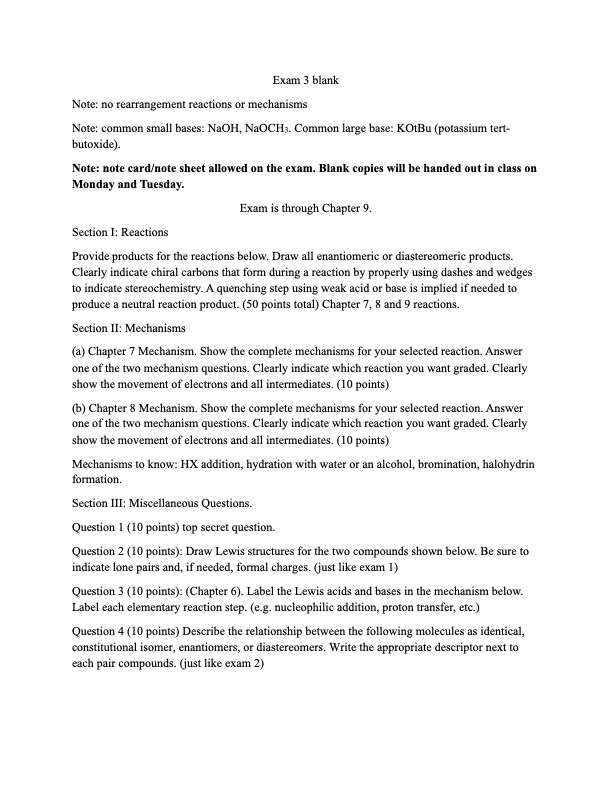
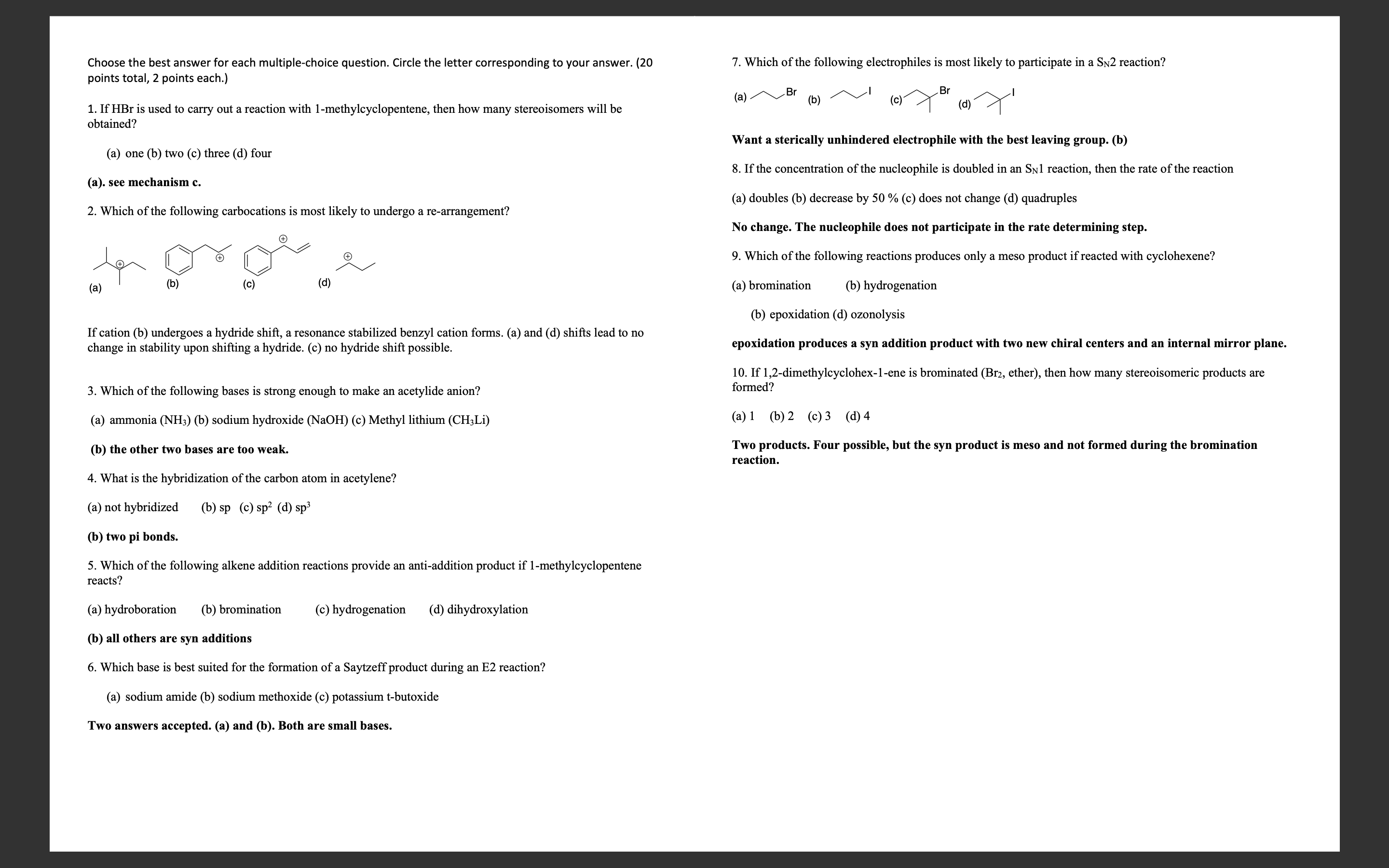
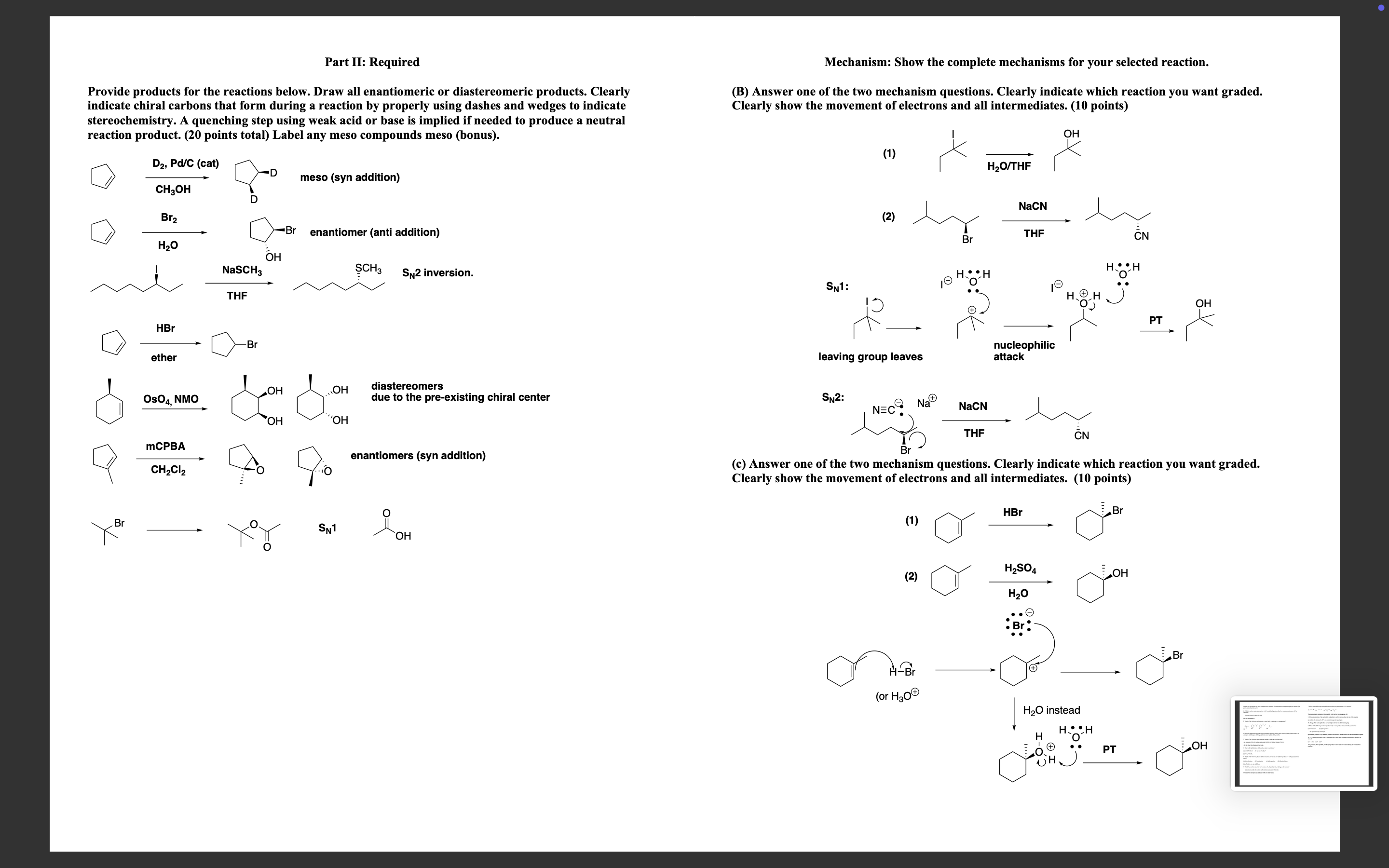
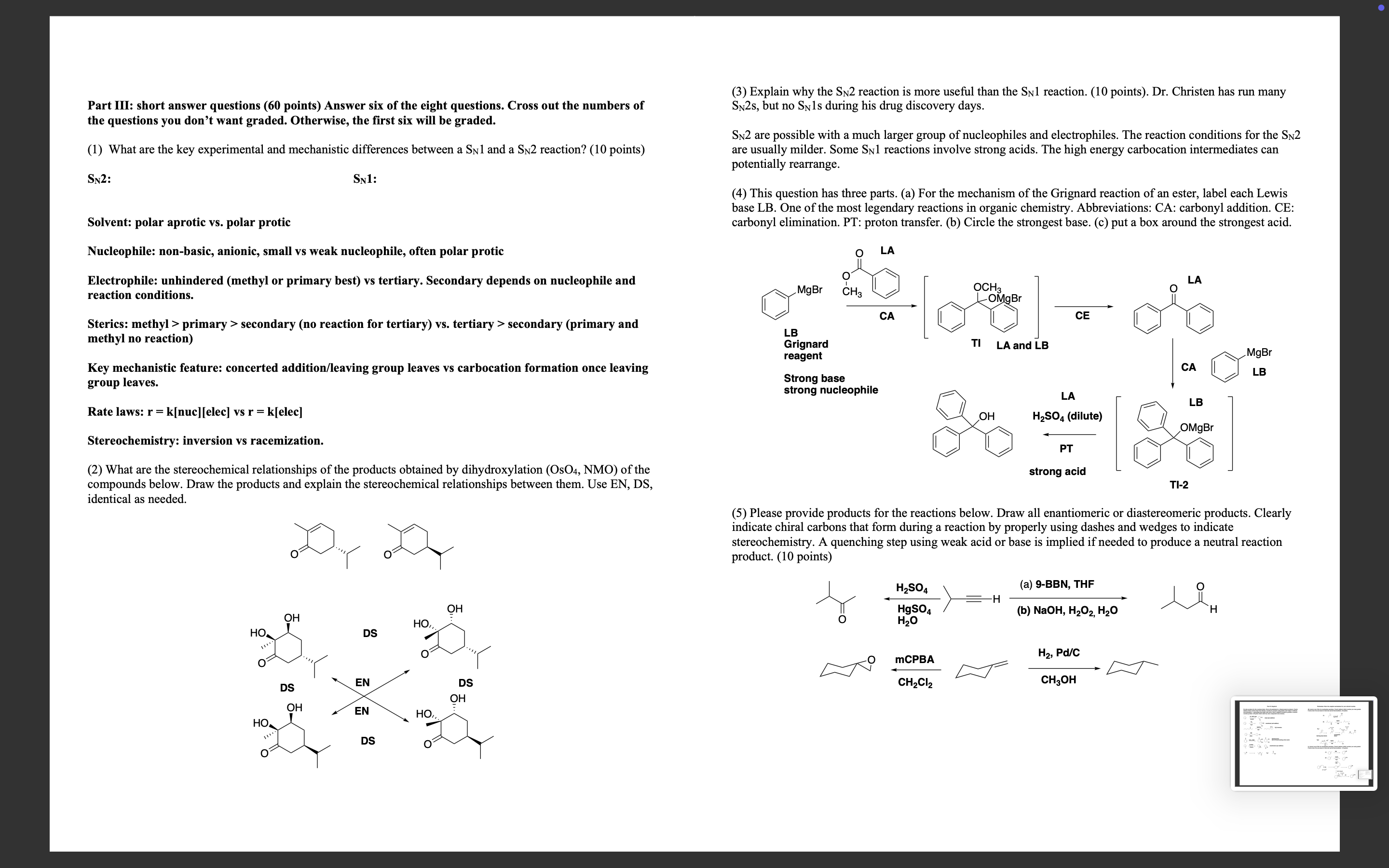
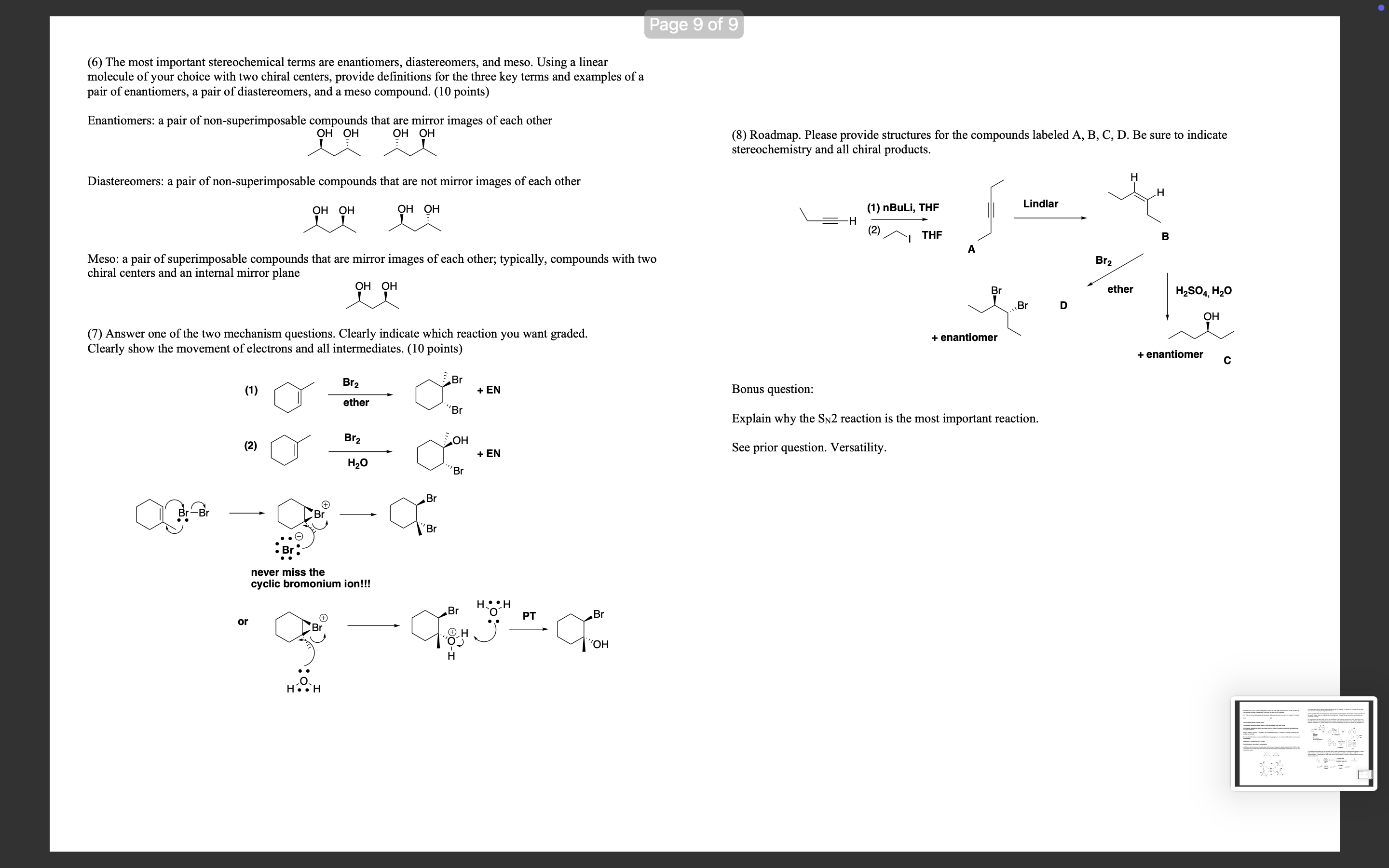
Question 5 (10 points) (a) For XX, add the proper substituents to the cyclohexane template (use dashes and wedges). (b) (b) Draw the two chair conformers for XX (use the provided template). (c) Which of the conformers is more stable? circle left, right, same energy. (just like exam 2) Bonus question. Exam 3 blank Note: no rearrangement reactions or mechanisms Note: common small bases: NaOH, NaQCH;. Common large base: KOtBu (potassium tert- butoxide). Note: pote cardote sheet allowed on the exam. Blank copies will be handed out in class on Monday and Tuesday. Exam is through Chapter 9. Section l: Reactions Provide products for the reactions below. Draw all enantiomeric or diastereomeric products. Clearly indicate chiral carbons that form during a reaction by properly using dashes and wedges to indicate stereochemistry. A quenching step using weak acid or base is implied if needed to produce a neutral reaction product. (50 points total) Chapter 7, 8 and 9 reactions. Section I: Mechanisms (a) Chapter 7 Mechanism. Show the complete mechanisms for your selected reaction. Answer one of the two mechanism questions. Clearly indicate which reaction you want graded. Clearly show the movement of electrons and all intermediates. (10 points) (b) Chapter 8 Mechanism. Show the complete mechanisms for your selected reaction. Answer one of the two mechanism questions. Clearly indicate which reaction you want graded. Clearly show the movement of electrons and all intermediates. (10 points) Mechanisms to know: HX addition, hydration with water or an alcohol, bromination, halohydrin formation. Section II: Miscellaneous Questions. Question | (10 points) top secret question. Question 2 (10 points): Draw Lewis structures for the two compounds shown below. Be sure to indicate lone pairs and, if needed, formal charges. (just like exam 1) Question 3 (10 points): (Chapter 6). Label the Lewis acids and bases in the mechanism below. Label each elementary reaction step. (e.g. nucleophilic addition, proton transfer, etc.) Question 4 (10 points) Describe the relationship between the following molecules as identical, constitutional isomer, enantiomers, or diastereomers. Write the appropriate descriptor next to each pair compounds. (just like exam 2) Choose the best answer for each multiple-choice question. Circle the letter corresponding to your answer. (20 7. Which of the following electrophiles is most likely to participate in a SN2 reaction? points total, 2 points each.) (a) Br 1. If HBr is used to carry out a reaction with 1-methylcyclopentene, then how many stereoisomers will be ( b ) - obtained? Want a sterically unhindered electrophile with the best leaving group. (b) (a) one (b) two (c) three (d) four 8. If the concentration of the nucleophile is doubled in an SNI reaction, then the rate of the reaction (a). see mechanism c. (a) doubles (b) decrease by 50 % (c) does not change (d) quadruples 2. Which of the following carbocations is most likely to undergo a re-arrangement? No change. The nucleophile does not participate in the rate determining step. 9. Which of the following reactions produces only a meso product if reacted with cyclohexene? a ) (d ) (a) bromination (b) hydrogenation (b) epoxidation (d) ozonolysis If cation (b) undergoes a hydride shift, a resonance stabilized benzyl cation forms. (a) and (d) shifts lead to no change in stability upon shifting a hydride. (c) no hydride shift possible epoxidation produces a syn addition product with two new chiral centers and an internal mirror plane. 10. If 1,2-dimethylcyclohex-1-ene is brominated (Br2, ether), then how many stereoisomeric products are 3. Which of the following bases is strong enough to make an acetylide anion? formed? (a) ammonia (NH3) (b) sodium hydroxide (NaOH) (c) Methyl lithium (CH3Li) (a) 1 (b) 2 (c) 3 (d) 4 (b) the other two bases are too weak. Two products. Four possible, but the syn product is meso and not formed during the bromination reaction. 4. What is the hybridization of the carbon atom in acetylene? (a) not hybridized (b) sp (c) sp2 (d) sp3 (b) two pi bonds. 5. Which of the following alkene addition reactions provide an anti-addition product if 1-methylcyclopentene reacts? (a) hydroboration (b) bromination (c) hydrogenation (d) dihydroxylation (b) all others are syn additions 6. Which base is best suited for the formation of a Saytzeff product during an E2 reaction? (a) sodium amide (b) sodium methoxide (c) potassium t-butoxide Two answers accepted. (a) and (b). Both are small bases.Part II: Required Mechanism: Show the complete mechanisms for your selected reaction. Provide products for the reactions below. Draw all enantiomeric or diastereomeric products. Clearly (B) Answer one of the two mechanism questions. Clearly indicate which reaction you want graded. indicate chiral carbons that form during a reaction by properly using dashes and wedges to indicate Clearly show the movement of electrons and all intermediates. (10 points) stereochemistry. A quenching step using weak acid or base is implied if needed to produce a neutral reaction product. (20 points total) Label any meso compounds meso (bonus). OH D2, Pd/C (cat) (1) - D H,O/THF meso (syn addition) CH3OH NaCN Br2 (2) -Br enantiomer (anti addition) THE HO CN OH NaSCH3 SCH3 SN2 inversion. THE SN1: HOH HBr PT -Br nucleophilic ether leaving group leaves attack diastereomers Os04, NMO OH OH due to the pre-existing chiral center SN2: NEC Nat NaCN OH OH THE mCPBA CN enantiomers (syn addition) CH2C12 (c) Answer one of the two mechanism questions. Clearly indicate which reaction you want graded. Clearly show the movement of electrons and all intermediates. (10 points) HBr SN1 (1) B (2) H2SO4 LOH HO . . . Br . . .. H-Br (or Hao H2O instead H .H H PT &OH UH(3) Explain why the SN2 reaction is more useful than the SNI reaction. (10 points). Dr. Christen has run many Part III: short answer questions (60 points) Answer six of the eight questions. Cross out the numbers of SN2s, but no SNIs during his drug discovery days. the questions you don't want graded. Otherwise, the first six will be graded. SN2 are possible with a much larger group of nucleophiles and electrophiles. The reaction conditions for the SN2 (1) What are the key experimental and mechanistic differences between a SN1 and a SN2 reaction? (10 points) are usually milder. Some SN1 reactions involve strong acids. The high energy carbocation intermediates can potentially rearrange. SN2: SN1: (4) This question has three parts. (a) For the mechanism of the Grignard reaction of an ester, label each Lewis base LB. One of the most legendary reactions in organic chemistry. Abbreviations: CA: carbonyl addition. CE: Solvent: polar aprotic vs. polar protic carbonyl elimination. PT: proton transfer. (b) Circle the strongest base. (c) put a box around the strongest acid. Nucleophile: non-basic, anionic, small vs weak nucleophile, often polar protic LA Electrophile: unhindered (methyl or primary best) vs tertiary. Secondary depends on nucleophile and reaction conditions. MgBr CH3 OCH3 OMgBr CA CE Sterics: methyl > primary > secondary (no reaction for tertiary) vs. tertiary > secondary (primary and methyl no reaction) LB Grignard TI LA and LB reagent MgBr Key mechanistic feature: concerted addition/leaving group leaves vs carbocation formation once leaving CA group leaves. Strong base LB strong nucleophile LA LB Rate laws: r = k[nuc][elec] vs r = k[elec] OH H2SO4 (dilute) OMgBr Stereochemistry: inversion vs racemization. PT (2) What are the stereochemical relationships of the products obtained by dihydroxylation (Os04, NMO) of the strong acid compounds below. Draw the products and explain the stereochemical relationships between them. Use EN, DS, TI-2 identical as needed. (5) Please provide products for the reactions below. Draw all enantiomeric or diastereomeric products. Clearly indicate chiral carbons that form during a reaction by properly using dashes and wedges to indicate stereochemistry. A quenching step using weak acid or base is implied if needed to produce a neutral reaction product. (10 points) H2SO4 (a) 9-BBN, THE =H OH HgSO4 OH 0 = b) NaOH, H202, H20 HO, H,C HO. DS mCPBA H2, Pd/C DS DS CH2 C12 CH3OH OH EN HO,, HO DSPage 9 of 9 (6) The most important stereochemical terms are enantiomers, diastereomers, and meso. Using a linear molecule of your choice with two chiral centers, provide definitions for the three key terms and examples of a pair of enantiomers, a pair of diastereomers, and a meso compound. (10 points) Enantiomers: a pair of non-superimposable compounds that are mirror images of each other OH OH OH OH (8) Roadmap. Please provide structures for the compounds labeled A, B, C, D. Be sure to indicate stereochemistry and all chiral products Diastereomers: a pair of non-superimposable compounds that are not mirror images of each other OH OH (1) nBuLi, THE Lindlar -H (2) THE A Meso: a pair of superimposable compounds that are mirror images of each other; typically, compounds with two chiral centers and an internal mirror plane Br ether H2SO4, H20 B OH 7) Answer one of the two mechanism questions. Clearly indicate which reaction you want graded. + enantiomer Clearly show the movement of electrons and all intermediates. (10 points) + enantiomer C Bro Br (1) + EN Bonus question: ether B Explain why the SN2 reaction is the most important reaction. ( 2 ) Bra OH + EN See prior question. Versatility. HO Br B Br Br .. .5 . Br . never miss the cyclic bromonium ion! Br PT - B or "OH I- HO . H 85 =1851
Step by Step Solution
There are 3 Steps involved in it
1 Expert Approved Answer
Step: 1 Unlock
Question Has Been Solved by an Expert!
Get step-by-step solutions from verified subject matter experts
Step: 2 Unlock
Step: 3 Unlock
Students Have Also Explored These Related Accounting Questions!









 Study Help