







Question: please make a small summary PowerPoint slides about this chapter below Staffing, Recruitment and selection also in international compamy. urgent please CHAPTER 5 SOURCING HUMAN
please make a small summary PowerPoint slides about this chapter below "Staffing, Recruitment and selection" also in international compamy. urgent please 
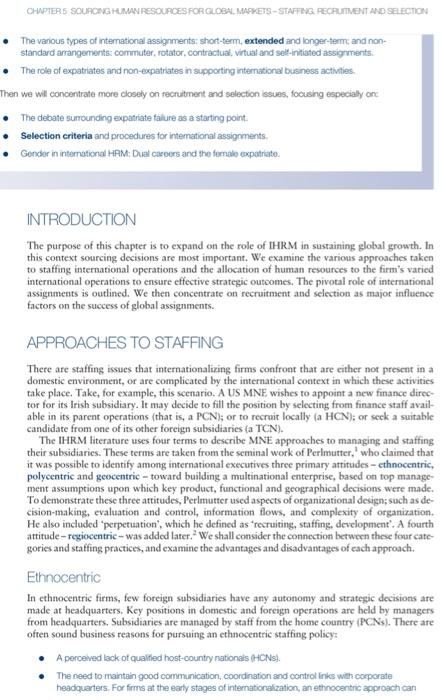
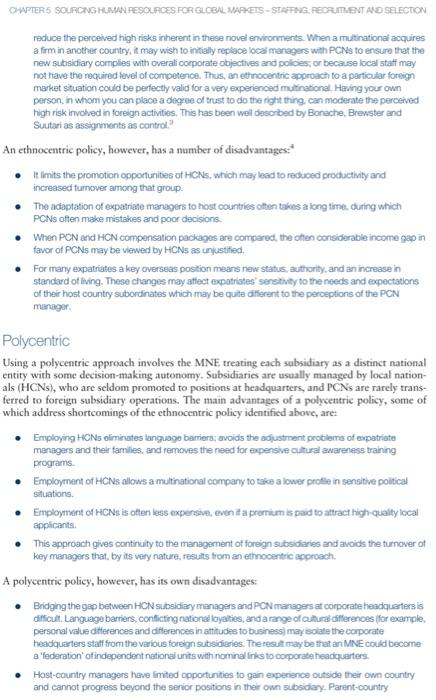
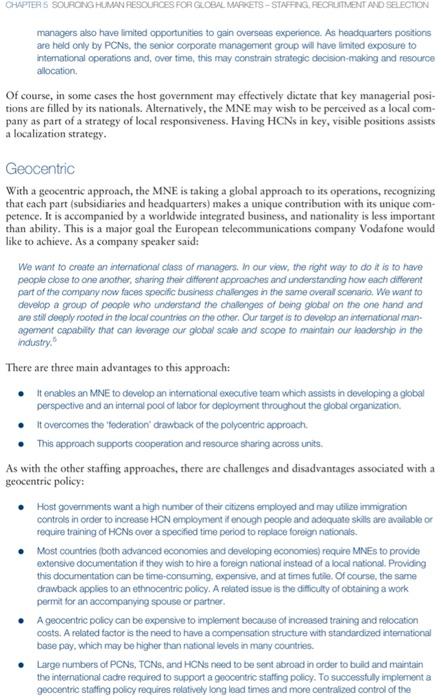
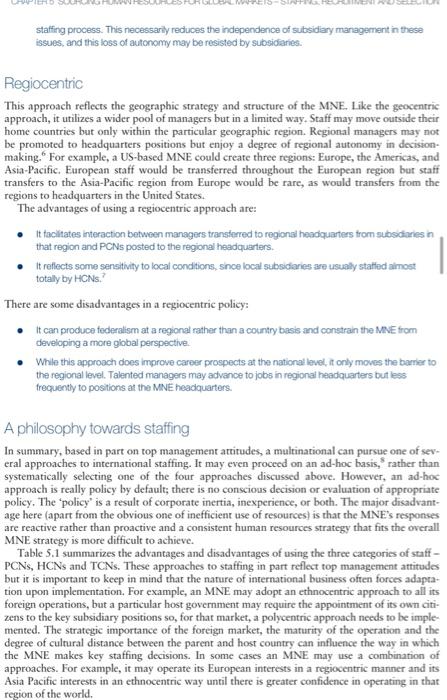
CHAPTER 5 SOURCING HUMAN RESOURCES FOR GLOBAL MARKETS - | STAFFING, RECRUITMENT AND SELECTION Chapter Objectives The previous three chapters have concentrated on the global environment and organization contexts. We now focus on the managing people' aspect. The aim is to establish the role of HRM in sustaining international business operations and growth. We first lay the foundations in covering the following: Issues relating to the various approaches to staffing foreign operations. The reasons for using international assignments: position fing, management development and organizational development CHAPIERS SOURCING HUMAN RESOURCES FOR GLOBAL MARKETS - STAFFNG. RECENTMENT AND SELECTION The various types of international assignments: short-term, extended and longer-term and non- standard arrangements: commuter, rotator, contractual, virtual and self-initiated assignments The role of expatriates and non-expatriates in supporting international business activities Then we will concentrate more closely on recruitment and selection issues, focusing especially one The debate surrounding expatriate failure as a starting point Selection criteria and procedures for international assignments. Gender in international HAM: Dual careers and the formato expatriate. INTRODUCTION The purpose of this chapter is to expand on the role of HRM in sustaining global growth. In this context sourcing decisions are most important. We examine the various approaches taken to staffing international operations and the allocation of human resources to the firm's varied international operations to ensure effective strategic outcomes. The pivotal role of international assignments is outlined. We then concentrate on recruitment and selection as major influence factors on the success of global assignments. APPROACHES TO STAFFING There are staffing issues that internationalizing firms confront that are either not present in a domestic environment, or are complicated by the international context in which these activities take place. Take, for example, this scenario. A US MNE wishes to appoint a new finance direc tor for its Irish subsidiary. It may decide to fill the position by selecting from finance staff avail able in its parent operations (that is, a PCN); or to recruit locally (a HCN); or seek a suitable candidate from one of its other foreign subsidiaries (a TCN). The IHRM literature uses four terms to describe MNE approaches to managing and staffing their subsidiaries. These terms are taken from the seminal work of Perlmutter,' who claimed that it was possible to identify among international executives three primary attitudes - ethnocentric, polycentric and geocentric - toward building a multinational enterprise, based on top manage- ment assumptions upon which key product, functional and geographical decisions were made. To demonstrate these three attitudes, Perlmutter used aspects of organizational design, such as de cision-making, evaluation and control, information flows, and complexity of organization. He also included "perpetuation', which he defined as recruiting, staffing, development'. A fourth attitude - regiocentric-was added later. We shall consider the connection between these four cate- gories and staffing practices, and examine the advantages and disadvantages of each approach. Ethnocentric In ethnocentric firms, few foreign subsidiaries have any autonomy and strategic decisions are made at headquarters. Key positions in domestic and foreign operations are held by managers from headquarters. Subsidiaries are managed by staff from the home country (PCN). There are often sound business reasons for pursuing an ethnocentric staffing policy A perceived lack of qualified host-country nationals (CNS). The need to maintain good communication, coordination and control Inks with corporate headquarters. For firms at the early stages of internationalization, an ethnocentric approach can CHAPTERS SOURCING HUMAN FESOURCES FOR GLOBAL MARKETS-STEPNG. FERMENT AND SECTION reduce the perceived high risks inherent in these novel environments. When a multinational acquires a fim in another country, it may wish to initially replace local managers with PCNs to ensure that the new subsidiary complies with overall corporate objectives and policies, or because local staff may not have the required level of competence. Thus, an etnocentric approach to a particular foreign market situation could be perfectly valid for a very experienced multinational. Haring your own person, in whom you can place a degree of trust to do the right thing can moderate the perceived high risk involved in foreign activities. This has been well described by Boneche, Brewster and Suutari as assignments as control." An ethnocentric policy, however, has a number of disadvantages: It limits the promotion opportunities of HCNs, which may lead to reduced productivity and increased turnover among that group. The adaptation of expatriate managers to host countries then takes a long time. during which PCNs often make mistakes and poor decisions When PCN and HCN compensation packages are compared, the che considerable income gap in favor of PCNs may be viewed by HCNs as unjustied. For many expatriates a key overseas position means new status, authority, and an increase in standard of living. These changes may attect expatriates' sensitivity to the needs and expectations of their host country subordinates which may be quite different to the perceptions of the PON manager Polycentric Using a polycentric approach involves the MNE treating each subsidiary as a distinct national entity with some decision-making autonomy. Subsidiaries are usually managed by local nation- als (HCNs), who are seldom promoted to positions at headquarters, and PCNs are rarely trans- ferred to foreign subsidiary operations. The main advantages of a polycentric policy, some of which address shortcomings of the ethnocentric policy identified above, are: Employing HONs oliminates language barriers; avoids the adjustment problems of expatriate managers and their families and removes the need for expensive cultural awareness training programs. Employment of HCNs allows a multinational company to take a lower profile in sensitive political Situations. Employment of HCNs is often less expensive, even if a premium is paid to attract high quality local applicants This approach gives continuity to the management of foreign subsidiaries and avoid the turnover of key managers that, by its very nature, results from an ethnocentric approach A polycentric policy, however, has its own disadvantages: Bridging the gap between HCN subsidiary managers and PON managers at corporate headquarters is difficult. Language barriers, conflicting national loyalties, and a range of cultural differences for example, personal value differences and differences in attitudes to business may isolate the corporate headquarters staff from the various foreign subsidiaries. The rest may be that an MNE could become a 'federation of independent national units with nominal links to corporate headquarters Host-country managers have limited opportunities to gain experience outside their own country and cannot progress beyond the senior positions in their own subsidiary Parent-country CHAPTER 5 SOURONG HUMAN RESOURCES FOR GLOBAL MARETS-STAFFING, RECRUITMENT AND SELECTION managers also have limited opportunities to gain overseas experience. As headquarters positions are held only by PCNs, the senior corporate management group will have limited exposure to International operations and over time, this may constrain strategic decision-making and resource allocation. Of course, in some cases the host government may effectively dictate that key managerial posi- tions are filled by its nationals. Alternatively, the MNE may wish to be perceived as a local com- pany as part of a strategy of local responsiveness. Having HCNs in key, visible positions assists a localization strategy. Geocentric With a geocentric approach, the MNE is taking a global approach to its operations, recognizing that each part (subsidiaries and headquarters) makes a unique contribution with its unique com- petence. It is accompanied by a worldwide integrated business, and nationality is less important than ability. This is a major goal the European telecommunications company Vodafone would like to achieve. As a company speaker said: We want to create an international class of managers. In our view, the night way to do it is to have people close to one another, sharing their different approaches and understanding how each different part of the company now faces specific business challenges in the same overal scenario, We want to develop a group of people who understand the challenges of being global on the one hand and are so deeply rooted in the local countries on the other. Our target is to develop an international man- agement capability that can leverage our global scale and scope to maintain our leadership in the industry There are three main advantages to this approach: It enables an MNE to develop an international executive team which assists in developing a global perspective and an internal pool of labor for deployment throughout the global organization It overcomes the federation' drawback of the polycentric approach. This approach supports cooperation and resource sharing across units. As with the other staffing approaches, there are challenges and disadvantages associated with a geocentric policy: Host governments want a high number of their citizens employed and may utilize immigration controls in order to increase HCN employment it enough people and adequate skills are available or require training of HCNs over a specified time period to replace foreign nationals. Most countries (both advanced economies and developing economies) require MNEs to provide extensive documentation if they wish to hire a foreign national instead of a local national. Providing this documentation can be time-consuming, expensive, and at times futile. Of course, the same drawback applies to an ethnocentric policy. A related issue is the difficulty of obtaining a work permit for an accompanying spouse or partner A geocentric policy can be expensive to implement because of increased training and relocation costs. A related factor is the need to have a compensation structure with standardized international base pay, which may be higher than national levels in many countries. Large numbers of PCNS, TCNs, and HCNs need to be sent abroad in order to build and maintain the international care required to support a goocentric staffing policy. To successfully implementa geocentric staffing policy requires relatively long lead times and more centralized control of the Staffing process. This necessarily reduces the independence of subsidiary management in these issues, and this toss of autonomy may be resisted by subsidiaries. Regiocentric This approach reflects the geographic strategy and structure of the MNE. Like the geocentric approach, it utilizes a wider pool of managers but in a limited way. Staff may move outside their home countries but only within the particular geographic region. Regional managers may not be promoted to headquarters positions but enjoy a degree of regional autonomy in decision- making. For example, a US-based MNE could create three regions: Europe, the Americas, and Asia-Pacific. European staff would be transferred throughout the European region but staff transfers to the Asia-Pacific region from Europe would be rare, as would transfers from the regions to headquarters in the United States. The advantages of using a regiocentric approach are: It tacitates interaction between managers transferred to regional headquarters from subdiaries in that region and PCNs posted to the regional headquarters. It reflects some sensitivity to local conditions, snce local subsidiaries are usually stated almost totally by HCNs.? There are some disadvantages in a regiocentric policy: It can produce federalism at a regional rather than a country basis and constrain the MNE from developing a more global perspective While this approach does improve career prospects at the national level, tonly moves the barrier to the regional level. Talented managers may advance to jobs in regional headquarters but less frequently to positions at the MNE headquarters. A philosophy towards staffing In summary, based in part on top management attitudes a multinational can pursue one of sev- eral approaches to international staffing. It may even proceed on an ad-hoc basis, rather than systematically selecting one of the four approaches discussed above. However, an ad-hoc approach is really policy by default; there is no conscious decision or evaluation of appropriate policy. The 'policy" is a result of corporate inertia, inexperience, or both. The major disadvant- age here (apart from the obvious one of inefficient use of resources) is that the MNE's responses are reactive rather than proactive and a consistent human resources strategy that fits the overall MNE strategy is more difficult to achieve. Table 5.1 summarizes the advantages and disadvantages of using the three categories of staff- PCNs, HCNs and TCNs. These approaches to staffing in part reflect top management attitudes but it is important to keep in mind that the nature of international business often forces adapta- tion upon implementation. For example, an MNE may adopt an ethnocentric approach to all its foreign operations, but a particular host government may require the appointment of its own citi- zens to the key subsidiary positions so, for that market, a polycentric approach needs to be imple mented. The strategic importance of the foreign market, the maturity of the operation and the degree of cultural distance berween the parent and host country can influence the way in which the MNE makes key staffing decisions. In some cases an MNE may use a combination of approaches. For example, it may operate its European interests in a regiocentric manner and its Asia Pacific interests in an ethnocentric way until there is greater confidence in operating in that region of the world. CHAPTER 5 SOURCING HUMAN RESOURCES FOR GLOBAL MARKETS - | STAFFING, RECRUITMENT AND SELECTION Chapter Objectives The previous three chapters have concentrated on the global environment and organization contexts. We now focus on the managing people' aspect. The aim is to establish the role of HRM in sustaining international business operations and growth. We first lay the foundations in covering the following: Issues relating to the various approaches to staffing foreign operations. The reasons for using international assignments: position fing, management development and organizational development CHAPIERS SOURCING HUMAN RESOURCES FOR GLOBAL MARKETS - STAFFNG. RECENTMENT AND SELECTION The various types of international assignments: short-term, extended and longer-term and non- standard arrangements: commuter, rotator, contractual, virtual and self-initiated assignments The role of expatriates and non-expatriates in supporting international business activities Then we will concentrate more closely on recruitment and selection issues, focusing especially one The debate surrounding expatriate failure as a starting point Selection criteria and procedures for international assignments. Gender in international HAM: Dual careers and the formato expatriate. INTRODUCTION The purpose of this chapter is to expand on the role of HRM in sustaining global growth. In this context sourcing decisions are most important. We examine the various approaches taken to staffing international operations and the allocation of human resources to the firm's varied international operations to ensure effective strategic outcomes. The pivotal role of international assignments is outlined. We then concentrate on recruitment and selection as major influence factors on the success of global assignments. APPROACHES TO STAFFING There are staffing issues that internationalizing firms confront that are either not present in a domestic environment, or are complicated by the international context in which these activities take place. Take, for example, this scenario. A US MNE wishes to appoint a new finance direc tor for its Irish subsidiary. It may decide to fill the position by selecting from finance staff avail able in its parent operations (that is, a PCN); or to recruit locally (a HCN); or seek a suitable candidate from one of its other foreign subsidiaries (a TCN). The IHRM literature uses four terms to describe MNE approaches to managing and staffing their subsidiaries. These terms are taken from the seminal work of Perlmutter,' who claimed that it was possible to identify among international executives three primary attitudes - ethnocentric, polycentric and geocentric - toward building a multinational enterprise, based on top manage- ment assumptions upon which key product, functional and geographical decisions were made. To demonstrate these three attitudes, Perlmutter used aspects of organizational design, such as de cision-making, evaluation and control, information flows, and complexity of organization. He also included "perpetuation', which he defined as recruiting, staffing, development'. A fourth attitude - regiocentric-was added later. We shall consider the connection between these four cate- gories and staffing practices, and examine the advantages and disadvantages of each approach. Ethnocentric In ethnocentric firms, few foreign subsidiaries have any autonomy and strategic decisions are made at headquarters. Key positions in domestic and foreign operations are held by managers from headquarters. Subsidiaries are managed by staff from the home country (PCN). There are often sound business reasons for pursuing an ethnocentric staffing policy A perceived lack of qualified host-country nationals (CNS). The need to maintain good communication, coordination and control Inks with corporate headquarters. For firms at the early stages of internationalization, an ethnocentric approach can CHAPTERS SOURCING HUMAN FESOURCES FOR GLOBAL MARKETS-STEPNG. FERMENT AND SECTION reduce the perceived high risks inherent in these novel environments. When a multinational acquires a fim in another country, it may wish to initially replace local managers with PCNs to ensure that the new subsidiary complies with overall corporate objectives and policies, or because local staff may not have the required level of competence. Thus, an etnocentric approach to a particular foreign market situation could be perfectly valid for a very experienced multinational. Haring your own person, in whom you can place a degree of trust to do the right thing can moderate the perceived high risk involved in foreign activities. This has been well described by Boneche, Brewster and Suutari as assignments as control." An ethnocentric policy, however, has a number of disadvantages: It limits the promotion opportunities of HCNs, which may lead to reduced productivity and increased turnover among that group. The adaptation of expatriate managers to host countries then takes a long time. during which PCNs often make mistakes and poor decisions When PCN and HCN compensation packages are compared, the che considerable income gap in favor of PCNs may be viewed by HCNs as unjustied. For many expatriates a key overseas position means new status, authority, and an increase in standard of living. These changes may attect expatriates' sensitivity to the needs and expectations of their host country subordinates which may be quite different to the perceptions of the PON manager Polycentric Using a polycentric approach involves the MNE treating each subsidiary as a distinct national entity with some decision-making autonomy. Subsidiaries are usually managed by local nation- als (HCNs), who are seldom promoted to positions at headquarters, and PCNs are rarely trans- ferred to foreign subsidiary operations. The main advantages of a polycentric policy, some of which address shortcomings of the ethnocentric policy identified above, are: Employing HONs oliminates language barriers; avoids the adjustment problems of expatriate managers and their families and removes the need for expensive cultural awareness training programs. Employment of HCNs allows a multinational company to take a lower profile in sensitive political Situations. Employment of HCNs is often less expensive, even if a premium is paid to attract high quality local applicants This approach gives continuity to the management of foreign subsidiaries and avoid the turnover of key managers that, by its very nature, results from an ethnocentric approach A polycentric policy, however, has its own disadvantages: Bridging the gap between HCN subsidiary managers and PON managers at corporate headquarters is difficult. Language barriers, conflicting national loyalties, and a range of cultural differences for example, personal value differences and differences in attitudes to business may isolate the corporate headquarters staff from the various foreign subsidiaries. The rest may be that an MNE could become a 'federation of independent national units with nominal links to corporate headquarters Host-country managers have limited opportunities to gain experience outside their own country and cannot progress beyond the senior positions in their own subsidiary Parent-country CHAPTER 5 SOURONG HUMAN RESOURCES FOR GLOBAL MARETS-STAFFING, RECRUITMENT AND SELECTION managers also have limited opportunities to gain overseas experience. As headquarters positions are held only by PCNs, the senior corporate management group will have limited exposure to International operations and over time, this may constrain strategic decision-making and resource allocation. Of course, in some cases the host government may effectively dictate that key managerial posi- tions are filled by its nationals. Alternatively, the MNE may wish to be perceived as a local com- pany as part of a strategy of local responsiveness. Having HCNs in key, visible positions assists a localization strategy. Geocentric With a geocentric approach, the MNE is taking a global approach to its operations, recognizing that each part (subsidiaries and headquarters) makes a unique contribution with its unique com- petence. It is accompanied by a worldwide integrated business, and nationality is less important than ability. This is a major goal the European telecommunications company Vodafone would like to achieve. As a company speaker said: We want to create an international class of managers. In our view, the night way to do it is to have people close to one another, sharing their different approaches and understanding how each different part of the company now faces specific business challenges in the same overal scenario, We want to develop a group of people who understand the challenges of being global on the one hand and are so deeply rooted in the local countries on the other. Our target is to develop an international man- agement capability that can leverage our global scale and scope to maintain our leadership in the industry There are three main advantages to this approach: It enables an MNE to develop an international executive team which assists in developing a global perspective and an internal pool of labor for deployment throughout the global organization It overcomes the federation' drawback of the polycentric approach. This approach supports cooperation and resource sharing across units. As with the other staffing approaches, there are challenges and disadvantages associated with a geocentric policy: Host governments want a high number of their citizens employed and may utilize immigration controls in order to increase HCN employment it enough people and adequate skills are available or require training of HCNs over a specified time period to replace foreign nationals. Most countries (both advanced economies and developing economies) require MNEs to provide extensive documentation if they wish to hire a foreign national instead of a local national. Providing this documentation can be time-consuming, expensive, and at times futile. Of course, the same drawback applies to an ethnocentric policy. A related issue is the difficulty of obtaining a work permit for an accompanying spouse or partner A geocentric policy can be expensive to implement because of increased training and relocation costs. A related factor is the need to have a compensation structure with standardized international base pay, which may be higher than national levels in many countries. Large numbers of PCNS, TCNs, and HCNs need to be sent abroad in order to build and maintain the international care required to support a goocentric staffing policy. To successfully implementa geocentric staffing policy requires relatively long lead times and more centralized control of the Staffing process. This necessarily reduces the independence of subsidiary management in these issues, and this toss of autonomy may be resisted by subsidiaries. Regiocentric This approach reflects the geographic strategy and structure of the MNE. Like the geocentric approach, it utilizes a wider pool of managers but in a limited way. Staff may move outside their home countries but only within the particular geographic region. Regional managers may not be promoted to headquarters positions but enjoy a degree of regional autonomy in decision- making. For example, a US-based MNE could create three regions: Europe, the Americas, and Asia-Pacific. European staff would be transferred throughout the European region but staff transfers to the Asia-Pacific region from Europe would be rare, as would transfers from the regions to headquarters in the United States. The advantages of using a regiocentric approach are: It tacitates interaction between managers transferred to regional headquarters from subdiaries in that region and PCNs posted to the regional headquarters. It reflects some sensitivity to local conditions, snce local subsidiaries are usually stated almost totally by HCNs.? There are some disadvantages in a regiocentric policy: It can produce federalism at a regional rather than a country basis and constrain the MNE from developing a more global perspective While this approach does improve career prospects at the national level, tonly moves the barrier to the regional level. Talented managers may advance to jobs in regional headquarters but less frequently to positions at the MNE headquarters. A philosophy towards staffing In summary, based in part on top management attitudes a multinational can pursue one of sev- eral approaches to international staffing. It may even proceed on an ad-hoc basis, rather than systematically selecting one of the four approaches discussed above. However, an ad-hoc approach is really policy by default; there is no conscious decision or evaluation of appropriate policy. The 'policy" is a result of corporate inertia, inexperience, or both. The major disadvant- age here (apart from the obvious one of inefficient use of resources) is that the MNE's responses are reactive rather than proactive and a consistent human resources strategy that fits the overall MNE strategy is more difficult to achieve. Table 5.1 summarizes the advantages and disadvantages of using the three categories of staff- PCNs, HCNs and TCNs. These approaches to staffing in part reflect top management attitudes but it is important to keep in mind that the nature of international business often forces adapta- tion upon implementation. For example, an MNE may adopt an ethnocentric approach to all its foreign operations, but a particular host government may require the appointment of its own citi- zens to the key subsidiary positions so, for that market, a polycentric approach needs to be imple mented. The strategic importance of the foreign market, the maturity of the operation and the degree of cultural distance berween the parent and host country can influence the way in which the MNE makes key staffing decisions. In some cases an MNE may use a combination of approaches. For example, it may operate its European interests in a regiocentric manner and its Asia Pacific interests in an ethnocentric way until there is greater confidence in operating in that region of the world Step by Step Solution
There are 3 Steps involved in it
1 Expert Approved Answer
Step: 1 Unlock

Question Has Been Solved by an Expert!
Get step-by-step solutions from verified subject matter experts
Step: 2 Unlock
Step: 3 Unlock
 Study Help