







Question: Please make sure the hand writing is eligible. I will give the highest rating I can give. 1. Let A(x) = I:f(t) dt where f
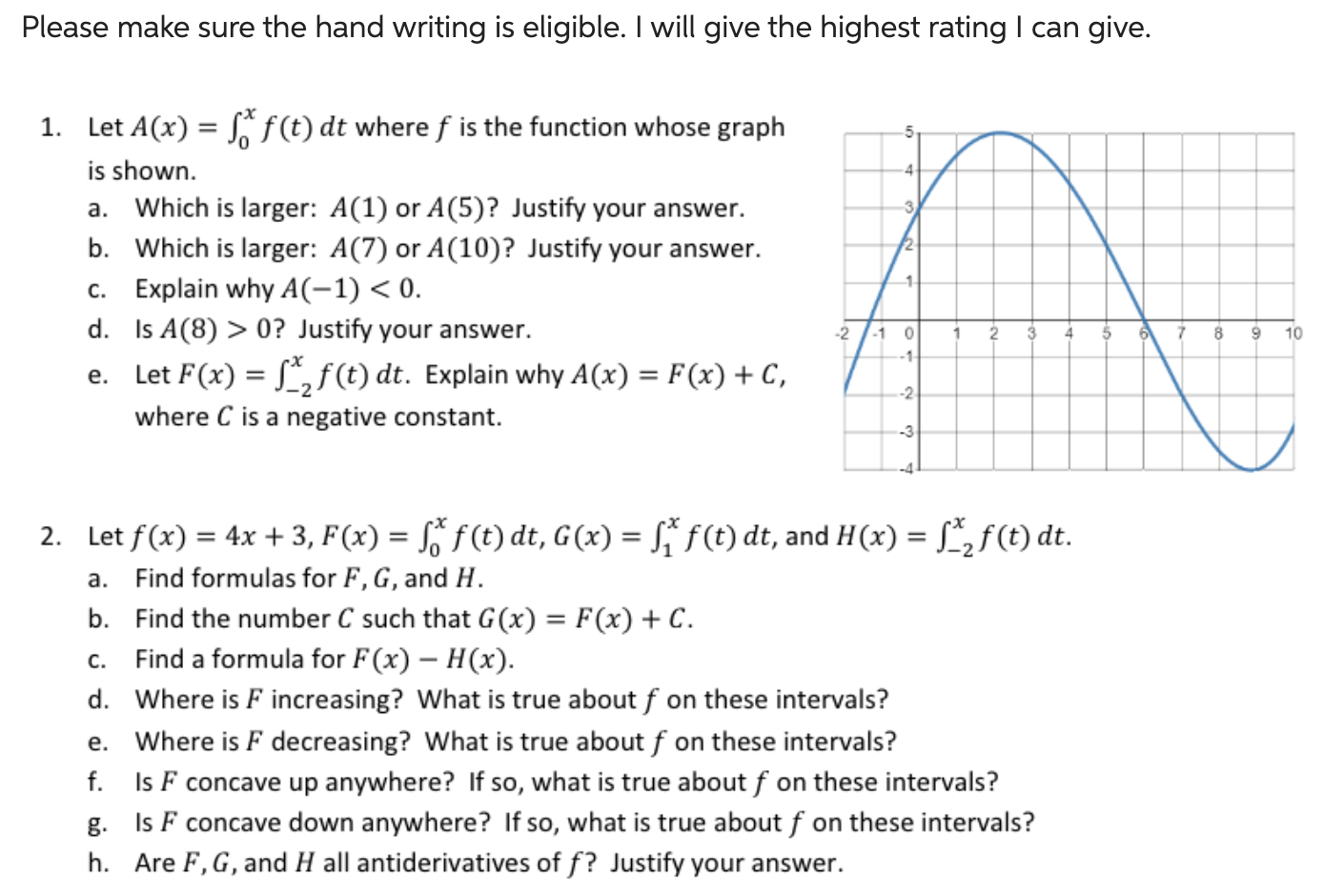
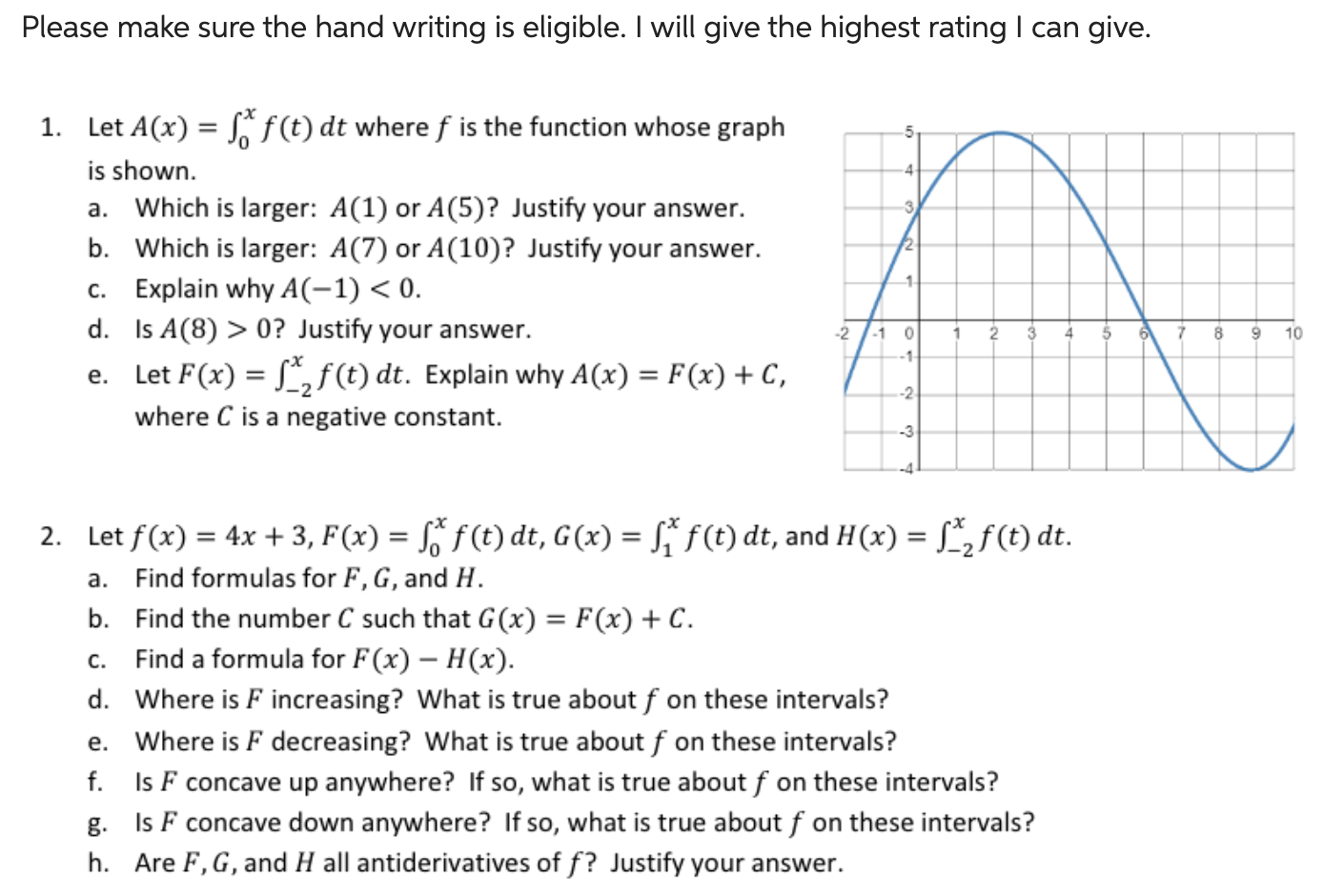
Please make sure the hand writing is eligible. I will give the highest rating I can give. 1. Let A(x) = I:f(t) dt where f is the function whose graph __5 is shown. a. Which is larger: A(1) or A(5)? Justify your answer. b Which is larger: AC7) or A(10)? Justify your answer. c. Explain why A(- 1) O? Justify your answer. .2 e Let F(x) = ; f(t) dt. Explain why 210:) = F(x) + c, ' where C is a negative constant. .1 73910 2. Let f(x) = 4x + 3, Pg) = fft) dt, 6(1) = {1" t) tit, and H(x) = 1'; f(t) dt. Find formulas for F, G. and H. Find the number C such that G (x) = F(x) + C. Find a formula for F(x) - H(x). Where is F increasing? What is true about f on these intervals? Where is F decreasing? What is true about f on these intervals? ls F concave up anywhere? If so, what is true about f on these intervals? Is F concave down anywhere? If so, what is true about f on these intervals? Are F, G, and H all antiderivatives of f? Justify your answer. 0 -1 -2 - -3 .4 .39" rhea 51.0515
Step by Step Solution
There are 3 Steps involved in it

Get step-by-step solutions from verified subject matter experts
 Study Help