







Question: Please make sure to explain all steps note: summary of knowledge needed to answer free fall question available at the end of questions Note: For
Please make sure to explain all steps
note: summary of knowledge needed to answer free fall question available at the end of questions
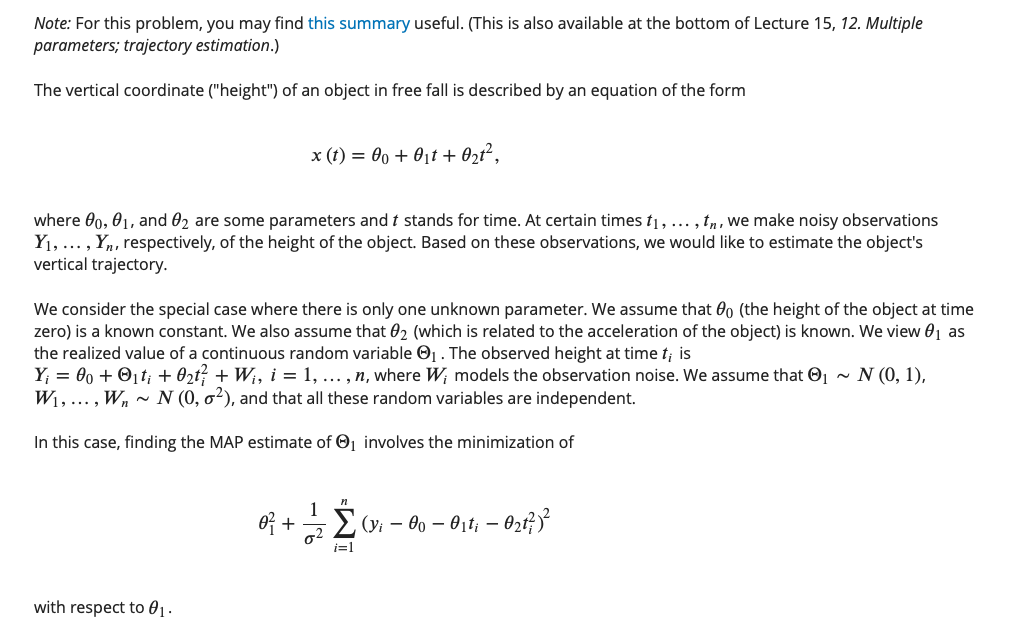
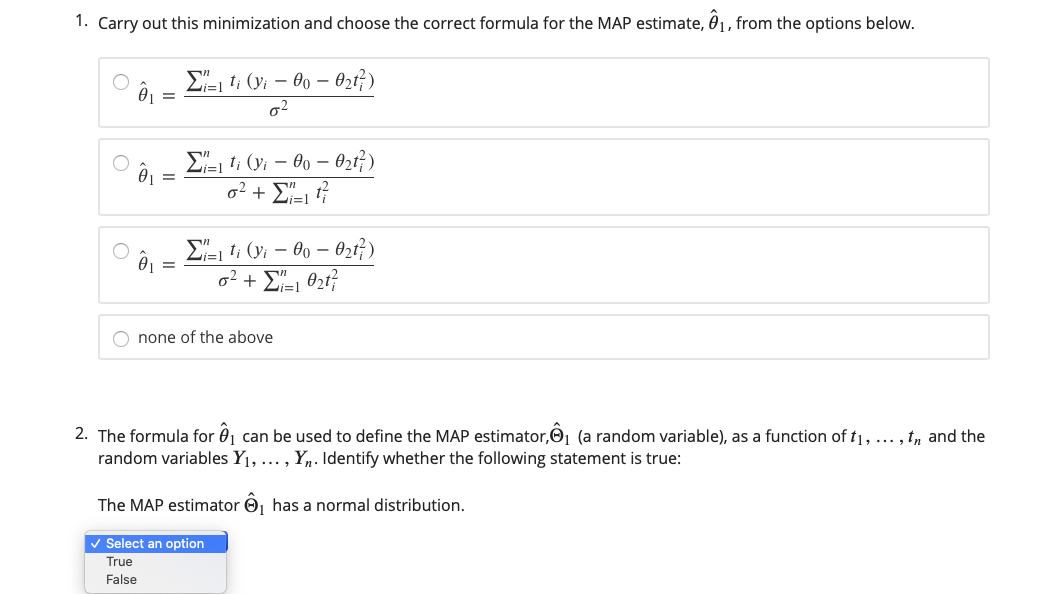
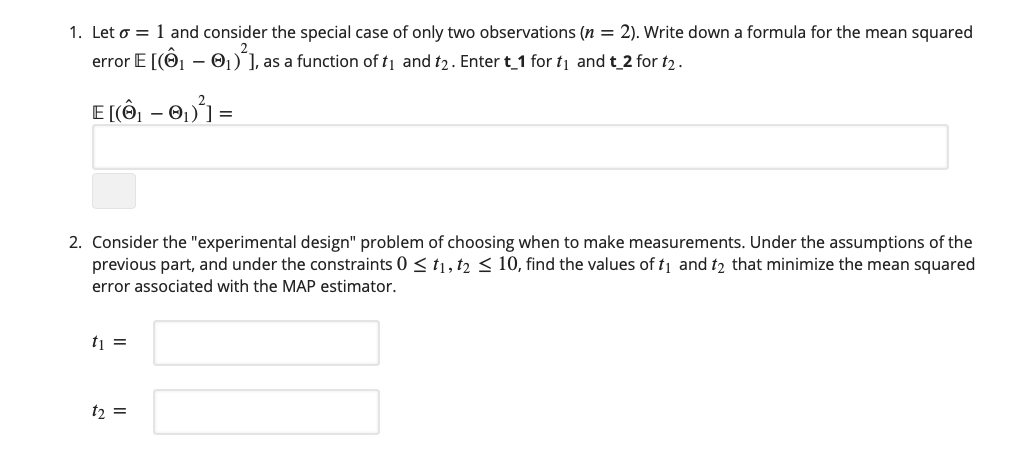
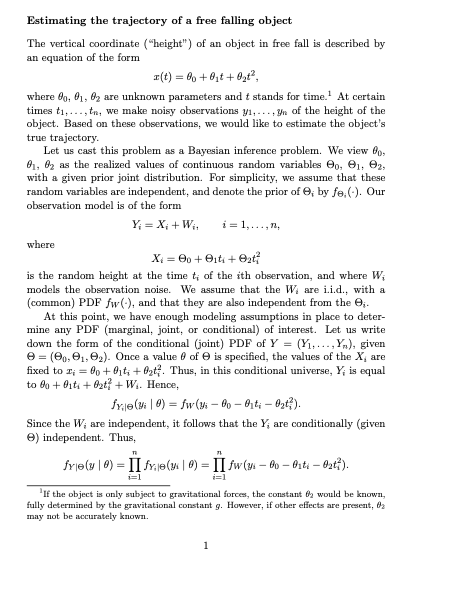
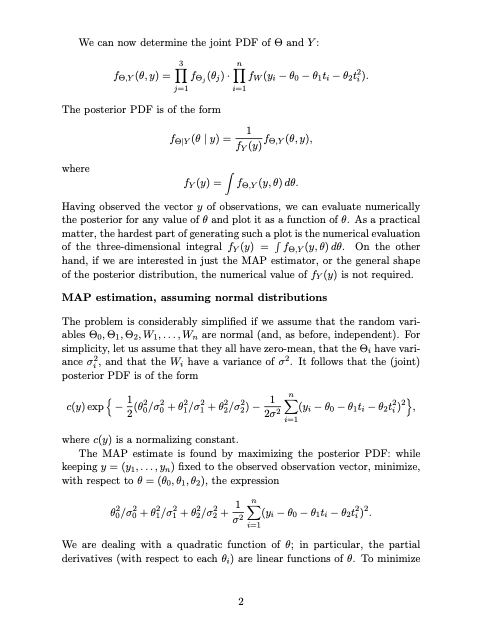
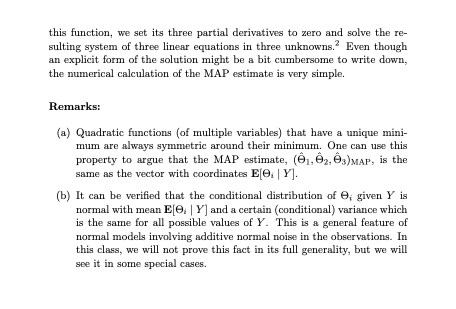
Note: For this problem, you may nd this summary useful. [T his is also available at the bottom of Lecture 15, 12. Muitipie parameters; trajectory estimation.) The vertical coordinate ("height") of an object in free fall is described by an equation of the form x (r) = 6.} + 611+ 6212, where :90, 31, and 92 are some parameters and 1 stands for time. At certain times 11, , in, we make noisy observations Y1, , Y\". respectively, of the height of the object. Based on these observations, we would like to estimate the object's vertical trajectory. We consider the special case where there is only one unknown parameter. We assume that 90 (the height of the object at time zero} is a known constant. We also assume that 92 (which is related to the acceleration of the object) is known. We view 91 as the realized value of a continuous random variable 81 . The observed height at time t,- is K- = 90 + 311',- + 6'21? + WE, i = 1, , n, where IV,- models the observation noise. We assumethat '81 ~ N (0, l), W], , W; ~ N (0, 0'2). and that all these random variables are independent. In this case, nding the MAP estimate of 81 involves the minimization of 1 6% + .72 2o.- 90 41:. 421?): i=1 with respect to 91 . 1. Carry out this minimization and choose the correct formula for the MAP estimate, 01, from the options below. Zizi ti (vi - 00 - 021? ) 02 Zi= ti (vi - 00 - 02t? ) Ei=I ti (vi - 00 - 02t? ) O none of the above 2. The formula for 1 can be used to define the MAP estimator,1 (a random variable), as a function of 1, ..., t and the random variables Y1, ... , Ym. Identify whether the following statement is true: The MAP estimator Oj has a normal distribution. Select an option True False1. Let o = 1 and consider the special case of only two observations (n = 2). Write down a formula for the mean squared error E [(01 - @1 )"], as a function of 1 and t2. Enter t_1 for t] and t 2 for 2. E[( 01 - 91) 1 = 2. Consider the "experimental design" problem of choosing when to make measurements. Under the assumptions of the previous part, and under the constraints 0
Step by Step Solution
There are 3 Steps involved in it

Get step-by-step solutions from verified subject matter experts
 Study Help