







Question: Please make sure your answer is correct, Thank You So Much! Question 1 (10 points) Suppose that you are interested in studying if young adults
Please make sure your answer is correct, Thank You So Much!
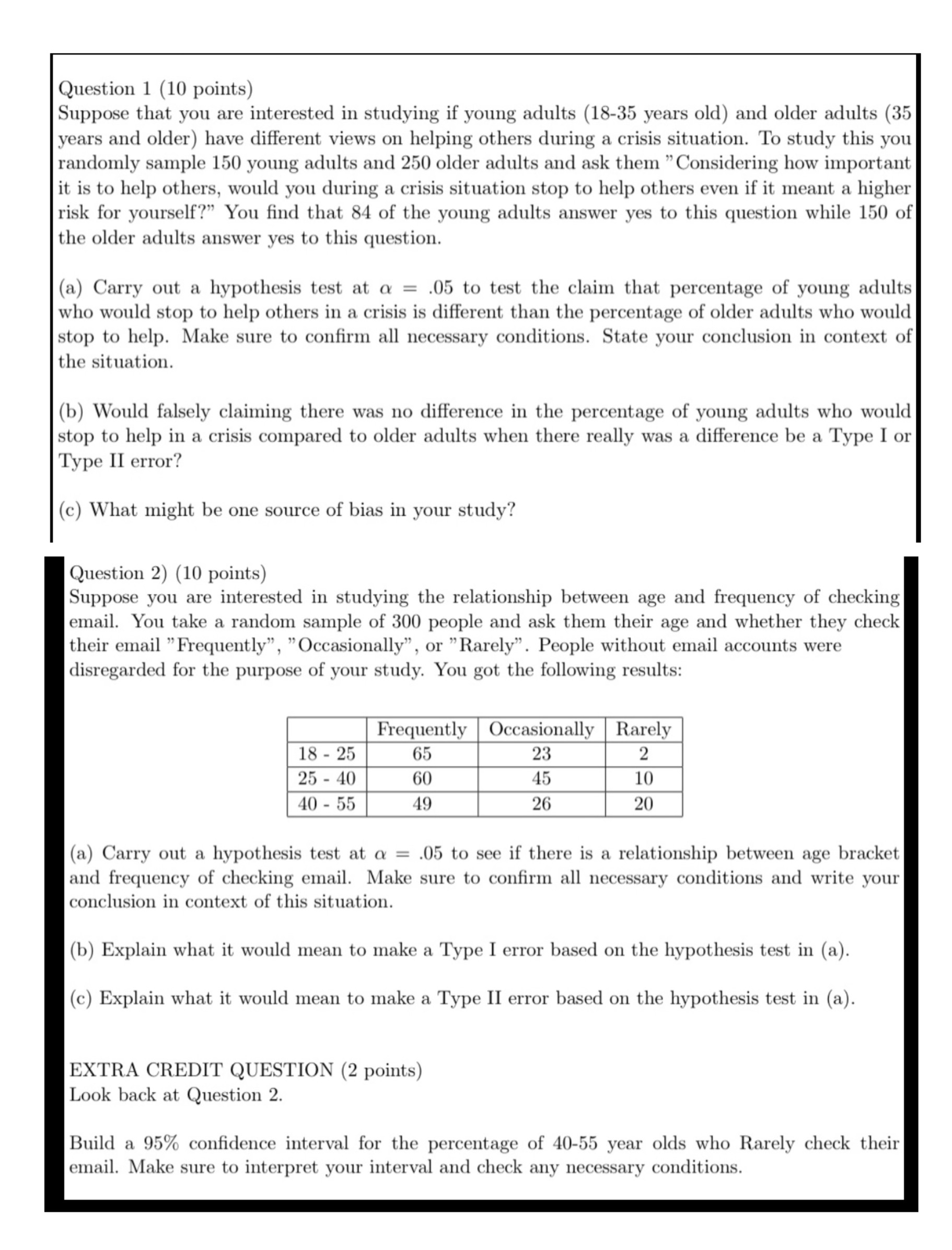
Question 1 (10 points) Suppose that you are interested in studying if young adults (18-35 years old) and older adults (35 years and older) have different views on helping others during a crisis situation. To study this you randomly sample 150 young adults and 250 older adults and ask them " Considering how important it is to help others, would you during a crisis situation stop to help others even if it meant a higher risk for yourself?" You find that 84 of the young adults answer yes to this question while 150 of the older adults answer yes to this question. (a) Carry out a hypothesis test at a = .05 to test the claim that percentage of young adults who would stop to help others in a crisis is different than the percentage of older adults who would stop to help. Make sure to confirm all necessary conditions. State your conclusion in context of the situation. (b) Would falsely claiming there was no difference in the percentage of young adults who would stop to help in a crisis compared to older adults when there really was a difference be a Type I or Type II error? (c) What might be one source of bias in your study? Question 2) (10 points) Suppose you are interested in studying the relationship between age and frequency of checking email. You take a random sample of 300 people and ask them their age and whether they check their email "Frequently", "Occasionally", or "Rarely". People without email accounts were disregarded for the purpose of your study. You got the following results: Frequently Occasionally Rarely 18 - 25 65 23 2 25 - 40 60 45 10 40 - 55 49 26 20 (a) Carry out a hypothesis test at o = .05 to see if there is a relationship between age bracket and frequency of checking email. Make sure to confirm all necessary conditions and write your conclusion in context of this situation. (b) Explain what it would mean to make a Type I error based on the hypothesis test in (a). (c) Explain what it would mean to make a Type II error based on the hypothesis test in (a). EXTRA CREDIT QUESTION (2 points) Look back at Question 2. Build a 95% confidence interval for the percentage of 40-55 year olds who Rarely check their email. Make sure to interpret your interval and check any necessary conditions
Step by Step Solution
There are 3 Steps involved in it

Get step-by-step solutions from verified subject matter experts
 Study Help