







Question: please name basic principle and explain the second part. 1.) The reaction below is known as ring closing metathesis and was developed by a chemist
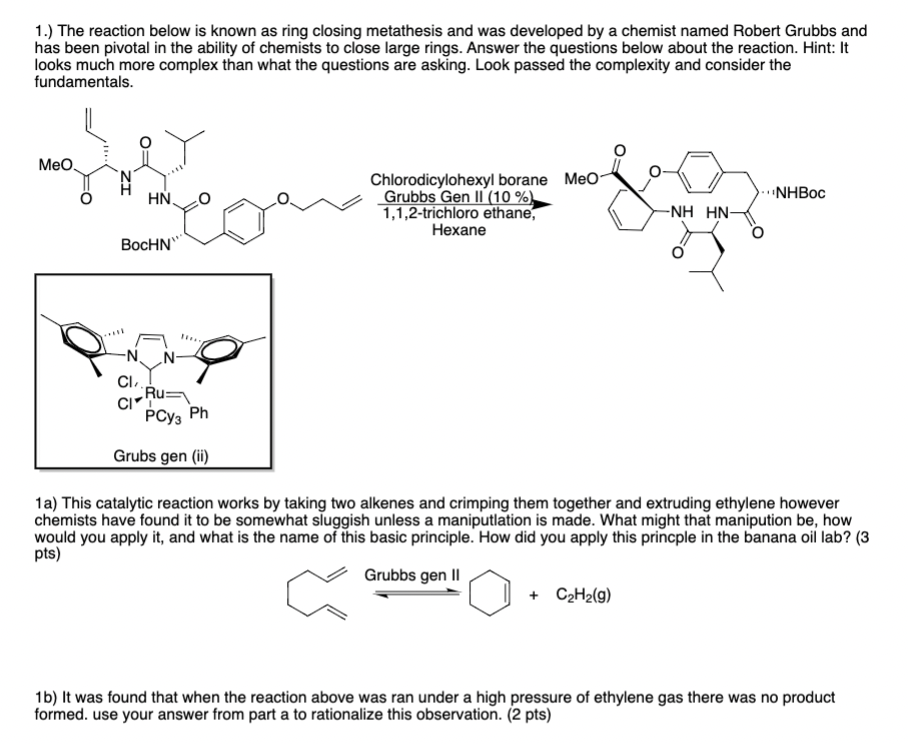
please name basic principle and explain the second part.
1.) The reaction below is known as ring closing metathesis and was developed by a chemist named Robert Grubbs and has been pivotal in the ability of chemists to close large rings. Answer the questions below about the reaction. Hint: It looks much more complex than what the questions are asking. Look passed the complexity and consider the fundamentals. Chlorodicylohexyl borane Grubbs Gen II (10\%) Hexane 1a) This catalytic reaction works by taking two alkenes and crimping them together and extruding ethylene however chemists have found it to be somewhat sluggish unless a maniputlation is made. What might that manipution be, how would you apply it, and what is the name of this basic principle. How did you apply this princple in the banana oil lab? (3 pts) Grubbs gen II 1b) It was found that when the reaction above was ran under a high pressure of ethylene gas there was no product formed. use your answer from part a to rationalize this observation. (2 pts) 1.) The reaction below is known as ring closing metathesis and was developed by a chemist named Robert Grubbs and has been pivotal in the ability of chemists to close large rings. Answer the questions below about the reaction. Hint: It looks much more complex than what the questions are asking. Look passed the complexity and consider the fundamentals. Chlorodicylohexyl borane Grubbs Gen II (10\%) Hexane 1a) This catalytic reaction works by taking two alkenes and crimping them together and extruding ethylene however chemists have found it to be somewhat sluggish unless a maniputlation is made. What might that manipution be, how would you apply it, and what is the name of this basic principle. How did you apply this princple in the banana oil lab? (3 pts) Grubbs gen II 1b) It was found that when the reaction above was ran under a high pressure of ethylene gas there was no product formed. use your answer from part a to rationalize this observation. (2 pts)
Step by Step Solution
There are 3 Steps involved in it

Get step-by-step solutions from verified subject matter experts
 Study Help