



Question: Please need heplp asap will give thumbs up 2:25 1 ... Done F2021_ME2 III.pdf 1 Question 1 (20 pts). True/False: State if the following statements
Please need heplp asap will give thumbs up 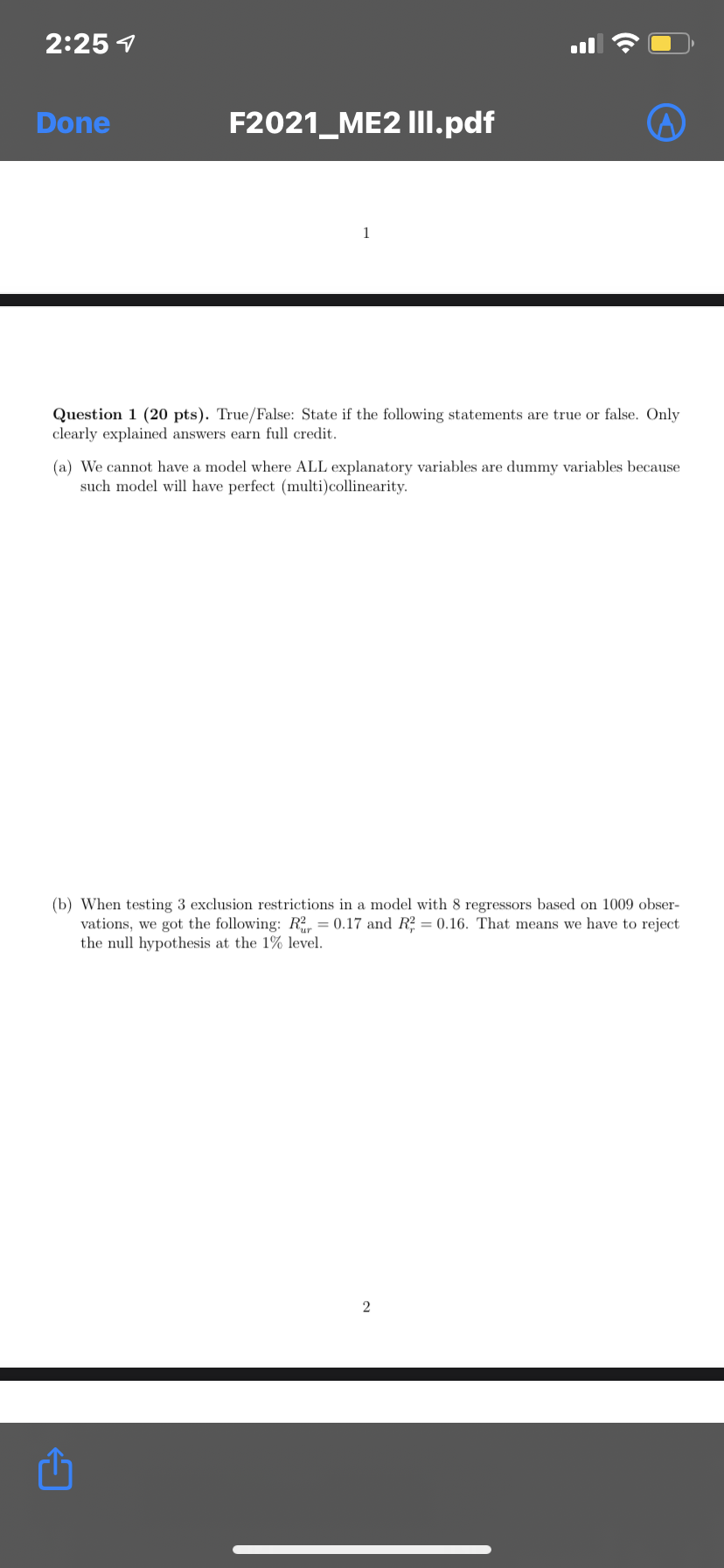

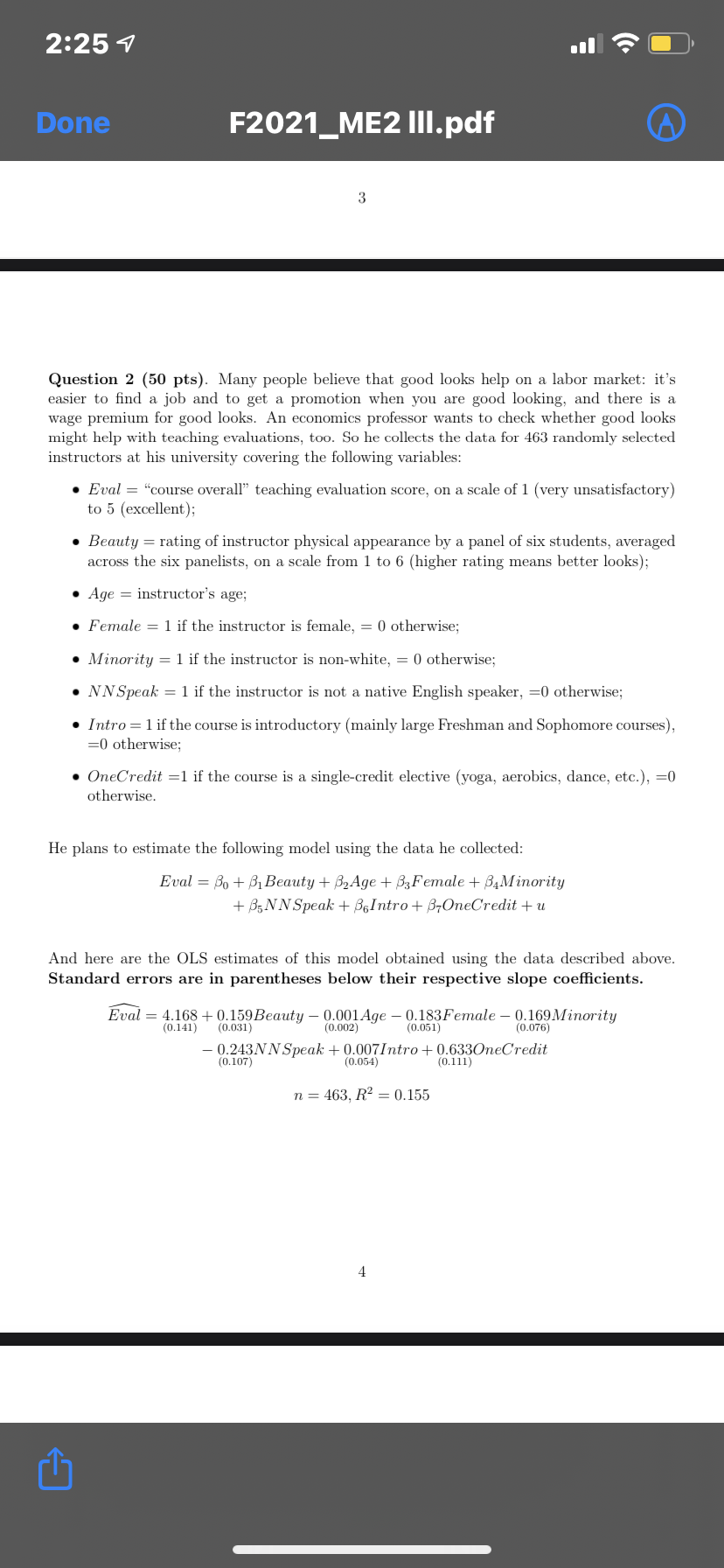
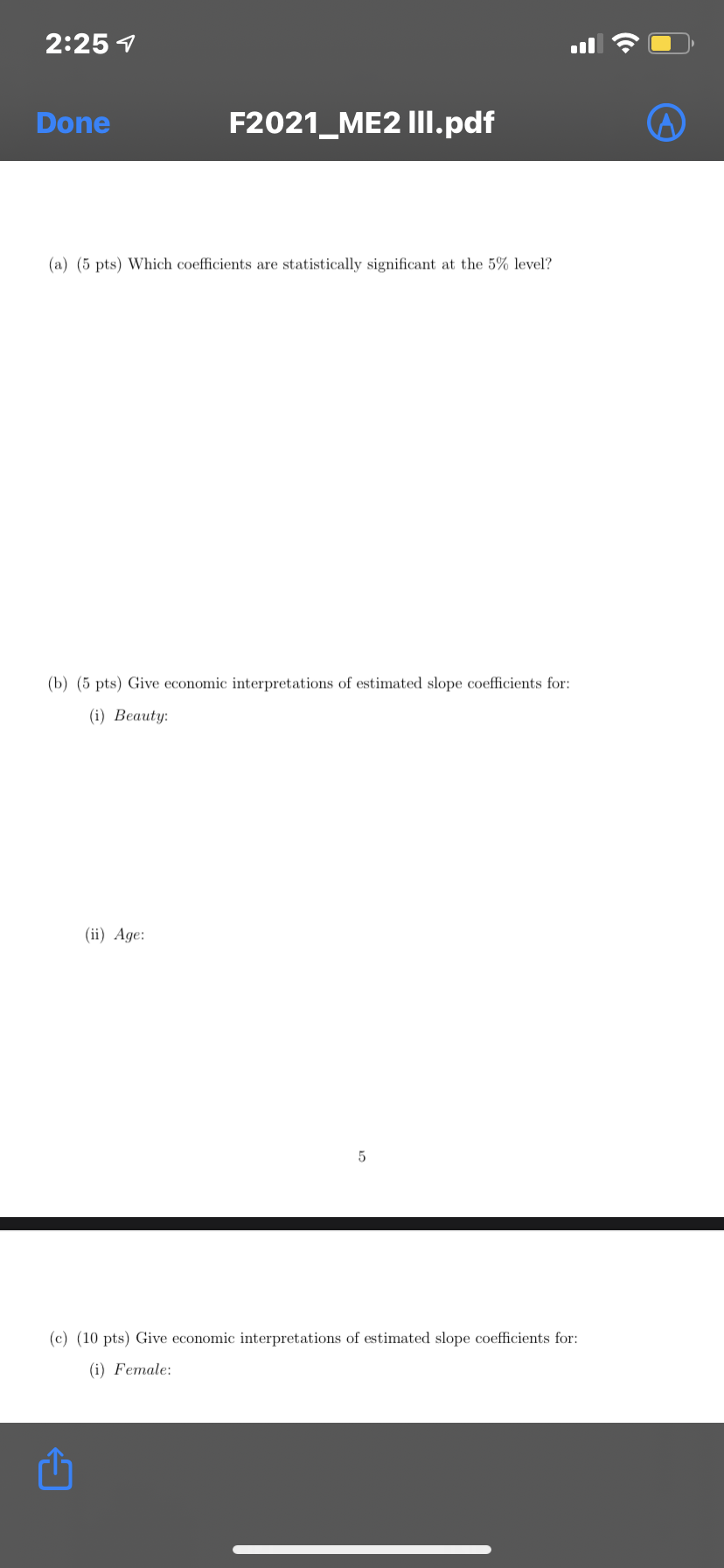
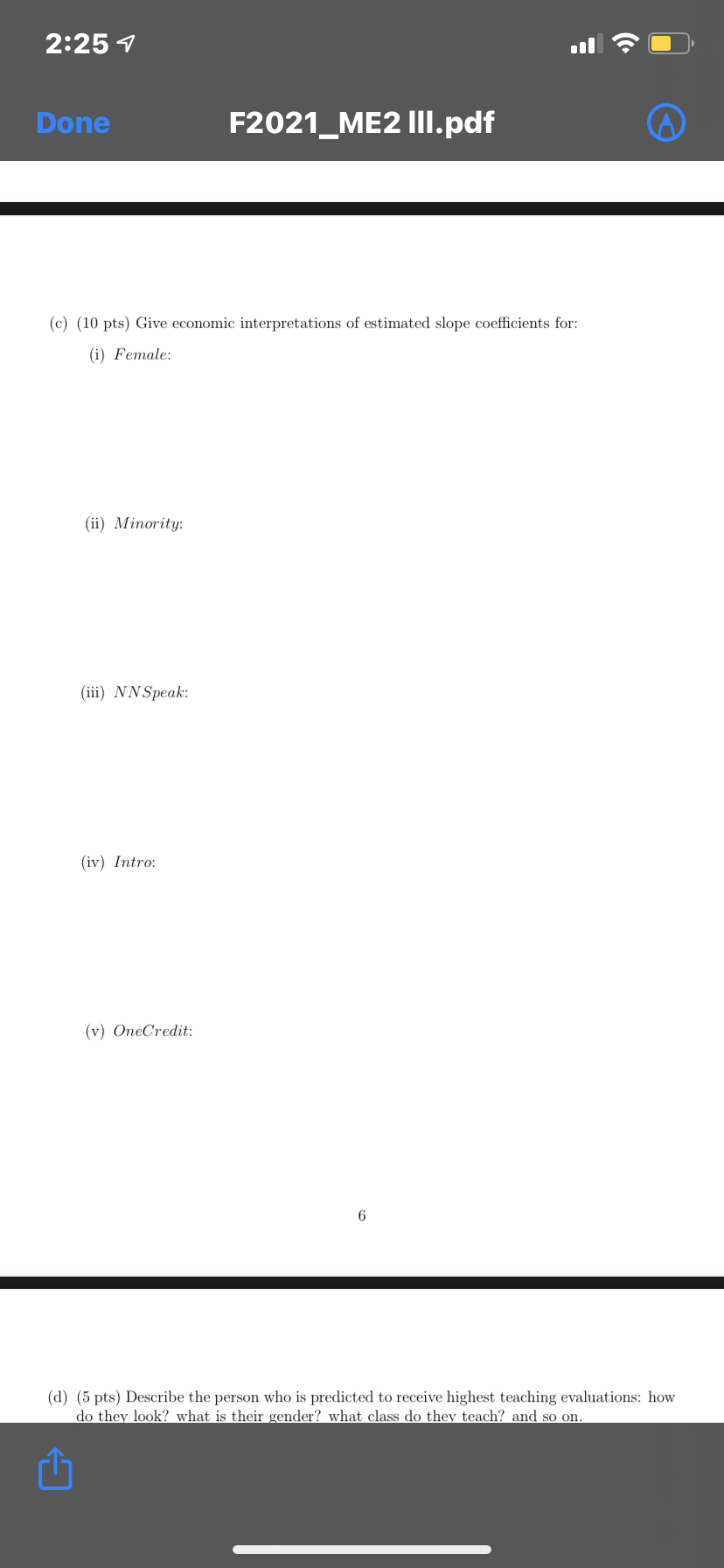
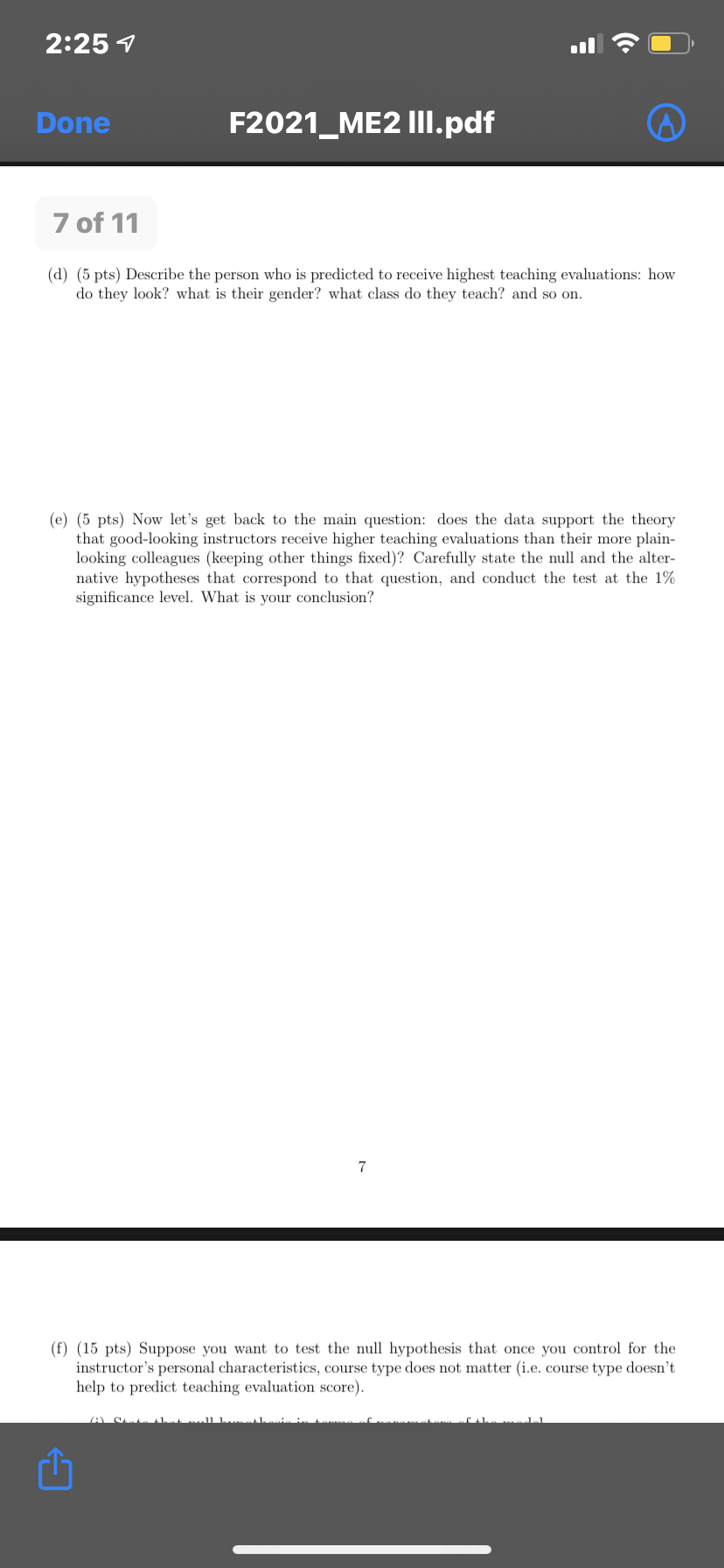
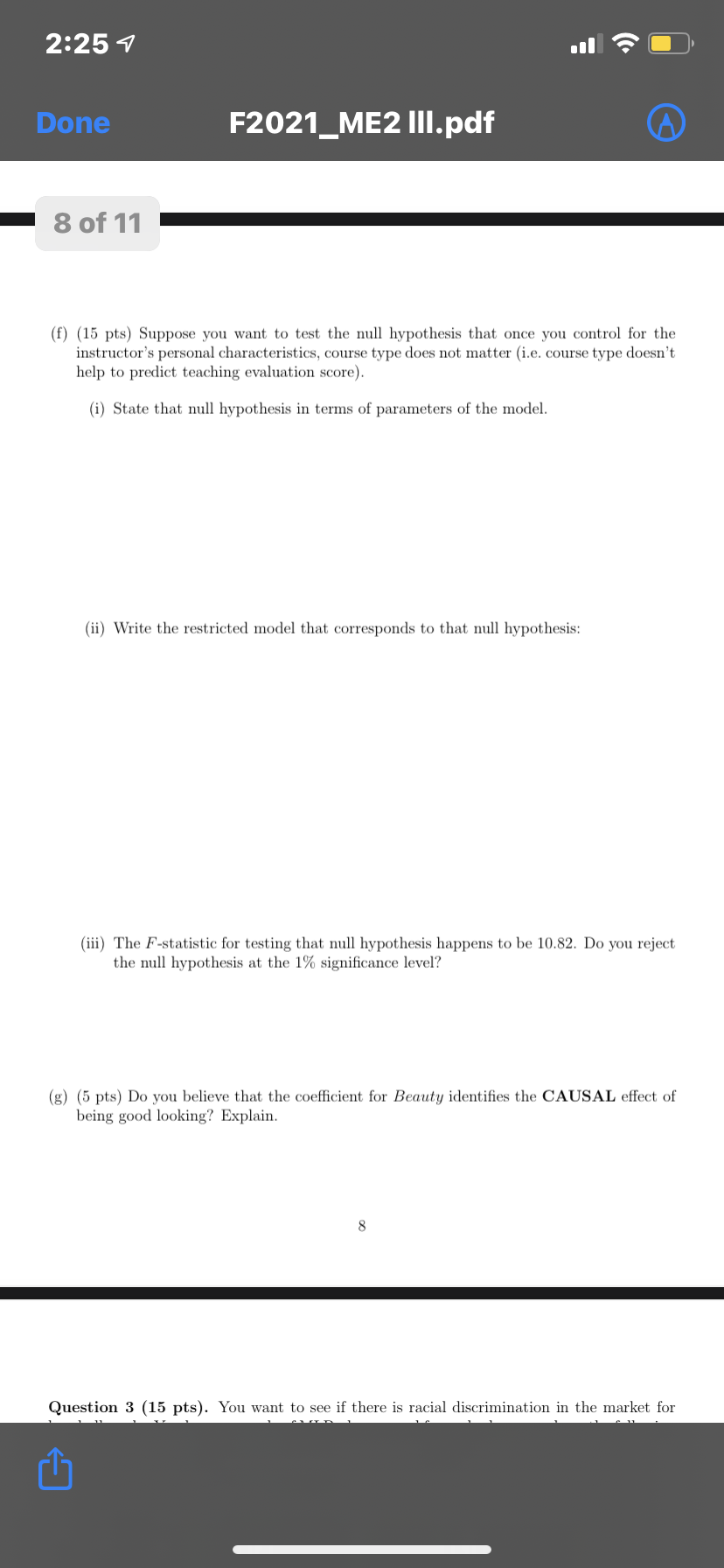
2:25 1 ... Done F2021_ME2 III.pdf 1 Question 1 (20 pts). True/False: State if the following statements are true or false. Only clearly explained answers earn full credit. (a) We cannot have a model where ALL explanatory variables are dummy variables because such model will have perfect (multi)collinearity. (b) When testing 3 exclusion restrictions in a model with 8 regressors based on 1009 obser- vations, we got the following: R2, = 0.17 and R} = 0.16. That means we have to reject the null hypothesis at the 1% level. 2 2:25 1 ... Done F2021_ME2 III.pdf 2 (c) If three explanatory variables are jointly significant at the 5% level, they also all have to be individually significant at the same significance level. (d) If we want to include a person's mode of transportation to work as an explanatory variable in our model, we will have to use dummy variables to represent it. 3 2:25 1 ... Done F2021_ME2 III.pdf 3 Question 2 (50 pts). Many people believe that good looks help on a labor market: it's easier to find a job and to get a promotion when you are good looking, and there is a wage premium for good looks. An economics professor wants to check whether good looks might help with teaching evaluations, too. So he collects the data for 463 randomly selected instructors at his university covering the following variables: Eval = "course overall teaching evaluation score, on a scale of 1 (very unsatisfactory) to 5 (excellent); Beauty = rating of instructor physical appearance by a panel of six students, averaged across the six panelists, on a scale from 1 to 6 (higher rating means better looks); Age = instructor's age; Female = 1 if the instructor is female, = 0 otherwise; Minority = 1 if the instructor is non-white, = 0 otherwise; NN Speak = 1 if the instructor is not a native English speaker, =0 otherwise; Intro = 1 if the course is introductory (mainly large Freshman and Sophomore courses), =0 otherwise; OneCredit =1 if the course is a single-credit elective (yoga, aerobics, dance, etc.), =0 otherwise. He plans to estimate the following model using the data he collected: Eval = Bo + B, Beauty + B2 Age + B3 Female + B4Minority + B5NN Speak + B6Intro + B-OneCredit+u And here are the OLS estimates of this model obtained using the data described above. Standard errors are in parentheses below their respective slope coefficients. Eval = 4.168 +0.159 Beauty -0.001 Age - 0.183Female - 0.169 Minority (0.141) (0.031) (0.002) (0.051) (0.076) - 0.243N N Speak +0.007Intro + 0.633OneCredit (0.107) (0.054) (0.111) n = 463, R2 = 0.155 4 2:25 1 ... Done F2021_ME2 III.pdf (a) (5 pts) Which coefficients are statistically significant at the 5% level? (b) (5 pts) Give economic interpretations of estimated slope coefficients for: (i) Beauty: (ii) Age: 5 (c) (10 pts) Give economic interpretations of estimated slope coefficients for: (i) Female: 2:25 1 ... Done F2021_ME2 III.pdf (c) (10 pts) Give economic interpretations of estimated slope coefficients for: (i) Female: (ii) Minority: (iii) NN Speak: (iv) Intro: (v) OneCredit: 6 (d) (5 pts) Describe the person who is predicted to receive highest teaching evaluations: how do they look? what is their gender? what class do they teach? and so on. 2:25 7 Done F2021_ME2 III.pdf 7 of 11 (d) (5 pts) Describe the person who is predicted to receive highest teaching evaluations: how do they look? what is their gender? what class do they teach? and so on. (e) (5 pts) Now let's get back to the main question: does the data support the theory that good-looking instructors receive higher teaching evaluations than their more plain- looking colleagues (keeping other things fixed)? Carefully state the null and the alter- native hypotheses that correspond to that question, and conduct the test at the 1% significance level. What is your conclusion? 7 (f) (15 pts) Suppose you want to test the null hypothesis that once you control for the instructor's personal characteristics, course type does not matter (i.e. course type doesn't help to predict teaching evaluation score). 2:25 1 ... Done F2021_ME2 III.pdf 8 of 11 (f) (15 pts) Suppose you want to test the null hypothesis that once you control for the instructor's personal characteristics, course type does not matter i.e. course type doesn't help to predict teaching evaluation score). (i) State that null hypothesis in terms of parameters of the model. (ii) Write the restricted model that corresponds to that null hypothesis: (iii) The F-statistic for testing that null hypothesis happens to be 10.82. Do you reject the null hypothesis at the 1% significance level? (g) (5 pts) Do you believe that the coefficient for Beauty identifies the CAUSAL effect of being good looking? Explain. 8 Question 3 (15 pts). You want to see if there is racial discrimination in the market for 2:25 1 ... Done F2021_ME2 III.pdf 1 Question 1 (20 pts). True/False: State if the following statements are true or false. Only clearly explained answers earn full credit. (a) We cannot have a model where ALL explanatory variables are dummy variables because such model will have perfect (multi)collinearity. (b) When testing 3 exclusion restrictions in a model with 8 regressors based on 1009 obser- vations, we got the following: R2, = 0.17 and R} = 0.16. That means we have to reject the null hypothesis at the 1% level. 2 2:25 1 ... Done F2021_ME2 III.pdf 2 (c) If three explanatory variables are jointly significant at the 5% level, they also all have to be individually significant at the same significance level. (d) If we want to include a person's mode of transportation to work as an explanatory variable in our model, we will have to use dummy variables to represent it. 3 2:25 1 ... Done F2021_ME2 III.pdf 3 Question 2 (50 pts). Many people believe that good looks help on a labor market: it's easier to find a job and to get a promotion when you are good looking, and there is a wage premium for good looks. An economics professor wants to check whether good looks might help with teaching evaluations, too. So he collects the data for 463 randomly selected instructors at his university covering the following variables: Eval = "course overall teaching evaluation score, on a scale of 1 (very unsatisfactory) to 5 (excellent); Beauty = rating of instructor physical appearance by a panel of six students, averaged across the six panelists, on a scale from 1 to 6 (higher rating means better looks); Age = instructor's age; Female = 1 if the instructor is female, = 0 otherwise; Minority = 1 if the instructor is non-white, = 0 otherwise; NN Speak = 1 if the instructor is not a native English speaker, =0 otherwise; Intro = 1 if the course is introductory (mainly large Freshman and Sophomore courses), =0 otherwise; OneCredit =1 if the course is a single-credit elective (yoga, aerobics, dance, etc.), =0 otherwise. He plans to estimate the following model using the data he collected: Eval = Bo + B, Beauty + B2 Age + B3 Female + B4Minority + B5NN Speak + B6Intro + B-OneCredit+u And here are the OLS estimates of this model obtained using the data described above. Standard errors are in parentheses below their respective slope coefficients. Eval = 4.168 +0.159 Beauty -0.001 Age - 0.183Female - 0.169 Minority (0.141) (0.031) (0.002) (0.051) (0.076) - 0.243N N Speak +0.007Intro + 0.633OneCredit (0.107) (0.054) (0.111) n = 463, R2 = 0.155 4 2:25 1 ... Done F2021_ME2 III.pdf (a) (5 pts) Which coefficients are statistically significant at the 5% level? (b) (5 pts) Give economic interpretations of estimated slope coefficients for: (i) Beauty: (ii) Age: 5 (c) (10 pts) Give economic interpretations of estimated slope coefficients for: (i) Female: 2:25 1 ... Done F2021_ME2 III.pdf (c) (10 pts) Give economic interpretations of estimated slope coefficients for: (i) Female: (ii) Minority: (iii) NN Speak: (iv) Intro: (v) OneCredit: 6 (d) (5 pts) Describe the person who is predicted to receive highest teaching evaluations: how do they look? what is their gender? what class do they teach? and so on. 2:25 7 Done F2021_ME2 III.pdf 7 of 11 (d) (5 pts) Describe the person who is predicted to receive highest teaching evaluations: how do they look? what is their gender? what class do they teach? and so on. (e) (5 pts) Now let's get back to the main question: does the data support the theory that good-looking instructors receive higher teaching evaluations than their more plain- looking colleagues (keeping other things fixed)? Carefully state the null and the alter- native hypotheses that correspond to that question, and conduct the test at the 1% significance level. What is your conclusion? 7 (f) (15 pts) Suppose you want to test the null hypothesis that once you control for the instructor's personal characteristics, course type does not matter (i.e. course type doesn't help to predict teaching evaluation score). 2:25 1 ... Done F2021_ME2 III.pdf 8 of 11 (f) (15 pts) Suppose you want to test the null hypothesis that once you control for the instructor's personal characteristics, course type does not matter i.e. course type doesn't help to predict teaching evaluation score). (i) State that null hypothesis in terms of parameters of the model. (ii) Write the restricted model that corresponds to that null hypothesis: (iii) The F-statistic for testing that null hypothesis happens to be 10.82. Do you reject the null hypothesis at the 1% significance level? (g) (5 pts) Do you believe that the coefficient for Beauty identifies the CAUSAL effect of being good looking? Explain. 8 Question 3 (15 pts). You want to see if there is racial discrimination in the market for
Step by Step Solution
There are 3 Steps involved in it

Get step-by-step solutions from verified subject matter experts