







Question: please need some help with those questions Create a UDP ping program as follows. Write a UDP ping server (call it udpPong) that will listen
please need some help with those questions
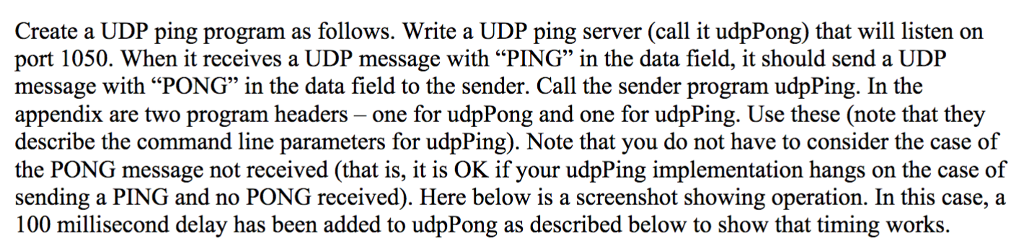
Create a UDP ping program as follows. Write a UDP ping server (call it udpPong) that will listen on port 1050. When it receives a UDP message with "PING" in the data field, it should send a UDP message with "PONG" in the data field to the sender. Call the sender program udpPing. In the appendix are two program headers- one for udpPong and one for udpPing. Use these (note that they describe the command line parameters for udpPing). Note that you do not have to consider the case of the PONG message not received (that is, it is OK if your udpPing implementation hangs on the case of sending a PING and no PONG received). Here below is a screenshot showing operation. In this case, a 100 millisecond delay has been added to udpPong as described below to show that timing works. Create a UDP ping program as follows. Write a UDP ping server (call it udpPong) that will listen on port 1050. When it receives a UDP message with "PING" in the data field, it should send a UDP message with "PONG" in the data field to the sender. Call the sender program udpPing. In the appendix are two program headers- one for udpPong and one for udpPing. Use these (note that they describe the command line parameters for udpPing). Note that you do not have to consider the case of the PONG message not received (that is, it is OK if your udpPing implementation hangs on the case of sending a PING and no PONG received). Here below is a screenshot showing operation. In this case, a 100 millisecond delay has been added to udpPong as described below to show that timing works
Step by Step Solution
There are 3 Steps involved in it

Get step-by-step solutions from verified subject matter experts
 Study Help