







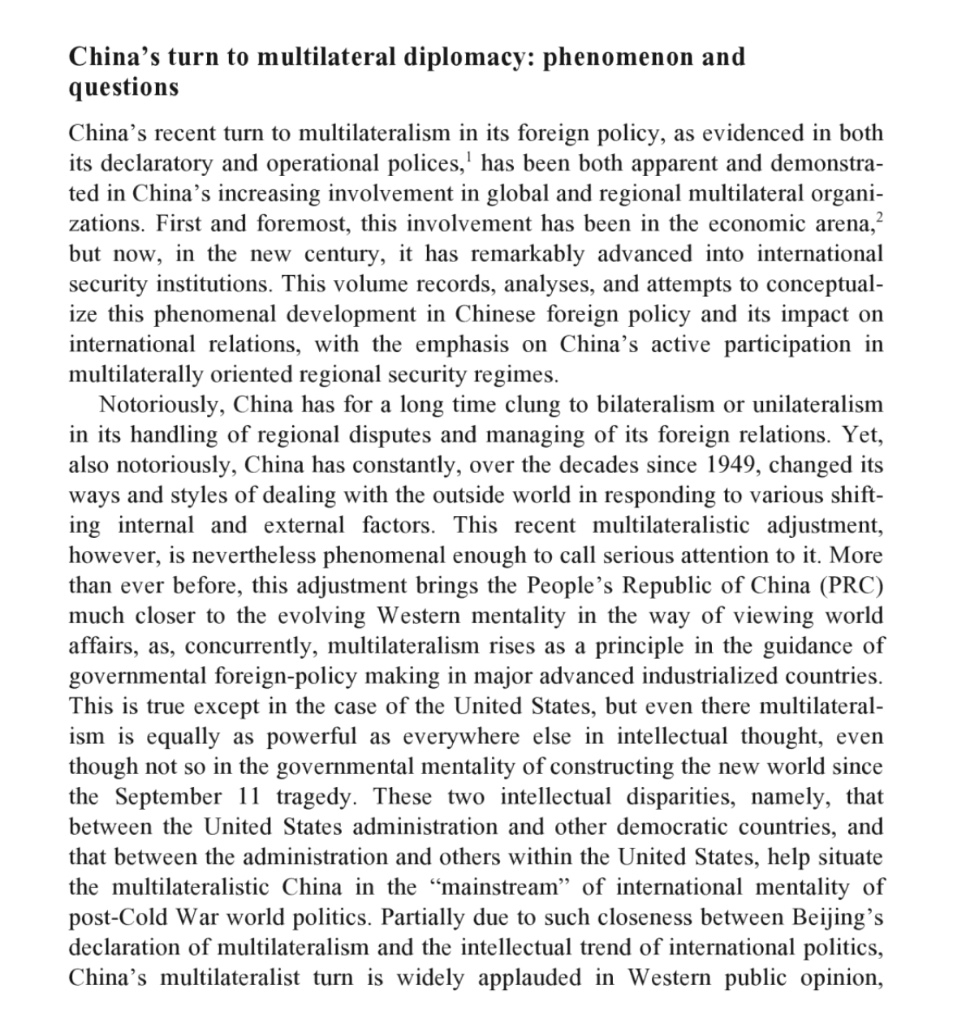
Question: ''' PLEASE NEED SOMEONE TO ANSWER THOSE QUESTIONS ASAP !!! ''' China has for a long time clung to bilateralism or unilateralism in its handing
''' PLEASE NEED SOMEONE TO ANSWER THOSE QUESTIONS ASAP !!! '''
China has for a long time clung to bilateralism or unilateralism in its handing of regional disputes and managing of its foreign relations . WHY ?
This is true except in the case of the United States , but even there multilateralism is equally as powerful as everywhere else in intellectual thought , even thought not so in the governmental mentality of constructing the new world since the September 11 tragedy . WHY U.S IS AN EXCEPTION ?
Intellectual thought vs government mentality ?
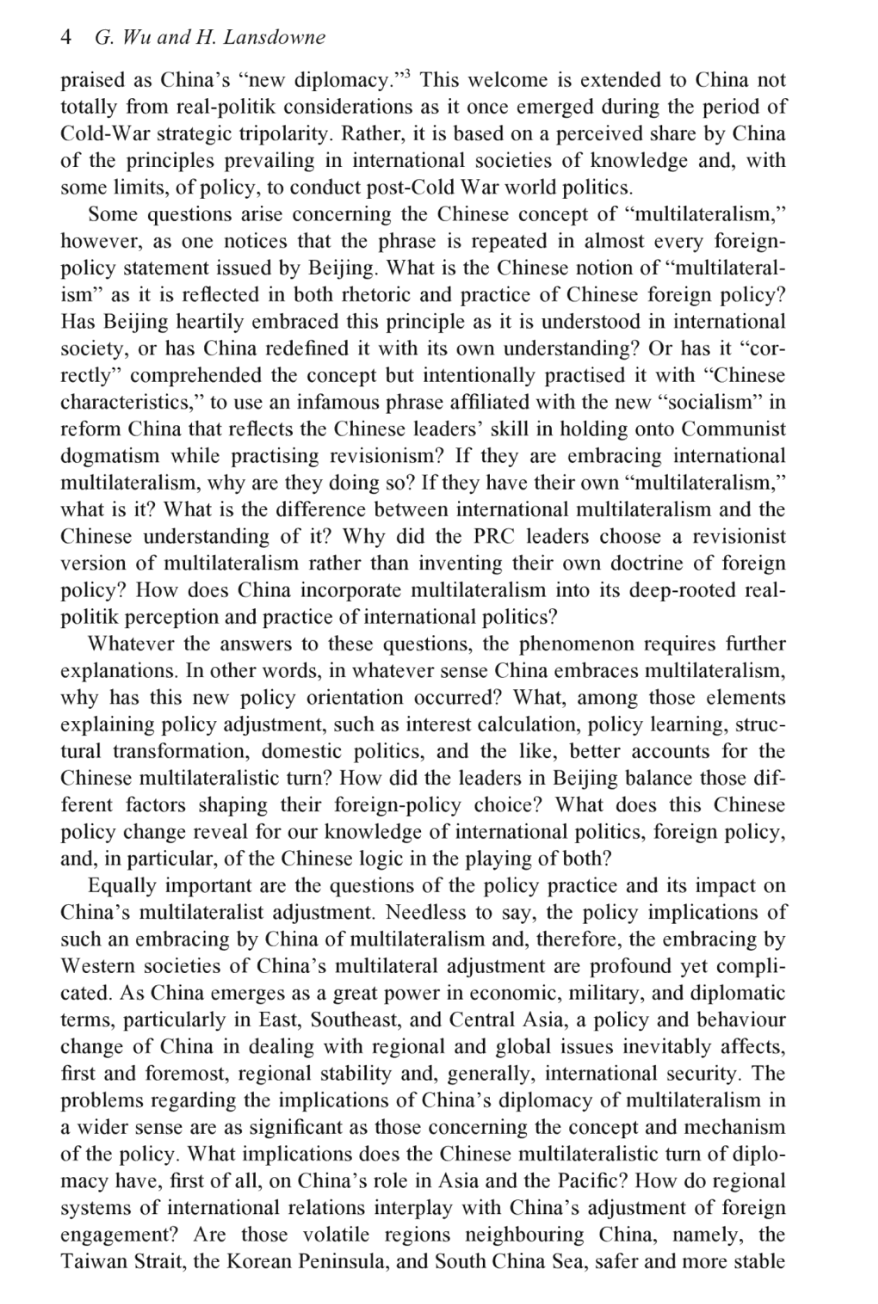
How does China incorporate multilateralism into its deep-rooted real-politik perception and practice of international politics ?
What is real-politik ?
Are those volatile region neighbouring China , namely , the Taiwan strait , the Korean peninsula , and South China Sea , safer and more stable than before with multilateral China ?what is safety ? What does stable mean ?
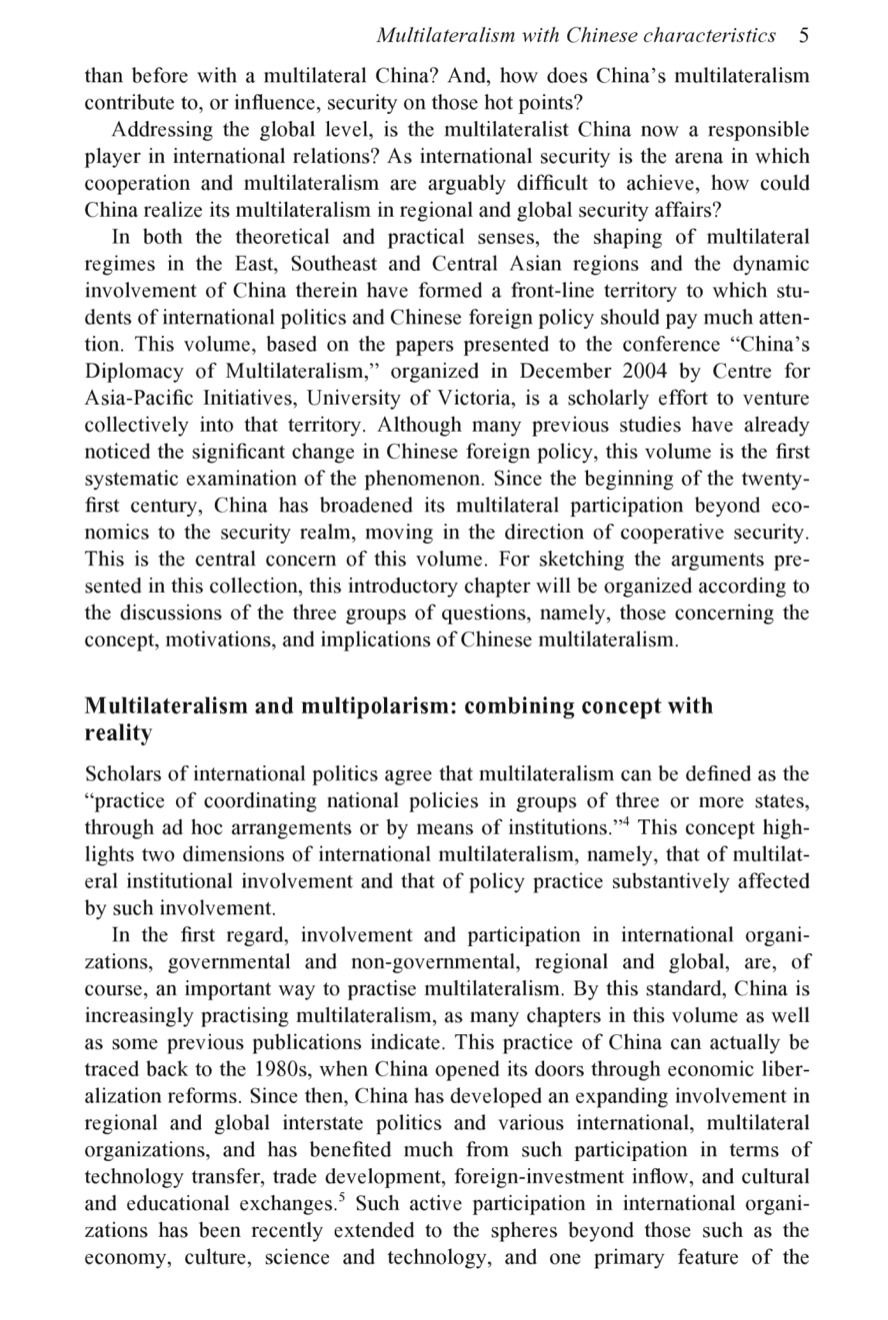
Why international security is the arena in which cooperation and multilateralism are arguably difficult to achieve ? How could China realize its multilateralism in regional and global security affairs ?
Definition of multilateralism ?
ANSWER QUESTIONS ON THE TEXT !
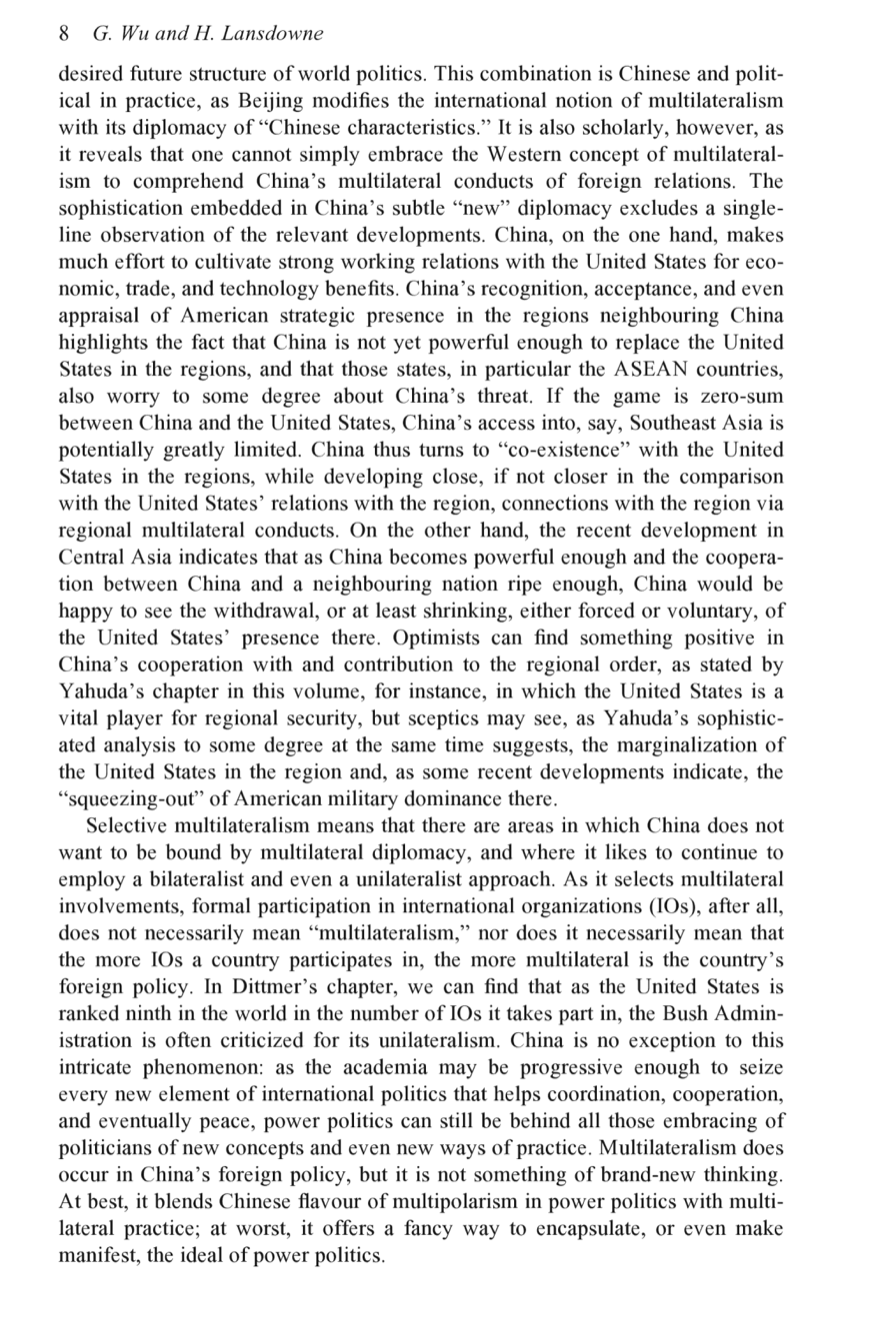
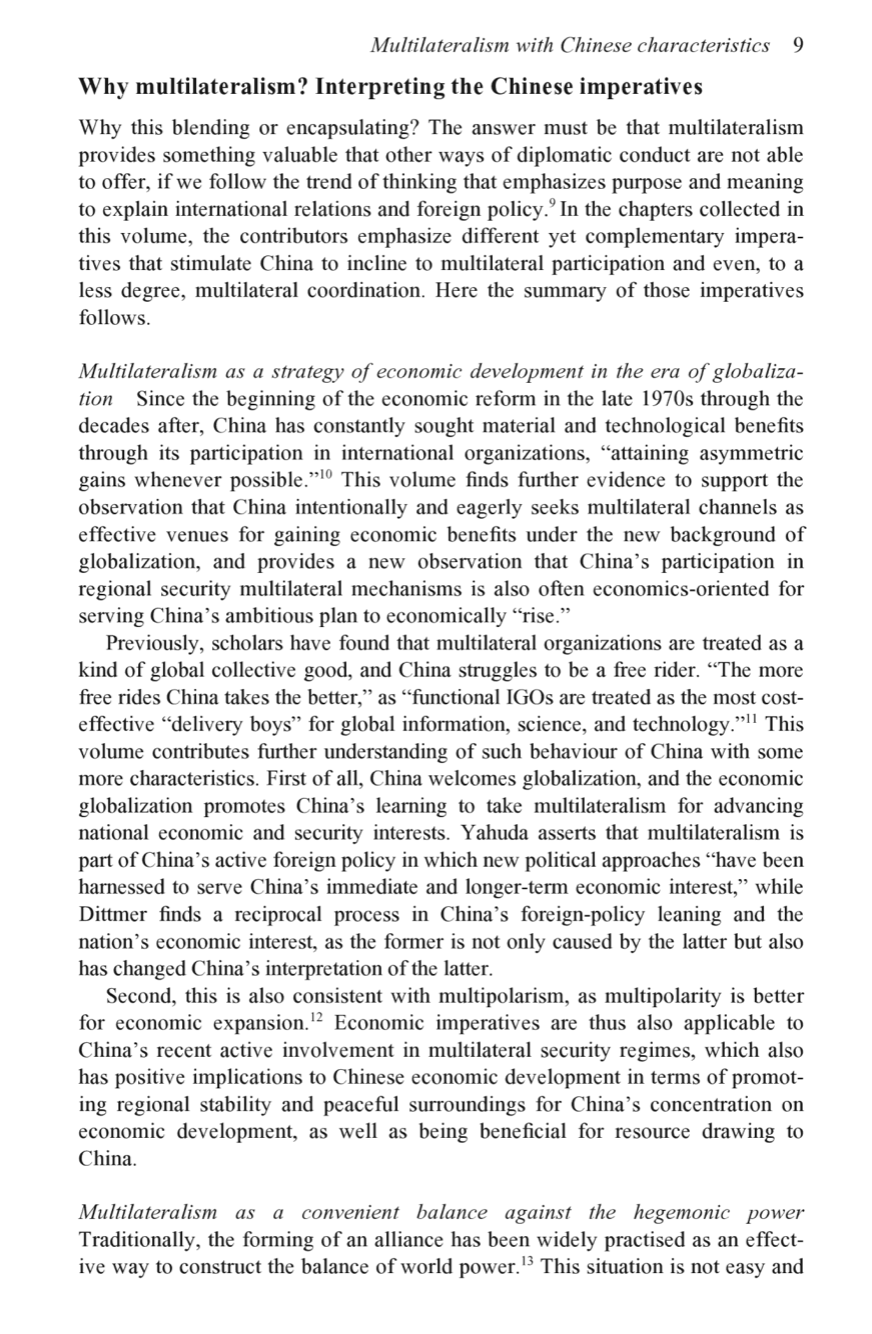
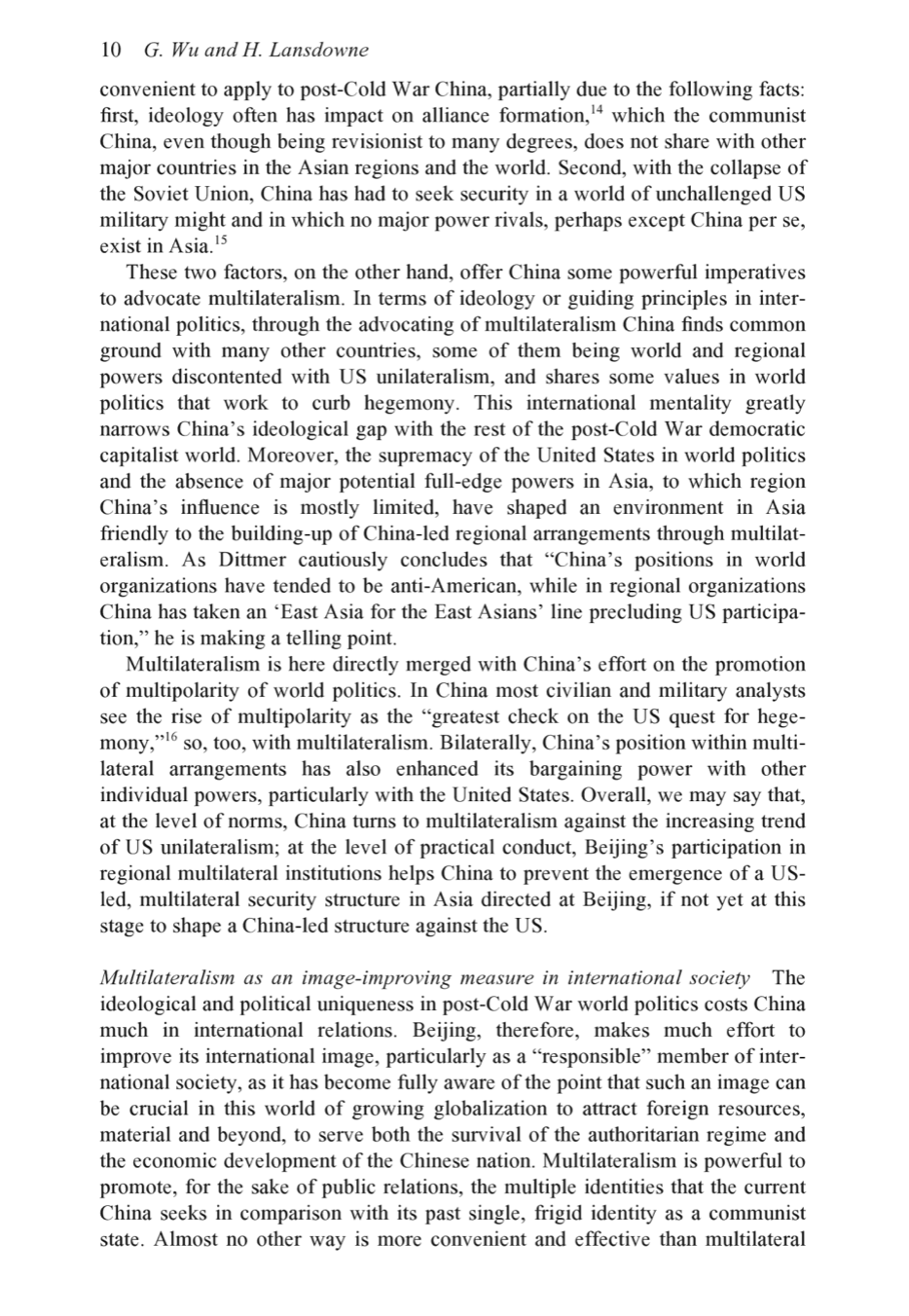
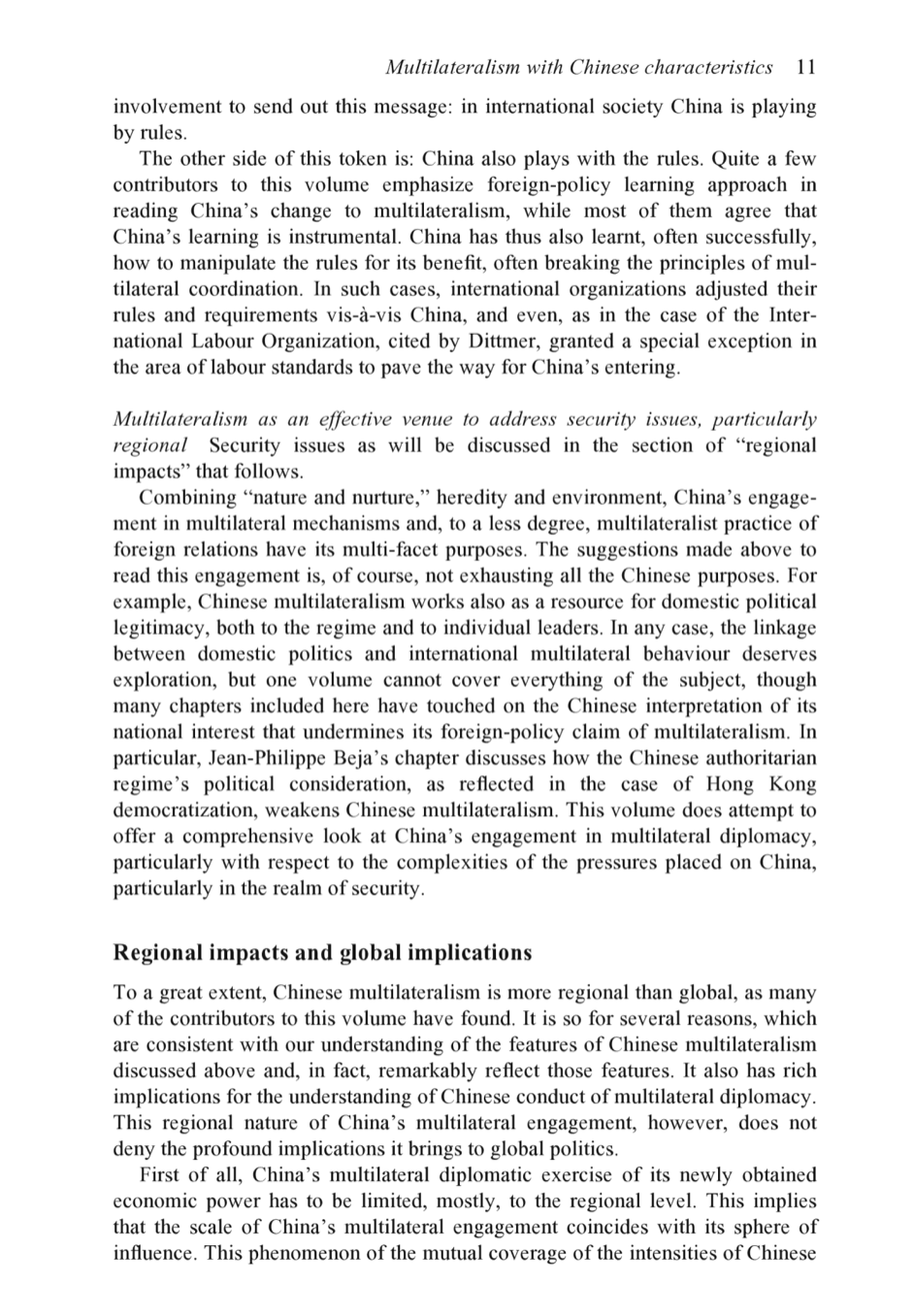
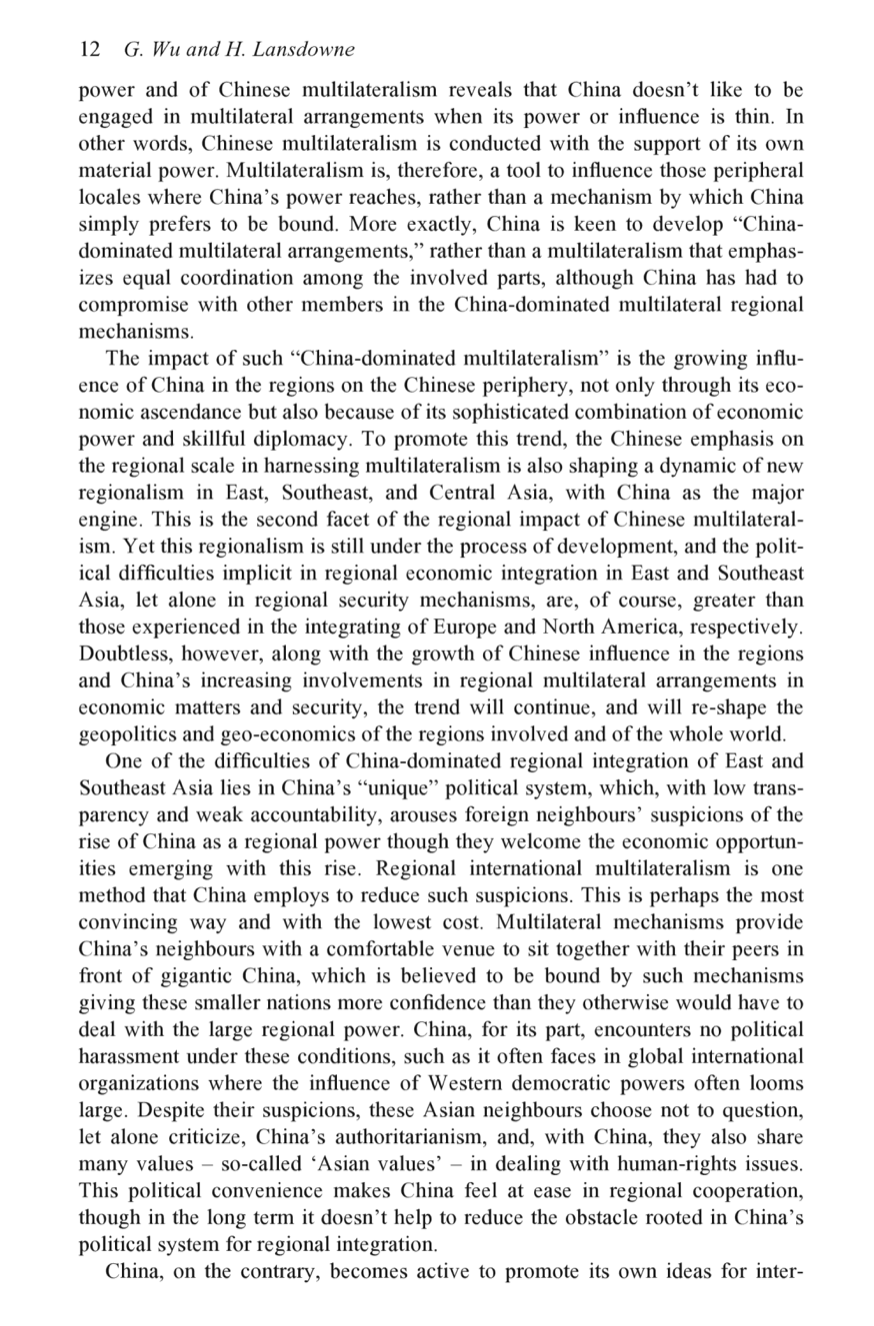
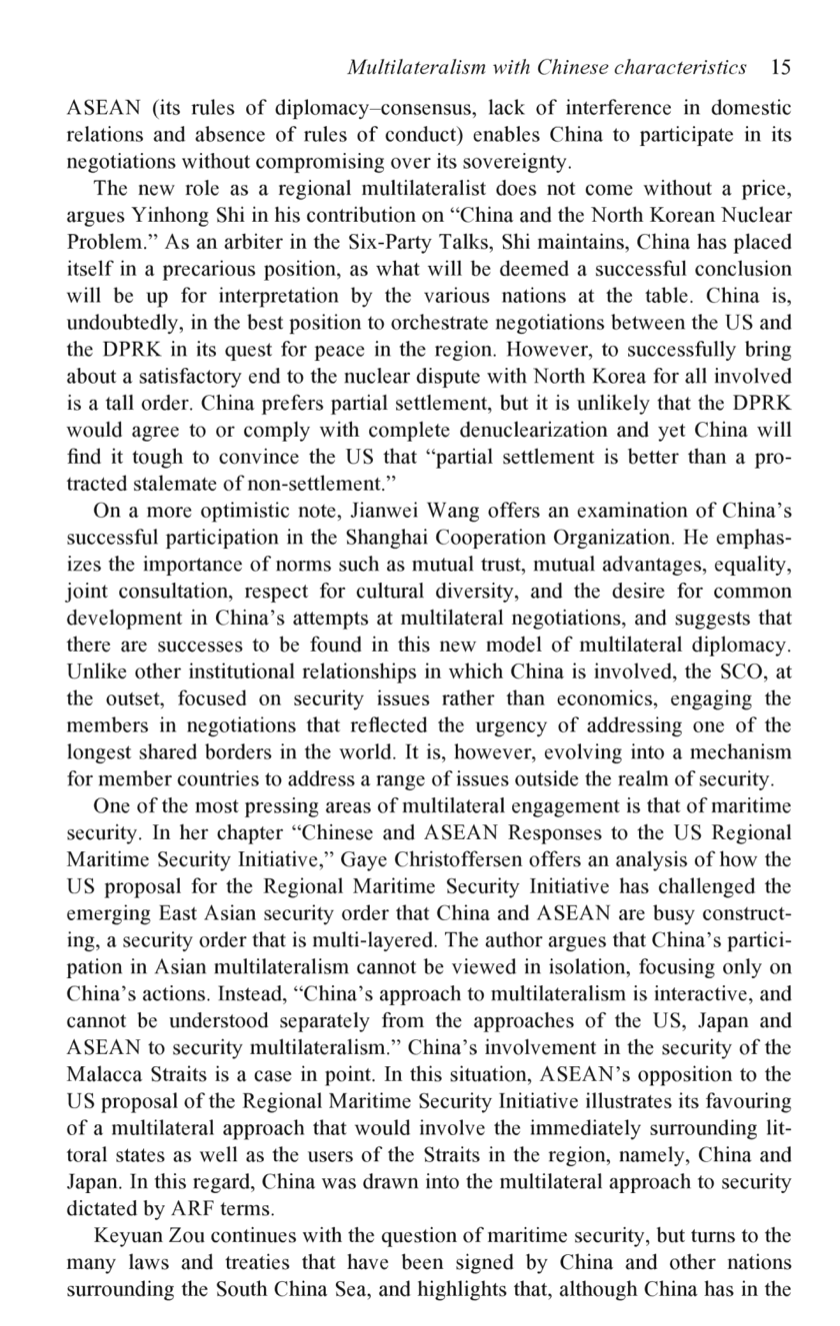
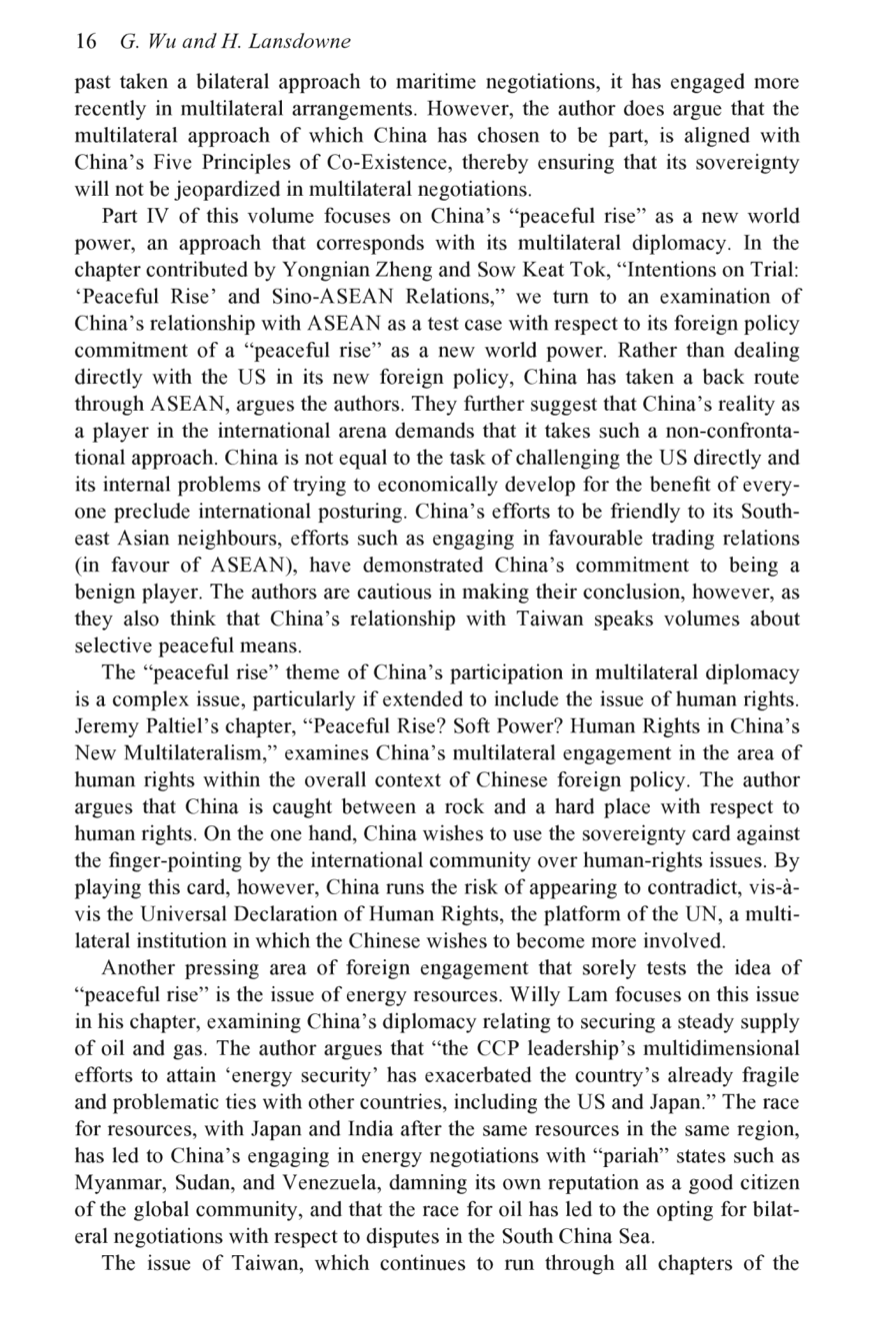
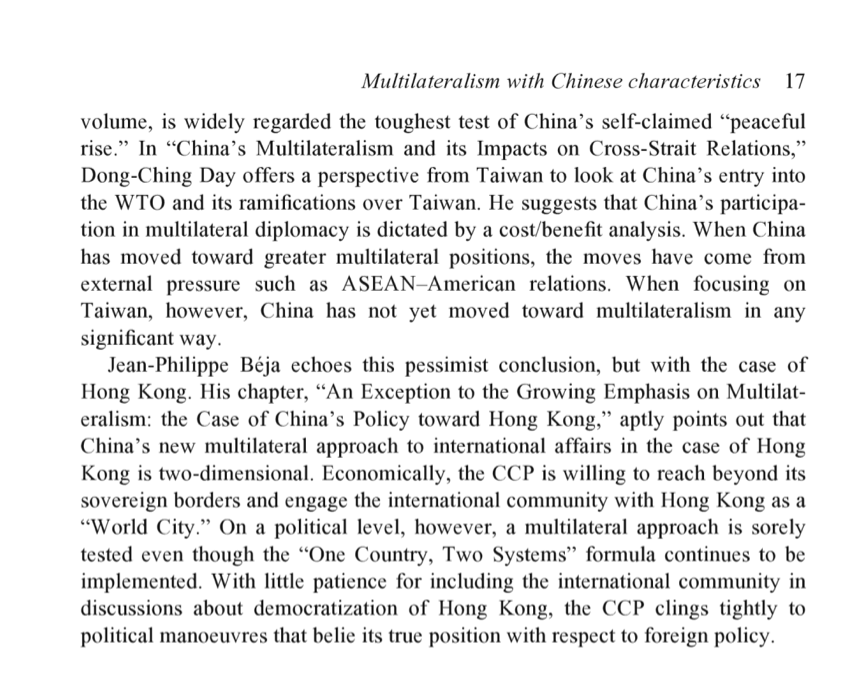
China's turn to multilateral diplomacy: phenomenon and questions China's recent turn to multilateralism in its foreign policy, as evidenced in both its declaratory and operational polices,' has been both apparent and demonstra- ted in China's increasing involvement in global and regional multilateral organi- zations. First and foremost, this involvement has been in the economic arena, but now, in the new century, it has remarkably advanced into international security institutions. This volume records, analyses, and attempts to conceptual- ize this phenomenal development in Chinese foreign policy and its impact on international relations, with the emphasis on China's active participation in multilaterally oriented regional security regimes. Notoriously, China has for a long time clung to bilateralism or unilateralism in its handling of regional disputes and managing of its foreign relations. Yet, also notoriously, China has constantly, over the decades since 1949, changed its ways and styles of dealing with the outside world in responding to various shift- ing internal and external factors. This recent multilateralistic adjustment, however, is nevertheless phenomenal enough to call serious attention to it. More than ever before, this adjustment brings the People's Republic of China (PRC) much closer to the evolving Western mentality in the way of viewing world affairs, as, concurrently, multilateralism rises as a principle in the guidance of governmental foreign-policy making in major advanced industrialized countries. This is true except in the case of the United States, but even there multilateral- ism is equally as powerful as everywhere else in intellectual thought, even though not so in the governmental mentality of constructing the new world since the September 11 tragedy. These two intellectual disparities, namely, that between the United States administration and other democratic countries, and that between the administration and others within the United States, help situate the multilateralistic China in the mainstream of international mentality of post-Cold War world politics. Partially due to such closeness between Beijing's declaration of multilateralism and the intellectual trend of international politics, China's multilateralist turn is widely applauded in Western public opinion, 4 G. Wu and H. Lansdowne praised as China's "new diplomacy.3 This welcome is extended to China not totally from real-politik considerations as it once emerged during the period of Cold War strategic tripolarity. Rather, it is based on a perceived share by China of the principles prevailing in international societies of knowledge and, with some limits, of policy, to conduct post-Cold War world politics. Some questions arise concerning the Chinese concept of multilateralism, however, as one notices that the phrase is repeated in almost every foreign- policy statement issued by Beijing. What is the Chinese notion of multilateral- ism as it is reflected in both rhetoric and practice of Chinese foreign policy? Has Beijing heartily embraced this principle as it is understood in international society, or has China redefined it with its own understanding? Or has it "cor- rectly comprehended the concept but intentionally practised it with "Chinese characteristics, to use an infamous phrase affiliated with the new "socialism in reform China that reflects the Chinese leaders' skill in holding onto Communist dogmatism while practising revisionism? If they are embracing international multilateralism, why are they doing so? If they have their own multilateralism, what is it? What is the difference between international multilateralism and the Chinese understanding of it? Why did the PRC leaders choose a revisionist version of multilateralism rather than inventing their own doctrine of foreign policy? How does China incorporate multilateralism into its deep-rooted real- politik perception and practice of international politics? Whatever the answers to these questions, the phenomenon requires further explanations. In other words, in whatever sense China embraces multilateralism, why has this new policy orientation occurred? What, among those elements explaining policy adjustment, such as interest calculation, policy learning, struc- tural transformation, domestic politics, and the like, better accounts for the Chinese multilateralistic turn? How did the leaders in Beijing balance those dif- ferent factors shaping their foreign-policy choice? What does this Chinese policy change reveal for our knowledge of international politics, foreign policy, and, in particular, of the Chinese logic in the playing of both? Equally important are the questions of the policy practice and its impact on China's multilateralist adjustment. Needless to say, the policy implications of such an embracing by China of multilateralism and, therefore, the embracing by Western societies of China's multilateral adjustment are profound yet compli- cated. As China emerges as a great power in economic, military, and diplomatic terms, particularly in East, Southeast, and Central Asia, a policy and behaviour change of China in dealing with regional and global issues inevitably affects, first and foremost, regional stability and, generally, international security. The problems regarding the implications of China's diplomacy of multilateralism in a wider sense are as significant as those concerning the concept and mechanism of the policy. What implications does the Chinese multilateralistic turn of diplo- macy have, first of all, on China's role in Asia and the Pacific? How do regional systems of international relations interplay with China's adjustment of foreign engagement? Are those volatile regions neighbouring China, namely, the Taiwan Strait, the Korean Peninsula, and South China Sea, safer and more stable Multilateralism with Chinese characteristics 5 than before with a multilateral China? And, how does China's multilateralism contribute to, or influence, security on those hot points? Addressing the global level, is the multilateralist China now a responsible player in international relations? As international security is the arena in which cooperation and multilateralism are arguably difficult to achieve, how could China realize its multilateralism in regional and global security affairs? In both the theoretical and practical senses, the shaping of multilateral regimes in the East, Southeast and Central Asian regions and the dynamic involvement of China therein have formed a front-line territory to which stu- dents of international politics and Chinese foreign policy should pay much atten- tion. This volume, based on the papers presented to the conference "China's Diplomacy of Multilateralism, organized in December 2004 by Centre for Asia-Pacific Initiatives, University of Victoria, is a scholarly effort to venture collectively into that territory. Although many previous studies have already noticed the significant change in Chinese foreign policy, this volume is the first systematic examination of the phenomenon. Since the beginning of the twenty- first century, China has broadened its multilateral participation beyond eco- nomics to the security realm, moving in the direction of cooperative security. This is the central concern of this volume. For sketching the arguments pre- sented in this collection, this introductory chapter will be organized according to the discussions of the three groups of questions, namely, those concerning the concept, motivations, and implications of Chinese multilateralism. Multilateralism and multipolarism: combining concept with reality Scholars of international politics agree that multilateralism can be defined as the "practice of coordinating national policies in groups of three or more states, through ad hoc arrangements or by means of institutions.4 This concept high- lights two dimensions of international multilateralism, namely, that of multilat- eral institutional involvement and that of policy practice substantively affected by such involvement. In the first regard, involvement and participation in international organi- zations, governmental and non-governmental, regional and global, are, of course, an important way to practise multilateralism. By this standard, China is increasingly practising multilateralism, as many chapters in this volume as well as some previous publications indicate. This practice of China can actually be traced back to the 1980s, when China opened its doors through economic liber- alization reforms. Since then, China has developed an expanding involvement in regional and global interstate politics and various international, multilateral organizations, and has benefited much from such participation in terms of technology transfer, trade development, foreign-investment inflow, and cultural and educational exchanges. Such active participation in international organi- zations has been recently extended to the spheres beyond those such as the economy, culture, science and technology, and one primary feature of the 8 G. Wu and H. Lansdowne desired future structure of world politics. This combination is Chinese and polit- ical in practice, as Beijing modifies the international notion of multilateralism with its diplomacy of Chinese characteristics. It is also scholarly, however, as it reveals that one cannot simply embrace the Western concept of multilateral- ism to comprehend China's multilateral conducts of foreign relations. The sophistication embedded in China's subtle new diplomacy excludes a single- line observation of the relevant developments. China, on the one hand, makes much effort to cultivate strong working relations with the United States for eco- nomic, trade, and technology benefits. China's recognition, acceptance, and even appraisal of American strategic presence in the regions neighbouring China highlights the fact that China is not yet powerful enough to replace the United States in the regions, and that those states, in particular the ASEAN countries, also worry to some degree about China's threat. If the game is zero-sum between China and the United States, China's access into, say, Southeast Asia is potentially greatly limited. China thus turns to "co-existence with the United States in the regions, while developing close, if not closer in the comparison with the United States' relations with the region, connections with the region via regional multilateral conducts. On the other hand, the recent development in Central Asia indicates that as China becomes powerful enough and the coopera- tion between China and a neighbouring nation ripe enough, China would be happy to see the withdrawal, or at least shrinking, either forced or voluntary, of the United States' presence there. Optimists can find something positive in China's cooperation with and contribution to the regional order, as stated by Yahuda's chapter in this volume, for instance, in which the United States is a vital player for regional security, but sceptics may see, as Yahuda's sophistic- ated analysis to some degree at the same time suggests, the marginalization of the United States in the region and, as some recent developments indicate, the "squeezing-out" of American military dominance there. Selective multilateralism means that there are areas in which China does not want to be bound by multilateral diplomacy, and where it likes to continue to employ a bilateralist and even a unilateralist approach. As it selects multilateral involvements, formal participation in international organizations (IOS), after all, does not necessarily mean multilateralism," nor does it necessarily mean that the more IOs a country participates in, the more multilateral is the country's foreign policy. In Dittmer's chapter, we can find that as the United States is ranked ninth in the world in the number of IOs it takes part in, the Bush Admin- istration is often criticized for its unilateralism. China is no exception to this intricate phenomenon: as the academia may be progressive enough to seize every new element of international politics that helps coordination, cooperation, and eventually peace, power politics can still be behind all those embracing of politicians of new concepts and even new ways of practice. Multilateralism does occur in China's foreign policy, but it is not something of brand-new thinking. At best, it blends Chinese flavour of multipolarism in power politics with multi- lateral practice; at worst, it offers a fancy way to encapsulate, or even make manifest, the ideal of power politics. Multilateralism with Chinese characteristics 9 Why multilateralism? Interpreting the Chinese imperatives Why this blending or encapsulating? The answer must be that multilateralism provides something valuable that other ways of diplomatic conduct are not able to offer, if we follow the trend of thinking that emphasizes purpose and meaning to explain international relations and foreign policy. In the chapters collected in this volume, the contributors emphasize different yet complementary impera- tives that stimulate China to incline to multilateral participation and even, to a less degree, multilateral coordination. Here the summary of those imperatives follows. Multilateralism as a strategy of economic development in the era of globaliza- tion Since the beginning of the economic reform in the late 1970s through the decades after, China has constantly sought material and technological benefits through its participation in international organizations, "attaining asymmetric gains whenever possible.10 This volume finds further evidence to support the observation that China intentionally and eagerly seeks multilateral channels as effective venues for gaining economic benefits under the new background of globalization, and provides a new observation that China's participation in regional security multilateral mechanisms is also often economics-oriented for serving China's ambitious plan to economically rise. Previously, scholars have found that multilateral organizations are treated as a kind of global collective good, and China struggles to be a free rider. The more free rides China takes the better," as "functional IGOs are treated as the most cost- effective "delivery boys for global information, science, and technology. This volume contributes further understanding of such behaviour of China with some more characteristics. First of all, China welcomes globalization, and the economic globalization promotes China's learning to take multilateralism for advancing national economic and security interests. Yahuda asserts that multilateralism is part of China's active foreign policy in which new political approaches have been harnessed to serve China's immediate and longer-term economic interest," while Dittmer finds a reciprocal process in China's foreign-policy leaning and the nation's economic interest, as the former is not only caused by the latter but also has changed China's interpretation of the latter. Second, this is also consistent with multipolarism, as multipolarity is better for economic expansion."2 Economic imperatives are thus also applicable to China's recent active involvement in multilateral security regimes, which also has positive implications to Chinese economic development in terms of promot- ing regional stability and peaceful surroundings for China's concentration on economic development, as well as being beneficial for resource drawing to China. Multilateralism as a convenient balance against the hegemonic power Traditionally, the forming of an alliance has been widely practised as an effect- ive way to construct the balance of world power. 13 This situation is not easy and 10 G. Wu and H. Lansdowne convenient to apply to post-Cold War China, partially due to the following facts: first, ideology often has impact on alliance formation, 14 which the communist China, even though being revisionist to many degrees, does not share with other major countries in the Asian regions and the world. Second, with the collapse of the Soviet Union, China has had to seek security in a world of unchallenged US military might and in which no major power rivals, perhaps except China per se, exist in Asia.15 These two factors, on the other hand, offer China some powerful imperatives to advocate multilateralism. In terms of ideology or guiding principles in inter- national politics, through the advocating of multilateralism China finds common ground with many other countries, some of them being world and regional powers discontented with US unilateralism, and shares some values in world politics that work to curb hegemony. This international mentality greatly narrows China's ideological gap with the rest of the post-Cold War democratic capitalist world. Moreover, the supremacy of the United States in world politics and the absence of major potential full-edge powers in Asia, to which region China's influence is mostly limited, have shaped an environment in Asia friendly to the building-up of China-led regional arrangements through multilat- eralism. As Dittmer cautiously concludes that China's positions in world organizations have tended to be anti-American, while in regional organizations China has taken an 'East Asia for the East Asians' line precluding US participa- tion, he is making a telling point. Multilateralism is here directly merged with China's effort on the promotion of multipolarity of world politics. In China most civilian and military analysts see the rise of multipolarity as the "greatest check on the US quest for hege- mony,16 so, too, with multilateralism. Bilaterally, China's position within multi- lateral arrangements has also enhanced its bargaining power with other individual powers, particularly with the United States. Overall, we may say that, at the level of norms, China turns to multilateralism against the increasing trend of US unilateralism; at the level of practical conduct, Beijing's participation in regional multilateral institutions helps China to prevent the emergence of a US- led, multilateral security structure in Asia directed at Beijing, if not yet at this stage to shape a China-led structure against the US. Multilateralism as an image-improving measure in international society The ideological and political uniqueness in post-Cold War world politics costs China much in international relations. Beijing, therefore, makes much effort to improve its international image, particularly as a "responsible" member of inter- national society, as it has become fully aware of the point that such an image can be crucial in this world of growing globalization to attract foreign resources, material and beyond, to serve both the survival of the authoritarian regime and the economic development of the Chinese nation. Multilateralism is powerful to promote, for the sake of public relations, the multiple identities that the current China seeks in comparison with its past single, frigid identity as a communist state. Almost no other way is more convenient and effective than multilateral Multilateralism with Chinese characteristics 11 involvement to send out this message: in international society China is playing by rules. The other side of this token is: China also plays with the rules. Quite a few contributors to this volume emphasize foreign-policy learning approach in reading China's change to multilateralism, while most of them agree that China's learning is instrumental. China has thus also learnt, often successfully, how to manipulate the rules for its benefit, often breaking the principles of mul- tilateral coordination. In such cases, international organizations adjusted their rules and requirements vis--vis China, and even, as in the case of the Inter- national Labour Organization, cited by Dittmer, granted a special exception in the area of labour standards to pave the way for China's entering. Multilateralism as an effective venue to address security issues, particularly regional Security issues as will be discussed in the section of regional impacts that follows. Combining nature and nurture, heredity and environment, China's engage- ment in multilateral mechanisms and, to a less degree, multilateralist practice of foreign relations have its multi-facet purposes. The suggestions made above to read this engagement is, of course, not exhausting all the Chinese purposes. For example, Chinese multilateralism works also as a resource for domestic political legitimacy, both to the regime and to individual leaders. In any case, the linkage between domestic politics and international multilateral behaviour deserves exploration, but one volume cannot cover everything of the subject, though many chapters included here have touched on the Chinese interpretation of its national interest that undermines its foreign-policy claim of multilateralism. In particular, Jean-Philippe Beja's chapter discusses how the Chinese authoritarian regime's political consideration, as reflected in the case of Hong Kong democratization, weakens Chinese multilateralism. This volume does attempt to offer a comprehensive look at China's engagement in multilateral diplomacy, particularly with respect to the complexities of the pressures placed on China, particularly in the realm of security. Regional impacts and global implications To a great extent, Chinese multilateralism is more regional than global, as many of the contributors to this volume have found. It is so for several reasons, which are consistent with our understanding of the features of Chinese multilateralism discussed above and, in fact, remarkably reflect those features. It also has rich implications for the understanding of Chinese conduct of multilateral diplomacy. This regional nature of China's multilateral engagement, however, does not deny the profound implications it brings to global politics. First of all, China's multilateral diplomatic exercise of its newly obtained economic power has to be limited, mostly, to the regional level. This implies that the scale of China's multilateral engagement coincides with its sphere of influence. This phenomenon of the mutual coverage of the intensities of Chinese 12 G. Wu and H. Lansdowne power and of Chinese multilateralism reveals that China doesn't like to be engaged in multilateral arrangements when its power or influence is thin. In other words, Chinese multilateralism is conducted with the support of its own material power. Multilateralism is, therefore, a tool to influence those peripheral locales where China's power reaches, rather than a mechanism by which China simply prefers to be bound. More exactly, China is keen to develop "China- dominated multilateral arrangements, rather than a multilateralism that emphas- izes equal coordination among the involved parts, although China has had to compromise with other members in the China-dominated multilateral regional mechanisms. The impact of such "China-dominated multilateralism is the growing influ- ence of China in the regions on the Chinese periphery, not only through its eco- nomic ascendance but also because of its sophisticated combination of economic power and skillful diplomacy. To promote this trend, the Chinese emphasis on the regional scale in harnessing multilateralism is also shaping a dynamic of new regionalism in East, Southeast, and Central Asia, with China as the major engine. This is the second facet of the regional impact of Chinese multilateral- ism. Yet this regionalism is still under the process of development, and the polit- ical difficulties implicit in regional economic integration in East and Southeast Asia, let alone in regional security mechanisms, are, of course, greater than those experienced in the integrating of Europe and North America, respectively. Doubtless, however, along with the growth of Chinese influence in the regions and China's increasing involvements in regional multilateral arrangements in economic matters and security, the trend will continue, and will re-shape the geopolitics and geo-economics of the regions involved and of the whole world. One of the difficulties of China-dominated regional integration of East and Southeast Asia lies in China's "unique political system, which, with low trans- parency and weak accountability, arouses foreign neighbours' suspicions of the rise of China as a regional power though they welcome the economic opportun- ities emerging with this rise. Regional international multilateralism is one method that China employs to reduce such suspicions. This is perhaps the most convincing way and with the lowest cost. Multilateral mechanisms provide China's neighbours with a comfortable venue to sit together with their peers in front of gigantic China, which is believed to be bound by such mechanisms giving these smaller nations more confidence than they otherwise would have to deal with the large regional power. China, for its part, encounters no political harassment under these conditions, such as it often faces in global international organizations where the influence of Western democratic powers often looms large. Despite their suspicions, these Asian neighbours choose not to question, let alone criticize, China's authoritarianism, and, with China, they also share many values so-called 'Asian values in dealing with human-rights issues. This political convenience makes China feel at ease in regional cooperation, though in the long term it doesn't help to reduce the obstacle rooted in China's political system for regional integration. China, on the contrary, becomes active to promote its own ideas for inter- Multilateralism with Chinese characteristics 15 ASEAN (its rules of diplomacy-consensus, lack of interference in domestic relations and absence of rules of conduct) enables China to participate in its negotiations without compromising over its sovereignty. The new role as a regional multilateralist does not come without a price, argues Yinhong Shi in his contribution on China and the North Korean Nuclear Problem. As an arbiter in the Six-Party Talks, Shi maintains, China has placed itself in a precarious position, as what will be deemed a successful conclusion will be up for interpretation by the various nations at the table. China is, undoubtedly, in the best position to orchestrate negotiations between the US and the DPRK in its quest for peace in the region. However, to successfully bring about a satisfactory end to the nuclear dispute with North Korea for all involved is a tall order. China prefers partial settlement, but it is unlikely that the DPRK would agree to or comply with complete denuclearization and yet China will find it tough to convince the US that "partial settlement is better than a pro- tracted stalemate of non-settlement. On a more optimistic note, Jianwei Wang offers an examination of China's successful participation in the Shanghai Cooperation Organization. He emphas- izes the importance of norms such as mutual trust, mutual advantages, equality, joint consultation, respect for cultural diversity, and the desire for common development in China's attempts at multilateral negotiations, and suggests that there are successes to be found in this new model of multilateral diplomacy. Unlike other institutional relationships in which China is involved, the SCO, at the outset, focused on security issues rather than economics, engaging the members in negotiations that reflected the urgency of addressing one of the longest shared borders in the world. It is, however, evolving into a mechanism for member countries to address a range of issues outside the realm of security. One of the most pressing areas of multilateral engagement is that of maritime security. In her chapter "Chinese and ASEAN Responses to the US Regional Maritime Security Initiative, Gaye Christoffersen offers an analysis of how the US proposal for the Regional Maritime Security Initiative has challenged the emerging East Asian security order that China and ASEAN are busy construct- ing, a security order that is multi-layered. The author argues that China's partici- pation in Asian multilateralism cannot be viewed in isolation, focusing only on China's actions. Instead, China's approach to multilateralism is interactive, and cannot be understood separately from the approaches of the US, Japan and ASEAN to security multilateralism. China's involvement in the security of the Malacca Straits is a case in point. In this situation, ASEAN's opposition to the US proposal of the Regional Maritime Security Initiative illustrates its favouring of a multilateral approach that would involve the immediately surrounding lit- toral states as well as the users of the Straits in the region, namely, China and Japan. In this regard, China was drawn into the multilateral approach to security dictated by ARF terms. Keyuan Zou continues with the question of maritime security, but turns to the many laws and treaties that have been signed by China and other nations surrounding the South China Sea, and highlights that, although China has in the 16 G. Wu and H. Lansdowne past taken a bilateral approach to maritime negotiations, it has engaged more recently in multilateral arrangements. However, the author does argue that the multilateral approach of which China has chosen to be part, is aligned with China's Five Principles of Co-Existence, thereby ensuring that its sovereignty will not be jeopardized in multilateral negotiations. Part IV of this volume focuses on China's "peaceful rise as a new world power, an approach that corresponds with its multilateral diplomacy. In the chapter contributed by Yongnian Zheng and Sow Keat Tok, Intentions on Trial: Peaceful Rise' and Sino-ASEAN Relations, we turn to an examination of China's relationship with ASEAN as a test case with respect to its foreign policy commitment of a "peaceful rise as a new world power. Rather than dealing directly with the US in its new foreign policy, China has taken a back route through ASEAN, argues the authors. They further suggest that China's reality as a player in the international arena demands that it takes such a non-confronta- tional approach. China is not equal to the task of challenging the US directly and its internal problems of trying to economically develop for the benefit of every- one preclude international posturing. China's efforts to be friendly to its South- east Asian neighbours, efforts such as engaging in favourable trading relations (in favour of ASEAN), have demonstrated China's commitment to being a benign player. The authors are cautious in making their conclusion, however, as they also think that China's relationship with Taiwan speaks volumes about selective peaceful means. The "peaceful rise" theme of China's participation in multilateral diplomacy is a complex issue, particularly if extended to include the issue of human rights. Jeremy Paltiel's chapter, Peaceful Rise? Soft Power? Human Rights in China's New Multilateralism, examines China's multilateral engagement in the area of human rights within the overall context of Chinese foreign policy. The author argues that China is caught between a rock and a hard place with respect to human rights. On the one hand, China wishes to use the sovereignty card against the finger-pointing by the international community over human-rights issues. By playing this card, however, China runs the risk of appearing to contradict, vis-- vis the Universal Declaration of Human Rights, the platform of the UN, a multi- lateral institution in which the Chinese wishes to become more involved. Another pressing area of foreign engagement that sorely tests the idea of "peaceful rise is the issue of energy resources. Willy Lam focuses on this issue in his chapter, examining China's diplomacy relating to securing a steady supply of oil and gas. The author argues that the CCP leadership's multidimensional efforts to attain energy security' has exacerbated the country's already fragile and problematic ties with other countries, including the US and Japan." The race for resources, with Japan and India after the same resources in the same region, has led to China's engaging in energy negotiations with pariah states such as Myanmar, Sudan, and Venezuela, damning its own reputation as a good citizen of the global community, and that the race for oil has led to the opting for bilat- eral negotiations with respect to disputes in the South China Sea. The issue of Taiwan, which continues to run through all chapters of the Multilateralism with Chinese characteristics 17 volume, is widely regarded the toughest test of China's self-claimed "peaceful rise. In "China's Multilateralism and its Impacts on Cross-Strait Relations," Dong-Ching Day offers a perspective from Taiwan to look at China's entry into the WTO and its ramifications over Taiwan. He suggests that China's participa- tion in multilateral diplomacy is dictated by a cost/benefit analysis. When China has moved toward greater multilateral positions, the moves have come from external pressure such as ASEAN-American relations. When focusing on Taiwan, however, China has not yet moved toward multilateralism in any significant way. Jean-Philippe Bja echoes this pessimist conclusion, but with the case of Hong Kong. His chapter, An Exception to the Growing Emphasis on Multilat- eralism: the Case of China's Policy toward Hong Kong," aptly points out that China's new multilateral approach to international affairs in the case of Hong Kong is two-dimensional. Economically, the CCP is willing to reach beyond its sovereign borders and engage the international community with Hong Kong as a World City. On a political level, however, a multilateral approach is sorely tested even though the One Country, Two Systems formula continues to be implemented. With little patience for including the international community in discussions about democratization of Hong Kong, the CCP clings tightly to political manoeuvres that belie its true position with respect to foreign policy. China's turn to multilateral diplomacy: phenomenon and questions China's recent turn to multilateralism in its foreign policy, as evidenced in both its declaratory and operational polices,' has been both apparent and demonstra- ted in China's increasing involvement in global and regional multilateral organi- zations. First and foremost, this involvement has been in the economic arena, but now, in the new century, it has remarkably advanced into international security institutions. This volume records, analyses, and attempts to conceptual- ize this phenomenal development in Chinese foreign policy and its impact on international relations, with the emphasis on China's active participation in multilaterally oriented regional security regimes. Notoriously, China has for a long time clung to bilateralism or unilateralism in its handling of regional disputes and managing of its foreign relations. Yet, also notoriously, China has constantly, over the decades since 1949, changed its ways and styles of dealing with the outside world in responding to various shift- ing internal and external factors. This recent multilateralistic adjustment, however, is nevertheless phenomenal enough to call serious attention to it. More than ever before, this adjustment brings the People's Republic of China (PRC) much closer to the evolving Western mentality in the way of viewing world affairs, as, concurrently, multilateralism rises as a principle in the guidance of governmental foreign-policy making in major advanced industrialized countries. This is true except in the case of the United States, but even there multilateral- ism is equally as powerful as everywhere else in intellectual thought, even though not so in the governmental mentality of constructing the new world since the September 11 tragedy. These two intellectual disparities, namely, that between the United States administration and other democratic countries, and that between the administration and others within the United States, help situate the multilateralistic China in the mainstream of international mentality of post-Cold War world politics. Partially due to such closeness between Beijing's declaration of multilateralism and the intellectual trend of international politics, China's multilateralist turn is widely applauded in Western public opinion, 4 G. Wu and H. Lansdowne praised as China's "new diplomacy.3 This welcome is extended to China not totally from real-politik considerations as it once emerged during the period of Cold War strategic tripolarity. Rather, it is based on a perceived share by China of the principles prevailing in international societies of knowledge and, with some limits, of policy, to conduct post-Cold War world politics. Some questions arise concerning the Chinese concept of multilateralism, however, as one notices that the phrase is repeated in almost every foreign- policy statement issued by Beijing. What is the Chinese notion of multilateral- ism as it is reflected in both rhetoric and practice of Chinese foreign policy? Has Beijing heartily embraced this principle as it is understood in international society, or has China redefined it with its own understanding? Or has it "cor- rectly comprehended the concept but intentionally practised it with "Chinese characteristics, to use an infamous phrase affiliated with the new "socialism in reform China that reflects the Chinese leaders' skill in holding onto Communist dogmatism while practising revisionism? If they are embracing international multilateralism, why are they doing so? If they have their own multilateralism, what is it? What is the difference between international multilateralism and the Chinese understanding of it? Why did the PRC leaders choose a revisionist version of multilateralism rather than inventing their own doctrine of foreign policy? How does China incorporate multilateralism into its deep-rooted real- politik perception and practice of international politics? Whatever the answers to these questions, the phenomenon requires further explanations. In other words, in whatever sense China embraces multilateralism, why has this new policy orientation occurred? What, among those elements explaining policy adjustment, such as interest calculation, policy learning, struc- tural transformation, domestic politics, and the like, better accounts for the Chinese multilateralistic turn? How did the leaders in Beijing balance those dif- ferent factors shaping their foreign-policy choice? What does this Chinese policy change reveal for our knowledge of international politics, foreign policy, and, in particular, of the Chinese logic in the playing of both? Equally important are the questions of the policy practice and its impact on China's multilateralist adjustment. Needless to say, the policy implications of such an embracing by China of multilateralism and, therefore, the embracing by Western societies of China's multilateral adjustment are profound yet compli- cated. As China emerges as a great power in economic, military, and diplomatic terms, particularly in East, Southeast, and Central Asia, a policy and behaviour change of China in dealing with regional and global issues inevitably affects, first and foremost, regional stability and, generally, international security. The problems regarding the implications of China's diplomacy of multilateralism in a wider sense are as significant as those concerning the concept and mechanism of the policy. What implications does the Chinese multilateralistic turn of diplo- macy have, first of all, on China's role in Asia and the Pacific? How do regional systems of international relations interplay with China's adjustment of foreign engagement? Are those volatile regions neighbouring China, namely, the Taiwan Strait, the Korean Peninsula, and South China Sea, safer and more stable Multilateralism with Chinese characteristics 5 than before with a multilateral China? And, how does China's multilateralism contribute to, or influence, security on those hot points? Addressing the global level, is the multilateralist China now a responsible player in international relations? As international security is the arena in which cooperation and multilateralism are arguably difficult to achieve, how could China realize its multilateralism in regional and global security affairs? In both the theoretical and practical senses, the shaping of multilateral regimes in the East, Southeast and Central Asian regions and the dynamic involvement of China therein have formed a front-line territory to which stu- dents of international politics and Chinese foreign policy should pay much atten- tion. This volume, based on the papers presented to the conference "China's Diplomacy of Multilateralism, organized in December 2004 by Centre for Asia-Pacific Initiatives, University of Victoria, is a scholarly effort to venture collectively into that territory. Although many previous studies have already noticed the significant change in Chinese foreign policy, this volume is the first systematic examination of the phenomenon. Since the beginning of the twenty- first century, China has broadened its multilateral participation beyond eco- nomics to the security realm, moving in the direction of cooperative security. This is the central concern of this volume. For sketching the arguments pre- sented in this collection, this introductory chapter will be organized according to the discussions of the three groups of questions, namely, those concerning the concept, motivations, and implications of Chinese multilateralism. Multilateralism and multipolarism: combining concept with reality Scholars of international politics agree that multilateralism can be defined as the "practice of coordinating national policies in groups of three or more states, through ad hoc arrangements or by means of institutions.4 This concept high- lights two dimensions of international multilateralism, namely, that of multilat- eral institutional involvement and that of policy practice substantively affected by such involvement. In the first regard, involvement and participation in international organi- zations, governmental and non-governmental, regional and global, are, of course, an important way to practise multilateralism. By this standard, China is increasingly practising multilateralism, as many chapters in this volume as well as some previous publications indicate. This practice of China can actually be traced back to the 1980s, when China opened its doors through economic liber- alization reforms. Since then, China has developed an expanding involvement in regional and global interstate politics and various international, multilateral organizations, and has benefited much from such participation in terms of technology transfer, trade development, foreign-investment inflow, and cultural and educational exchanges. Such active participation in international organi- zations has been recently extended to the spheres beyond those such as the economy, culture, science and technology, and one primary feature of the 8 G. Wu and H. Lansdowne desired future structure of world politics. This combination is Chinese and polit- ical in practice, as Beijing modifies the international notion of multilateralism with its diplomacy of Chinese characteristics. It is also scholarly, however, as it reveals that one cannot simply embrace the Western concept of multilateral- ism to comprehend China's multilateral conducts of foreign relations. The sophistication embedded in China's subtle new diplomacy excludes a single- line observation of the relevant developments. China, on the one hand, makes much effort to cultivate strong working relations with the United States for eco- nomic, trade, and technology benefits. China's recognition, acceptance, and even appraisal of American strategic presence in the regions neighbouring China highlights the fact that China is not yet powerful enough to replace the United States in the regions, and that those states, in particular the ASEAN countries, also worry to some degree about China's threat. If the game is zero-sum between China and the United States, China's access into, say, Southeast Asia is potentially greatly limited. China thus turns to "co-existence with the United States in the regions, while developing close, if not closer in the comparison with the United States' relations with the region, connections with the region via regional multilateral conducts. On the other hand, the recent development in Central Asia indicates that as China becomes powerful enough and the coopera- tion between China and a neighbouring nation ripe enough, China would be happy to see the withdrawal, or at least shrinking, either forced or voluntary, of the United States' presence there. Optimists can find something positive in China's cooperation with and contribution to the regional order, as stated by Yahuda's chapter in this volume, for instance, in which the United States is a vital player for regional security, but sceptics may see, as Yahuda's sophistic- ated analysis to some degree at the same time suggests, the marginalization of the United States in the region and, as some recent developments indicate, the "squeezing-out" of American military dominance there. Selective multilateralism means that there are areas in which China does not want to be bound by multilateral diplomacy, and where it likes to continue to employ a bilateralist and even a unilateralist approach. As it selects multilateral involvements, formal participation in international organizations (IOS), after all, does not necessarily mean multilateralism," nor does it necessarily mean that the more IOs a country participates in, the more multilateral is the country's foreign policy. In Dittmer's chapter, we can find that as the United States is ranked ninth in the world in the number of IOs it takes part in, the Bush Admin- istration is often criticized for its unilateralism. China is no exception to this intricate phenomenon: as the academia may be progressive enough to seize every new element of international politics that helps coordination, cooperation, and eventually peace, power politics can still be behind all those embracing of politicians of new concepts and even new ways of practice. Multilateralism does occur in China's foreign policy, but it is not something of brand-new thinking. At best, it blends Chinese flavour of multipolarism in power politics with multi- lateral practice; at worst, it offers a fancy way to encapsulate, or even make manifest, the ideal of power politics. Multilateralism with Chinese characteristics 9 Why multilateralism? Interpreting the Chinese imperatives Why this blending or encapsulating? The answer must be that multilateralism provides something valuable that other ways of diplomatic conduct are not able to offer, if we follow the trend of thinking that emphasizes purpose and meaning to explain international relations and foreign policy. In the chapters collected in this volume, the contributors emphasize different yet complementary impera- tives that stimulate China to incline to multilateral participation and even, to a less degree, multilateral coordination. Here the summary of those imperatives follows. Multilateralism as a strategy of economic development in the era of globaliza- tion Since the beginning of the economic reform in the late 1970s through the decades after, China has constantly sought material and technological benefits through its participation in international organizations, "attaining asymmetric gains whenever possible.10 This volume finds further evidence to support the observation that China intentionally and eagerly seeks multilateral channels as effective venues for gaining economic benefits under the new background of globalization, and provides a new observation that China's participation in regional security multilateral mechanisms is also often economics-oriented for serving China's ambitious plan to economically rise. Previously, scholars have found that multilateral organizations are treated as a kind of global collective good, and China struggles to be a free rider. The more free rides China takes the better," as "functional IGOs are treated as the most cost- effective "delivery boys for global information, science, and technology. This volume contributes further understanding of such behaviour of China with some more characteristics. First of all, China welcomes globalization, and the economic globalization promotes China's learning to take multilateralism for advancing national economic and security interests. Yahuda asserts that multilateralism is part of China's active foreign policy in which new political approaches have been harnessed to serve China's immediate and longer-term economic interest," while Dittmer finds a reciprocal process in China's foreign-policy leaning and the nation's economic interest, as the former is not only caused by the latter but also has changed China's interpretation of the latter. Second, this is also consistent with multipolarism, as multipolarity is better for economic expansion."2 Economic imperatives are thus also applicable to China's recent active involvement in multilateral security regimes, which also has positive implications to Chinese economic development in terms of promot- ing regional stability and peaceful surroundings for China's concentration on economic development, as well as being beneficial for resource drawing to China. Multilateralism as a convenient balance against the hegemonic power Traditionally, the forming of an alliance has been widely practised as an effect- ive way to construct the balance of world power. 13 This situation is not easy and 10 G. Wu and H. Lansdowne convenient to apply to post-Cold War China, partially due to the following facts: first, ideology often has impact on alliance formation, 14 which the communist China, even though being revisionist to many degrees, does not share with other major countries in the Asian regions and the world. Second, with the collapse of the Soviet Union, China has had to seek security in a world of unchallenged US military might and in which no major power rivals, perhaps except China per se, exist in Asia.15 These two factors, on the other hand, offer China some powerful imperatives to advocate multilateralism. In terms of ideology or guiding principles in inter- national politics, through the advocating of multilateralism China finds common ground with many other countries, some of them being world and regional powers discontented with US unilateralism, and shares some values in world politics that work to curb hegemony. This international mentality greatly narrows China's ideological gap with the rest of the post-Cold War democratic capitalist world. Moreover, the supremacy of the United States in world politics and the absence of major potential full-edge powers in Asia, to which region China's influence is mostly limited, have shaped an environment in Asia friendly to the building-up of China-led regional arrangements through multilat- eralism. As Dittmer cautiously concludes that China's positions in world organizations have tended to be anti-American, while in regional organizations China has taken an 'East Asia for the East Asians' line precluding US participa- tion, he is making a telling point. Multilateralism is here directly merged with China's effort on the promotion of multipolarity of world politics. In China most civilian and military analysts see the rise of multipolarity as the "greatest check on the US quest for hege- mony,16 so, too, with multilateralism. Bilaterally, China's position within multi- lateral arrangements has also enhanced its bargaining power with other individual powers, particularly with the United States. Overall, we may say that, at the level of norms, China turns to multilateralism against the increasing trend of US unilateralism; at the level of practical conduct, Beijing's participation in regional multilateral institutions helps China to prevent the emergence of a US- led, multilateral security structure in Asia directed at Beijing, if not yet at this stage to shape a China-led structure against the US. Multilateralism as an image-improving measure in international society The ideological and political uniqueness in post-Cold War world politics costs China much in international relations. Beijing, therefore, makes much effort to improve its international image, particularly as a "responsible" member of inter- national society, as it has become fully aware of the point that such an image can be crucial in this world of growing globalization to attract foreign resources, material and beyond, to serve both the survival of the authoritarian regime and the economic development of the Chinese nation. Multilateralism is powerful to promote, for the sake of public relations, the multiple identities that the current China seeks in comparison with its past single, frigid identity as a communist state. Almost no other way is more convenient and effective than multilateral Multilateralism with Chinese characteristics 11 involvement to send out this message: in international society China is playing by rules. The other side of this token is: China also plays with the rules. Quite a few contributors to this volume emphasize foreign-policy learning approach in reading China's change to multilateralism, while most of them agree that China's learning is instrumental. China has thus also learnt, often successfully, how to manipulate the rules for its benefit, often breaking the principles of mul- tilateral coordination. In such cases, international organizations adjusted their rules and requirements vis--vis China, and even, as in the case of the Inter- national Labour Organization, cited by Dittmer, granted a special exception in the area of labour standards to pave the way for China's entering. Multilateralism as an effective venue to address security issues, particularly regional Security issues as will be discussed in the section of regional impacts that follows. Combining nature and nurture, heredity and environment, China's engage- ment in multilateral mechanisms and, to a less degree, multilateralist practice of foreign relations have its multi-facet purposes. The suggestions made above to read this engagement is, of course, not exhausting all the Chinese purposes. For example, Chinese multilateralism works also as a resource for domestic political legitimacy, both to the regime and to individual leaders. In any case, the linkage between domestic politics and international multilateral behaviour deserves exploration, but one volume cannot cover everything of the subject, though many chapters included here have touched on the Chinese interpretation of its national interest that undermines its foreign-policy claim of multilateralism. In particular, Jean-Philippe Beja's chapter discusses how the Chinese authoritarian regime's political consideration, as reflected in the case of Hong Kong democratization, weakens Chinese multilateralism. This volume does attempt to offer a comprehensive look at China's engagement in multilateral diplomacy, particularly with respect to the complexities of the pressures placed on China, particularly in the realm of security. Regional impacts and global implications To a great extent, Chinese multilateralism is more regional than global, as many of the contributors to this volume have found. It is so for several reasons, which are consistent with our understanding of the features of Chinese multilateralism discussed above and, in fact, remarkably reflect those features. It also has rich implications for the understanding of Chinese conduct of multilateral diplomacy. This regional nature of China's multilateral engagement, however, does not deny the profound implications it brings to global politics. First of all, China's multilateral diplomatic exercise of its newly obtained economic power has to be limited, mostly, to the regional level. This implies that the scale of China's multilateral engagement coincides with its sphere of influence. This phenomenon of the mutual coverage of the intensities of Chinese 12 G. Wu and H. Lansdowne power and of Chinese multilateralism reveals that China doesn't like to be engaged in multilateral arrangements when its power or influence is thin. In other words, Chinese multilateralism is conducted with the support of its own material power. Multilateralism is, therefore, a tool to influence those peripheral locales where China's power reaches, rather than a mechanism by which China simply prefers to be bound. More exactly, China is keen to develop "China- dominated multilateral arrangements, rather than a multilateralism that emphas- izes equal coordination among the involved parts, although China has had to compromise with other members in the China-dominated multilateral regional mechanisms. The impact of such "China-dominated multilateralism is the growing influ- ence of China in the regions on the Chinese periphery, not only through its eco- nomic ascendance but also because of its sophisticated combination of economic power and skillful diplomacy. To promote this trend, the Chinese emphasis on the regional scale in harnessing multilateralism is also shaping a dynamic of new regionalism in East, Southeast, and Central Asia, with China as the major engine. This is the second facet of the regional impact of Chinese multilateral- ism. Yet this regionalism is still under the process of development, and the polit- ical difficulties implicit in regional economic integration in East and Southeast Asia, let alone in regional security mechanisms, are, of course, greater than those experienced in the integrating of Europe and North America, respectively. Doubtless, however, along with the growth of Chinese influence in the regions and China's increasing involvements in regional multilateral arrangements in economic matters and security, the trend will continue, and will re-shape the geopolitics and geo-economics of the regions involved and of the whole world. One of the difficulties of China-dominated regional integration of East and Southeast Asia lies in China's "unique political system, which, with low trans- parency and weak accountability, arouses foreign neighbours' suspicions of the rise of China as a regional power though they welcome the economic opportun- ities emerging with this rise. Regional international multilateralism is one method that China employs to reduce such suspicions. This is perhaps the most convincing way and with the lowest cost. Multilateral mechanisms provide China's neighbours with a comfortable venue to sit together with their peers in front of gigantic China, which is believed to be bound by such mechanisms giving these smaller nations more confidence than they otherwise would have to deal with the large regional power. China, for its part, encounters no political harassment under these conditions, such as it often faces in global international organizations where the influence of Western democratic powers often looms large. Despite their suspicions, these Asian neighbours choose not to question, let alone criticize, China's authoritarianism, and, with China, they also share many values so-called 'Asian values in dealing with human-rights issues. This political convenience makes China feel at ease in regional cooperation, though in the long term it doesn't help to reduce the obstacle rooted in China's political system for regional integration. China, on the contrary, becomes active to promote its own ideas for inter- Multilateralism with Chinese characteristics 15 ASEAN (its rules of diplomacy-consensus, lack of interference in domestic relations and absence of rules of conduct) enables China to participate in its negotiations without compromising over its sovereignty. The new role as a regional multilateralist does not come without a price, argues Yinhong Shi in his contribution on China and the North Korean Nuclear Problem. As an arbiter in the Six-Party Talks, Shi maintains, China has placed itself in a precarious position, as what will be deemed a successful conclusion will be up for interpretation by the various nations at the table. China is, undoubtedly, in the best position to orchestrate negotiations between the US and the DPRK in its quest for peace in the region. However, to successfully bring about a satisfactory end to the nuclear dispute with North Korea for all involved is a tall order. China prefers partial settlement, but it is unlikely that the DPRK would agree to or comply with complete denuclearization and yet China will find it tough to convince the US that "partial settlement is better than a pro- tracted stalemate of non-settlement. On a more optimistic note, Jianwei Wang offers an examination of China's successful participation in the Shanghai Cooperation Organization. He emphas- izes the importance of norms such as mutual trust, mutual advantages, equality, joint consultation, respect for cultural diversity, and the desire for common development in China's attempts at multilateral negotiations, and suggests that there are successes to be found in this new model of multilateral diplomacy. Unlike other institutional relationships in which China is involved, the SCO, at the outset, focused on security issues rather than economics, engaging the members in negotiations that reflected the urgency of addressing one of the longest shared borders in the world. It is, however, evolving into a mechanism for member countries to address a range of issues outside the realm of security. One of the most pressing areas of multilateral engagement is that of maritime security. In her chapter "Chinese and ASEAN Responses to the US Regional Maritime Security Initiative, Gaye Christoffersen offers an analysis of how the US proposal for theStep by Step Solution
There are 3 Steps involved in it

Get step-by-step solutions from verified subject matter experts
 Study Help