







Question: Please note: Starting with the report for this experiment, units obviously filled in after calculations were completed will be treated as decorations and will
Please note:
Starting with the report for this experiment, units obviously "filled in after calculations were completed
will be treated as "decorations" and will earn you no credit. To get full credit, you must write units at the
same time you write the numbers, and then cross out units you can cancel in the given calculation so
that the remaining unit is appropriate for the variable you calculated if it is not, you will know something
was done wrong
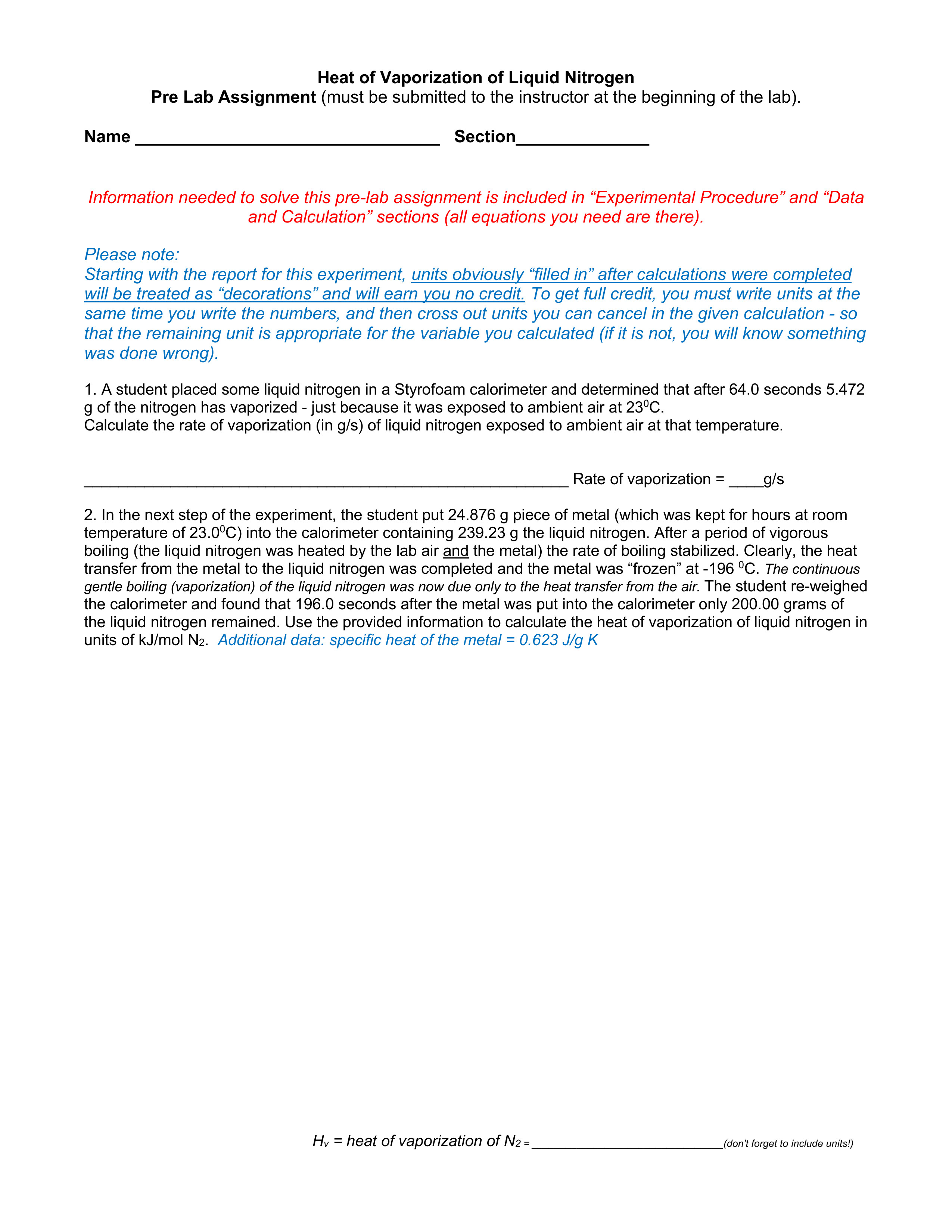
A student placed some liquid nitrogen in a Styrofoam calorimeter and determined that after seconds
of the nitrogen has vaporized just because it was exposed to ambient air at
Calculate the rate of vaporization in gs of liquid nitrogen exposed to ambient air at that temperature.
Rate of vaporization
In the next step of the experiment, the student put piece of metal which was kept for hours at room
temperature of into the calorimeter containing the liquid nitrogen. After a period of vigorous
boiling the liquid nitrogen was heated by the lab air and the metal the rate of boiling stabilized. Clearly, the heat
transfer from the metal to the liquid nitrogen was completed and the metal was "frozen" at The continuous
gentle boiling vaporization of the liquid nitrogen was now due only to the heat transfer from the air. The student reweighed
the calorimeter and found that seconds after the metal was put into the calorimeter only grams of
the liquid nitrogen remained. Use the provided information to calculate the heat of vaporization of liquid nitrogen in
units of Additional data: specific heat of the metal
Step by Step Solution
There are 3 Steps involved in it
1 Expert Approved Answer
Step: 1 Unlock

Question Has Been Solved by an Expert!
Get step-by-step solutions from verified subject matter experts
Step: 2 Unlock
Step: 3 Unlock
 Study Help