Question: Please note that the book in question is the Chapter 15 of the Doing Bayesian Data Analysis book. Context: MLR (Questions 3-10) The following questions
Please note that the book in question is the Chapter 15 of the Doing Bayesian Data Analysis book.
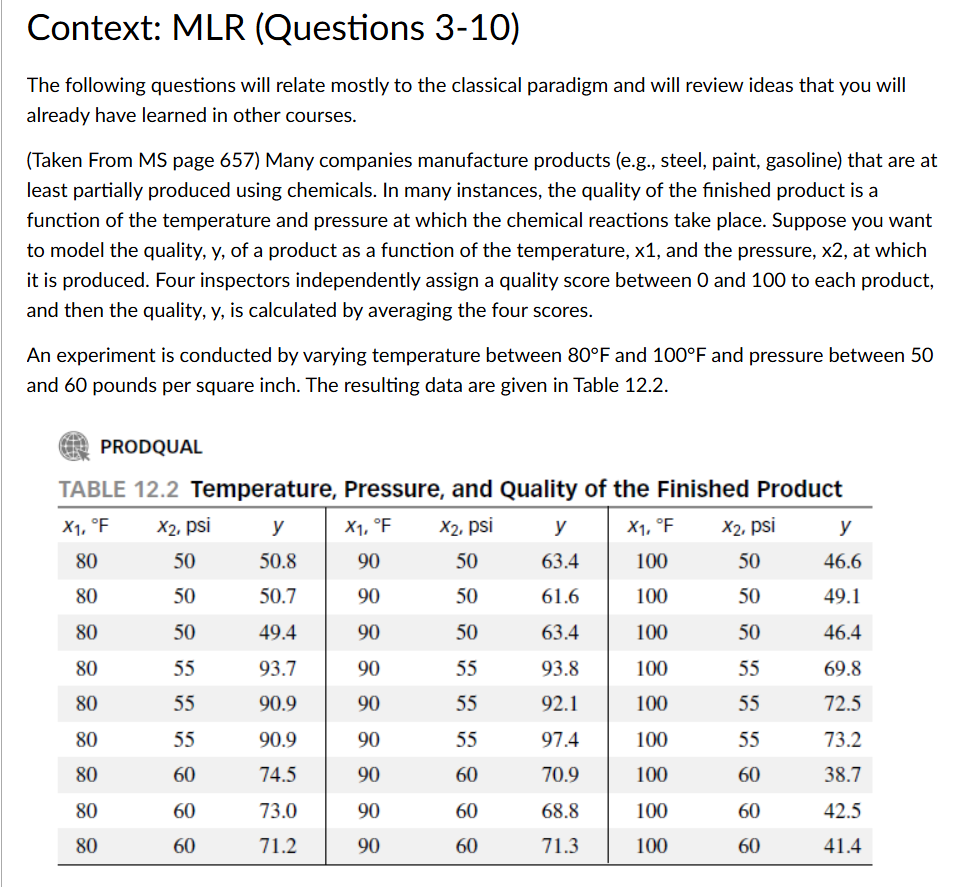
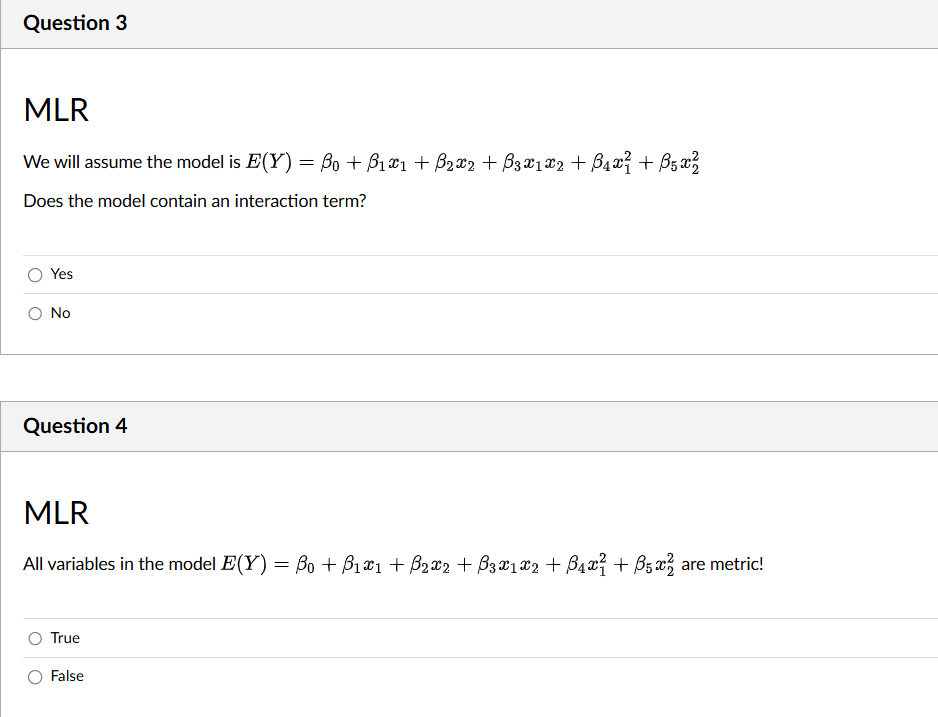
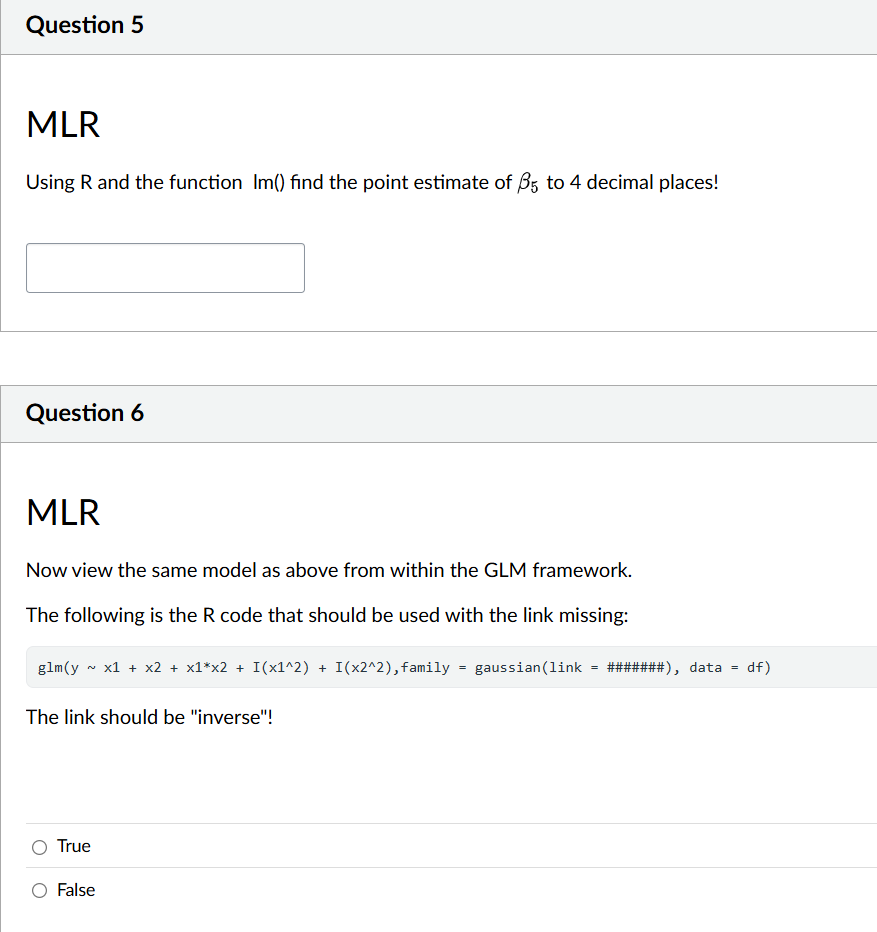
Context: MLR (Questions 3-10) The following questions will relate mostly to the classical paradigm and will review ideas that you will already have learned in other courses. (Taken From MS page 657) Many companies manufacture products (e.g., steel, paint, gasoline) that are at least partially produced using chemicals. In many instances, the quality of the finished product is a function of the temperature and pressure at which the chemical reactions take place. Suppose you want to model the quality, y, of a product as a function of the temperature, x1, and the pressure, x2, at which it is produced. Four inspectors independently assign a quality score between O and 100 to each product, and then the quality, y, is calculated by averaging the four scores. An experiment is conducted by varying temperature between 80F and 100F and pressure between 50 and 60 pounds per square inch. The resulting data are given in Table 12.2. GQ PRODQUAL TABLE 12.2 Temperature, Pressure, and Quality of the Finished Product x4, F X92, Psi y Xa, \"F X9, psi X9, psi y 80 50 50.8 90 50 46.6 80 50 50.7 90 50 49.1 80 50 49.4 90 50 46.4 80 55 93.7 90 55 69.8 80 55 90.9 90 : 55 mS 80 55 90.9 90 55 73.2 80 60 74.5 90 60 38.7 80 60 73.0 90 60 42.5 80 60 a2 90 60 41.4 Question 3 MLR We will assume the model is E(Y) = Bo + Bix1 + B2x2 + 832122 + Bax; + Box? Does the model contain an interaction term? Yes O No Question 4 MLR All variables in the model E(Y) = Bo + B121 + B2x2 + 832122 + BAx] + Box? are metric! O True O FalseQuestion 5 MLR Using R and the function Im() find the point estimate of 85 to 4 decimal places! Question 6 MLR Now view the same model as above from within the GLM framework. The following is the R code that should be used with the link missing: glm(y ~ x1 + x2 + x1*x2 + I(x1^2) + I(x2^2), family = gaussian(link = #######), data = df) The link should be "inverse"! O True O FalseQuestion 7 MLR Under the classical paradigm we can evaluate sub-models using the R function anova(). M1: E(Y) = Bo + B121 + 32x2 + B3x172 M2: E(Y) = Bo + B121 + 322 + B32122 + BAx] + 3523 Which model should we choose to keep? O M1 O M2 Question 8 MLR For model 2 use glm() and determine the point estimate for 83 to 4 decimal places and submit below M2: E(Y) = Bo + B121 + 32 2 + B3212 + Bax] + 85x3Question 9 MLR The book discusses how to establish the baseline when Nominal predictors are used. This is done in the case of one Nominal predictor by setting the baseline to the intercept Sp True False Question 10 MLR lfy = what is the threshold "x" value
Step by Step Solution
There are 3 Steps involved in it
1 Expert Approved Answer
Step: 1 Unlock
Question Has Been Solved by an Expert!
Get step-by-step solutions from verified subject matter experts
Step: 2 Unlock
Step: 3 Unlock
Students Have Also Explored These Related Mathematics Questions!











 Study Help