







Question: Please note that this is a single question as indicated by the question indicator on the top right. Glycogen phosphorylase catalyzes the removal of glucose
Please note that this is a single question as indicated by the question indicator on the top right.
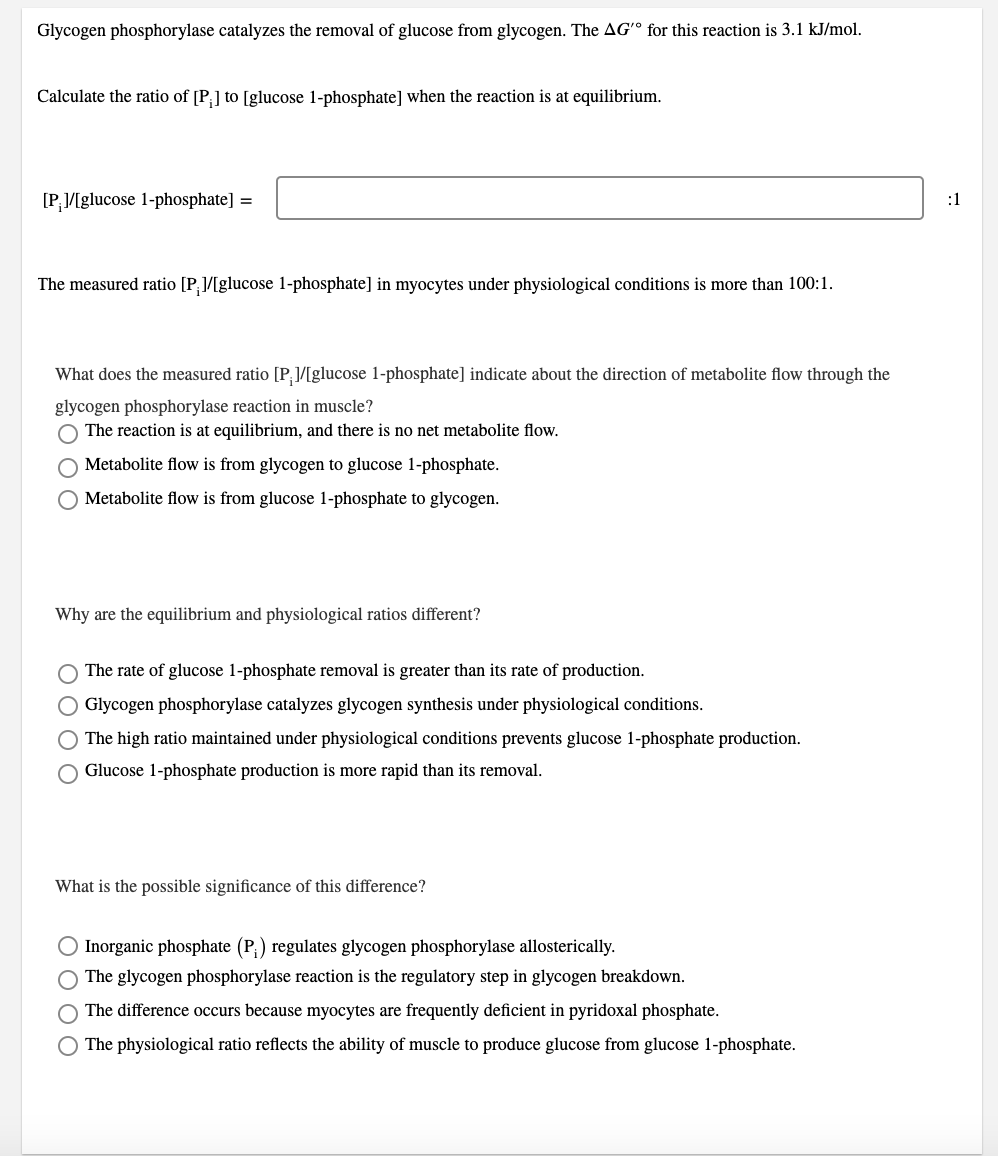
Glycogen phosphorylase catalyzes the removal of glucose from glycogen. The AG' for this reaction is 3.1 kJ/mol. Calculate the ratio of [P] to (glucose 1-phosphate] when the reaction is at equilibrium. [P:/[glucose 1-phosphate) = :1 The measured ratio [P]/[glucose 1-phosphate) in myocytes under physiological conditions is more than 100:1. What does the measured ratio [P]/[glucose 1-phosphate) indicate about the direction of metabolite flow through the glycogen phosphorylase reaction in muscle? The reaction is at equilibrium, and there is no net metabolite flow. Metabolite flow is from glycogen to glucose 1-phosphate. Metabolite flow is from glucose 1-phosphate to glycogen. Why are the equilibrium and physiological ratios different? The rate of glucose 1-phosphate removal is greater than its rate of production. O Glycogen phosphorylase catalyzes glycogen synthesis under physiological conditions. O The high ratio maintained under physiological conditions prevents glucose 1-phosphate production. Glucose 1-phosphate production is more rapid than its removal. What is the possible significance of this difference? Inorganic phosphate (P:) regulates glycogen phosphorylase allosterically. The glycogen phosphorylase reaction is the regulatory step in glycogen breakdown. The difference occurs because myocytes are frequently deficient in pyridoxal phosphate. The physiological ratio reflects the ability of muscle to produce glucose from glucose 1-phosphate
Step by Step Solution
There are 3 Steps involved in it

Get step-by-step solutions from verified subject matter experts
 Study Help