







Question: Please note this Question has a column for cycling as well (not the same answer as previous questions posted) A survey of travellers in the
Please note this Question has a column for cycling as well (not the same answer as previous questions posted)
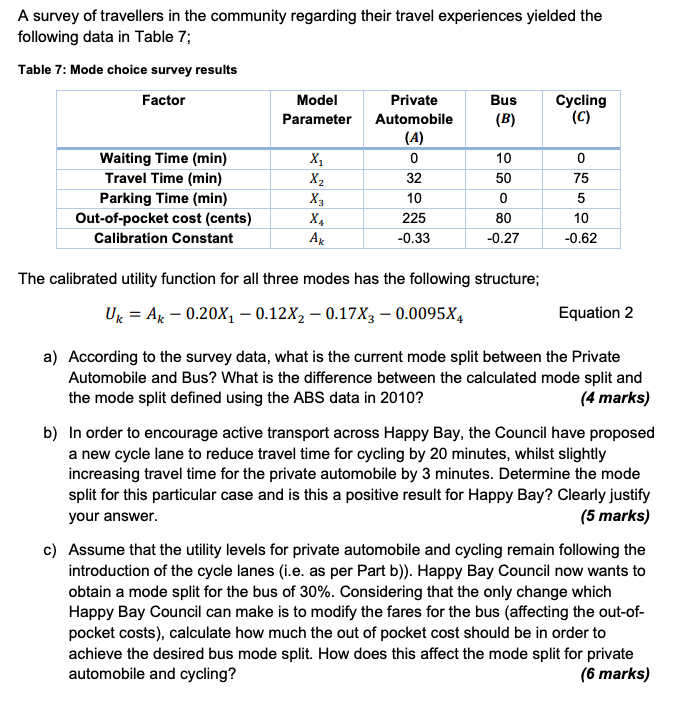
A survey of travellers in the community regarding their travel experiences yielded the following data in Table 7; Table 7: Mode choice survey results Factor Model Private Bus Cycling Parameter Automobile (B) (C) (A) Waiting Time (min) X 0 10 0 Travel Time (min) X2 32 50 75 Parking Time (min) X3 10 0 5 Out-of-pocket cost (cents) X 225 80 10 Calibration Constant AK -0.33 -0.27 -0.62 The calibrated utility function for all three modes has the following structure; UK = Ak 0.20%, 0.12X, 0.17X3 0.0095X4 Equation 2 a) According to the survey data, what is the current mode split between the Private Automobile and Bus? What is the difference between the calculated mode split and the mode split defined using the ABS data in 2010? (4 marks) b) In order to encourage active transport across Happy Bay, the Council have proposed a new cycle lane to reduce travel time for cycling by 20 minutes, whilst slightly increasing travel time for the private automobile by 3 minutes. Determine the mode split for this particular case and is this a positive result for Happy Bay? Clearly justify your answer. (5 marks) c) Assume that the utility levels for private automobile and cycling remain following the introduction of the cycle lanes (i.e. as per Part b)). Happy Bay Council now wants to obtain a mode split for the bus of 30%. Considering that the only change which Happy Bay Council can make is to modify the fares for the bus (affecting the out-of- pocket costs), calculate how much the out of pocket cost should be in order to achieve the desired bus mode split. How does this affect the mode split for private automobile and cycling? (6 marks) A survey of travellers in the community regarding their travel experiences yielded the following data in Table 7; Table 7: Mode choice survey results Factor Model Private Bus Cycling Parameter Automobile (B) (C) (A) Waiting Time (min) X 0 10 0 Travel Time (min) X2 32 50 75 Parking Time (min) X3 10 0 5 Out-of-pocket cost (cents) X 225 80 10 Calibration Constant AK -0.33 -0.27 -0.62 The calibrated utility function for all three modes has the following structure; UK = Ak 0.20%, 0.12X, 0.17X3 0.0095X4 Equation 2 a) According to the survey data, what is the current mode split between the Private Automobile and Bus? What is the difference between the calculated mode split and the mode split defined using the ABS data in 2010? (4 marks) b) In order to encourage active transport across Happy Bay, the Council have proposed a new cycle lane to reduce travel time for cycling by 20 minutes, whilst slightly increasing travel time for the private automobile by 3 minutes. Determine the mode split for this particular case and is this a positive result for Happy Bay? Clearly justify your answer. (5 marks) c) Assume that the utility levels for private automobile and cycling remain following the introduction of the cycle lanes (i.e. as per Part b)). Happy Bay Council now wants to obtain a mode split for the bus of 30%. Considering that the only change which Happy Bay Council can make is to modify the fares for the bus (affecting the out-of- pocket costs), calculate how much the out of pocket cost should be in order to achieve the desired bus mode split. How does this affect the mode split for private automobile and cycling? (6 marks)
Step by Step Solution
There are 3 Steps involved in it

Get step-by-step solutions from verified subject matter experts
 Study Help