







Question: Please note to solve this problem using a stack. (b.1) The Fibonacci sequence {fib}izi is defined recursively as follows: fib(1) = 1, fib(2) = 1
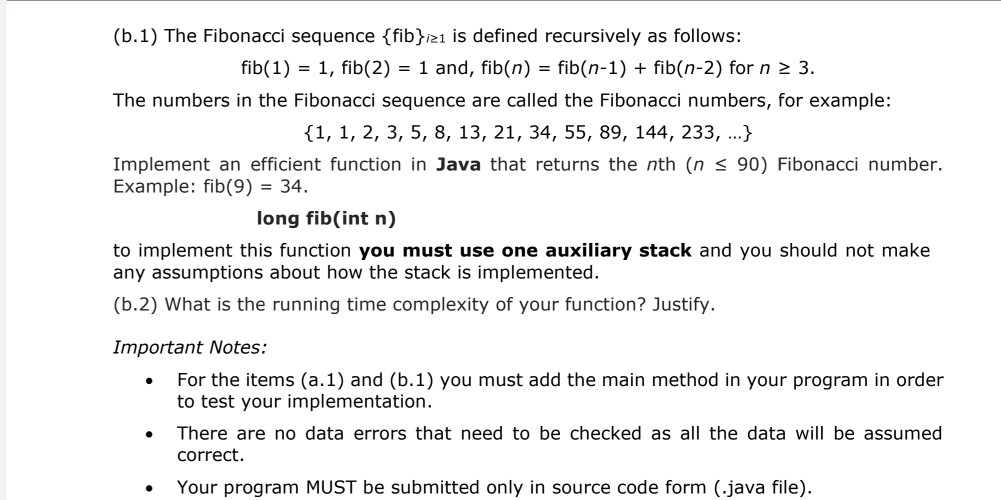
Please note to solve this problem using a stack.
(b.1) The Fibonacci sequence {fib}izi is defined recursively as follows: fib(1) = 1, fib(2) = 1 and, fib(n) = fib(n-1) + fib(n-2) for n > 3. The numbers in the Fibonacci sequence are called the Fibonacci numbers, for example: {1, 1, 2, 3, 5, 8, 13, 21, 34, 55, 89, 144, 233, ...} Implement an efficient function in Java that returns the nth (n = 90) Fibonacci number. Example: fib(9) = 34. long fib(int n) to implement this function you must use one auxiliary stack and you should not make any assumptions about how the stack is implemented. (5.2) What is the running time complexity of your function? Justify. Important Notes: For the items (a.1) and (b.1) you must add the main method in your program in order to test your implementation. There are no data errors that need to be checked as all the data will be assumed correct. Your program MUST be submitted only in source code form (.java file)
Step by Step Solution
There are 3 Steps involved in it

Get step-by-step solutions from verified subject matter experts
 Study Help