







Question: Please only answer 2b Exercise 4.1 (*ww - Likelihood principle and p-values (50%)). (Background) Suppose that, in a social media FaceLook, advertisements may pop up
Please only answer 2b
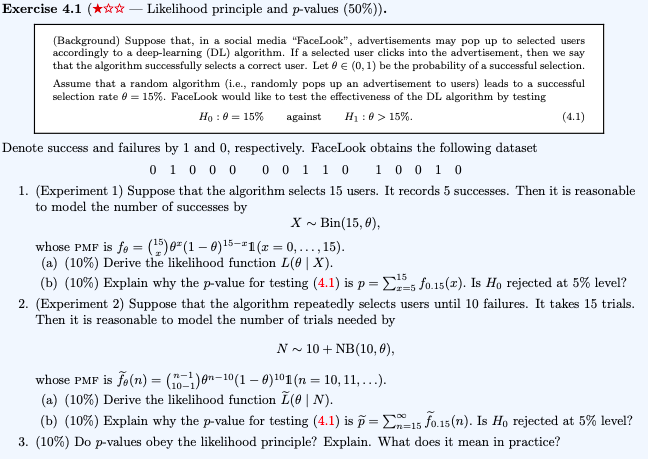
Exercise 4.1 (*ww - Likelihood principle and p-values (50%)). (Background) Suppose that, in a social media "FaceLook", advertisements may pop up to selected users accordingly to a deep-learning (DL) algorithm. If a selected user clicks into the advertisement, then we say that the algorithm successfully selects a correct user. Let o E (0, 1) be the probability of a successful selection. Assume that a random algorithm (i.e., randomly pops up an advertisement to users) leads to a successful selection rate o = 15%. FaceLook would like to test the effectiveness of the DL algorithm by testing Ho : 8 = 15% against H1 : 0 > 15%. (4.1) Denote success and failures by 1 and 0, respectively. FaceLook obtains the following dataset 0 10 0 0 001 10 10 010 1. (Experiment 1) Suppose that the algorithm selects 15 users. It records 5 successes. Then it is reasonable to model the number of successes by X ~ Bin (15, 0), Whose PMF is fo = (15)0= (1 -0)15-=1(x = 0, . . ., 15). (a) (10%) Derive the likelihood function L(0 | X"). (b) (10%) Explain why the p-value for testing (4.1) is p = Eres fois(x). Is Ho rejected at 5% level? 2. (Experiment 2) Suppose that the algorithm repeatedly selects users until 10 failures. It takes 15 trials. Then it is reasonable to model the number of trials needed by N ~ 10 + NB(10, #), whose PMF is fo(n) = (1 1)on-10(1 -0) 101(n = 10, 11, ...). (a) (10%) Derive the likelihood function L(# | N). (b) (10%) Explain why the p-value for testing (4.1) is p = En-is fos(n). Is Ho rejected at 5% level? 3. (10%) Do p-values obey the likelihood principle? Explain. What does it mean in practice
Step by Step Solution
There are 3 Steps involved in it

Get step-by-step solutions from verified subject matter experts
 Study Help