Please only answer Question #1 and The first part of question #3. Please separate answers for better understanding.
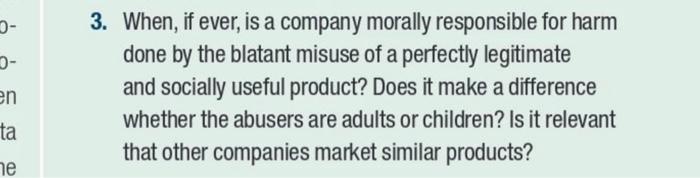
FARVEY BENJAMIN FULLER FOUNDED THE H. B. Fuller Company in 1887. Originally a one-man wallpaper- paste shop, H. B. Fuller is now a leading manufacturer of industrial glues, coatings, and paints, with operations world- wide. The company's 10,000 varieties of glue hold together everything from cars to cigarettes to disposable diapers. However, some of its customers don't use Fuller's glues in the way they are intended to be used. That's particularly the case in Central America, where Fuller derives 27 percent of its profits and where tens of thou- sands of homeless children sniff some sort of glue. Addicted to glue's intoxicating but dangerous fumes, these unfortunate children are called resistoleros after Fuller's Resistol brand. Child-welfare advocates have urged the company to add a noxious oil to its glue to discourage abusers, but the company has resisted, either because it might reduce the glue's effec- tiveness or because it will irritate legitimate users. 111 Either way, the issue is irritating H. B. Fuller, which has been recognized by various awards, honors, and socially con- scious mutual funds as a company with a conscience. Fuller's mission statement says that it will conduct business legally and ethically, support the activities of its employees in their communities and be a responsible corporate citizen." The St. Paul-based company gives 5 percent of its profits to charity; it has committed itself to safe environmental prac- tices worldwide (practices that are often more stringent than local government standards," the company says); and it has even endowed a chair in business ethics at the University of Minnesota. Now Fuller must contend with dissident stockhold- ers inside, and demonstrators outside, its annual meetings. ers inside, and demonstrators outside, its annual meetings. The glue-sniffing issue is not a new one. In 1969, the Testor Corporation added a noxious ingredient to its hobby Tour giue to discourage abuse, and in 1994 Henkel, a German chemical company that competes with Fuller, stopped mak- ing certain toxic glues in Central America. However, Fuller seems to have been singled out for criticism not only because its brand dominates Central America but also because in the eyes of its critics, anywaythe company has not lived up to its own good citizen image. Timothy Smith, executive director of the Interfaith Center for Corporate Responsibility, believes that companies with a reputation as good corporate citizens are more vulnerable to attack. "But as I see it," he says, "the hazard is not in acting in a socially responsible way. The hazard is in over-marketing yourself as a saint." Saintly or not, the company has made matters worse for itself by its handling of the issue. H. B. Fuller's board of directors acknowledged that illegal distribution was con- tinuing" and that "a suitable replacement product would not be available in the near future." Accordingly, it voted to stop selling Resistol adhesives in Central America. "We simply don't believe it is the right decision to keep our sol- vent product on the market," a company spokesman said. The Coalition on Resistoleros and other corporate gadflies were ecstatic, but their jubilation turned to anger when they learned a few months later that Fuller had not in fact stopped sell- ing Resistol in Central America and did not intend to. True, Fuller no longer sold glue to retailers and small-scale users in Honduras and Guatemala, but it continued to sell large tubs and barrels of it to industrial customers in those countries and to a broader list of commercial and industrial users in neighboring countries. The company says that it has not only restricted dis- The company says that it has not only restricted dis- tribution but also taken other steps to stop the abuse of its product. It has altered Resistol's formula, replacing the sweet-smelling but highly toxic solvent toluene with the slightly less toxic chemical cyclohexane. In addition, the company has triedwithout success, it saysto develop a nonintoxicating water-based glue, and it contributes to com- munity programs for homeless children in Central America. But the company's critics disparage these actions as mere image polishing. Bruce Harris, director of Latin American pro- grams for Covenant House, a nonprofit child-welfare advo- cate, asserts that Resistol is still readily available to children in Nicaragua and El Salvador and, to a lesser extent, in Costa Rica. "If they are genuinely concerned about the children," he asks, "why haven't they pulled out of all the countriesas their board mandated?" DISCUSSION QUESTIONS 1. What are H. B. Fuller's moral obligations in this case? What ideals, effects, and consequences are at stake? Have any moral rights been violated? What would a utilitarian recommend? A Kantian? D- en ta 3. When, if ever, is a company morally responsible for harm done by the blatant misuse of a perfectly legitimate and socially useful product? Does it make a difference whether the abusers are adults or children? Is it relevant that other companies market similar products? he