







Question: PLEASE ONLY ANSWER QUESTION 2!!!! Already solved one, thanks Computer graphics programmers face the same challenge as the great painters of the past: how to
PLEASE ONLY ANSWER QUESTION 2!!!! Already solved one, thanks
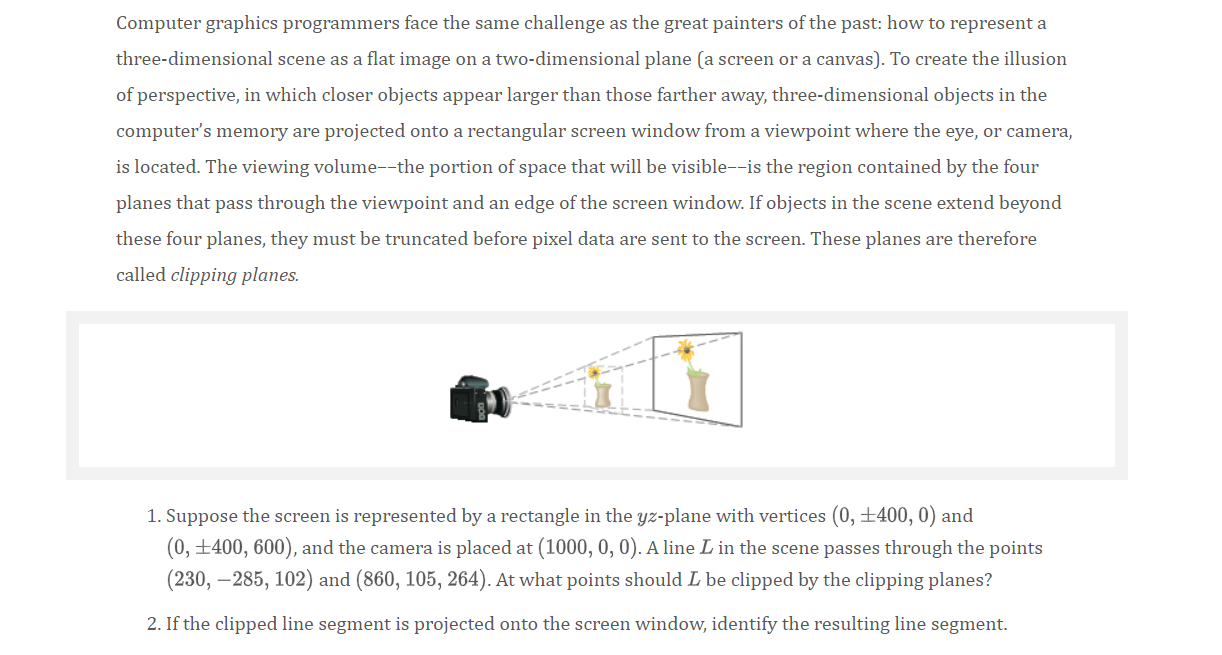
Computer graphics programmers face the same challenge as the great painters of the past: how to represent a three-dimensional scene as a flat image on a two-dimensional plane (a screen or a canvas). To create the illusion of perspective, in which closer objects appear larger than those farther away, three-dimensional objects in the computer's memory are projected onto a rectangular screen window from a viewpoint where the eye, or camera, is located. The viewing volume--the portion of space that will be visible--is the region contained by the four planes that pass through the viewpoint and an edge of the screen window. If objects in the scene extend beyond these four planes, they must be truncated before pixel data are sent to the screen. These planes are therefore called clipping planes. 1. Suppose the screen is represented by a rectangle in the yz-plane with vertices (0, 400,0) and (0, 400, 600), and the camera is placed at 1000,0,0). A line L in the scene passes through the points (230, -285, 102) and (860, 105, 264). At what points should I be clipped by the clipping planes? 2. If the clipped line segment is projected onto the screen window, identify the resulting line segment. Computer graphics programmers face the same challenge as the great painters of the past: how to represent a three-dimensional scene as a flat image on a two-dimensional plane (a screen or a canvas). To create the illusion of perspective, in which closer objects appear larger than those farther away, three-dimensional objects in the computer's memory are projected onto a rectangular screen window from a viewpoint where the eye, or camera, is located. The viewing volume--the portion of space that will be visible--is the region contained by the four planes that pass through the viewpoint and an edge of the screen window. If objects in the scene extend beyond these four planes, they must be truncated before pixel data are sent to the screen. These planes are therefore called clipping planes. 1. Suppose the screen is represented by a rectangle in the yz-plane with vertices (0, 400,0) and (0, 400, 600), and the camera is placed at 1000,0,0). A line L in the scene passes through the points (230, -285, 102) and (860, 105, 264). At what points should I be clipped by the clipping planes? 2. If the clipped line segment is projected onto the screen window, identify the resulting line segment
Step by Step Solution
There are 3 Steps involved in it

Get step-by-step solutions from verified subject matter experts
 Study Help