







Question: *****PLEASE ONLY ANSWER QUESTION 7 - ARTICLE BELOW***** Questions 1 through 7 are related. 1. Refer to the attached article titled Steelmakers Gird for a
*****PLEASE ONLY ANSWER QUESTION 7 - ARTICLE BELOW*****
Questions 1 through 7 are related.
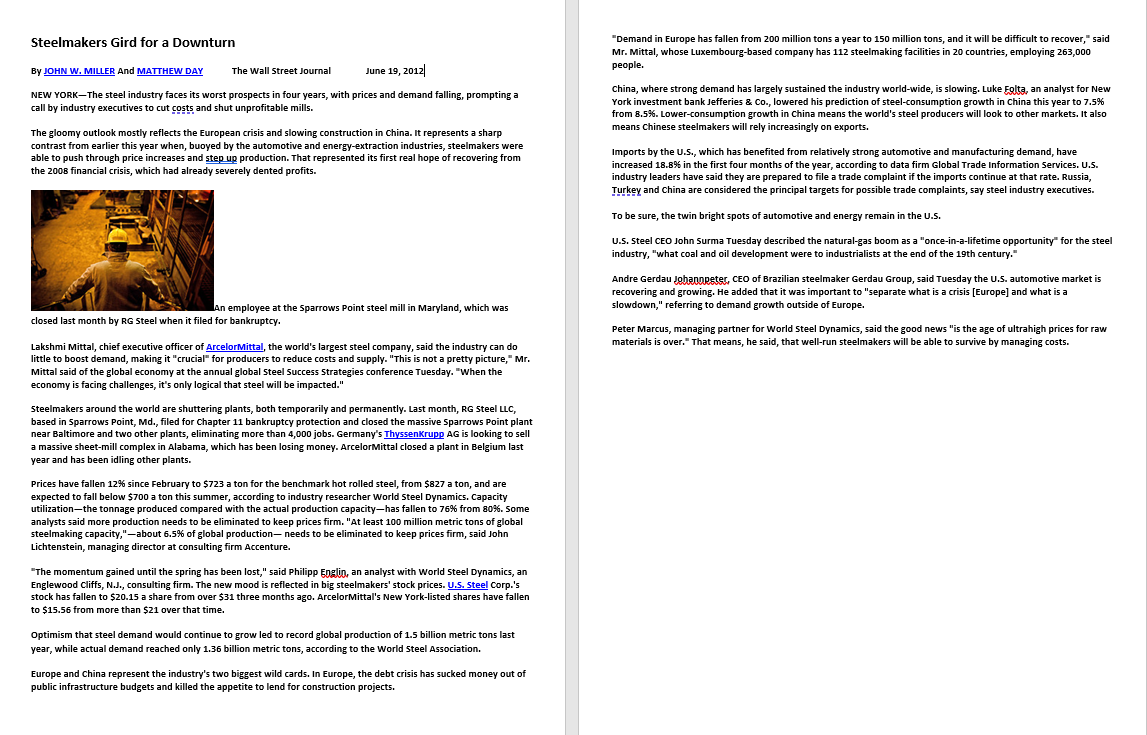
1. Refer to the attached article titled Steelmakers Gird for a Downturn. The photograph shows a steel mill at Sparrows Point, Maryland which was closed last month by RG Steel when it filed for bankruptcy. As a result of the bankruptcy filing, the steel mill:
a. has exited the industry.
b. has shutdown but not exited the industry.
c. has increased the demand for steel.
d. should re-open if the price of steel decreases.
e. none of the above answers is correct.
2. The article also informs us that prices have fallen approximately 12% since February to $723 a ton for the benchmark hot rolled steel, from $827 a ton. It also provides the following information: Capacity utilizationthe tonnage produced compared with the actual production capacityhas fallen to 76% from 80%. Changes to capacity utilization represent changes in production or output. If the changes to the steel industry are attributable to changes in demand, what is the arc Price Elasticity of Supply over the range of the supply curve for the information given using the midpoint method? [Think carefully about the percentage change in quantity.]
a. 0.33.
b. 0.38.
c. 0.57.
d. 2.40.
e. 3.00.
3. One analyst believes "at least 100 million metric tons of global steelmaking capacity,about 6.5% of global production needs to be eliminated to keep prices firm. If 100 million tons equals 6.5% of current output and current output is 76% of capacity utilization, what is the estimated capacity output for the steel industry?
a. 1,169 million tons
b. 1,538 million tons
c. 1,893 million tons
d. 2,024 million tons
e. 2,165 million tons
4. The capacity output calculated in the previous question would be the capacity output:
a. in the short term
b. in the long term
c. in both the short and long term
d. in neither the short nor long term
e. none of the above answers is correct
5. Given the information in the previous questions and your answer to question 2, the estimated current production or output of the steel industry would be:
a. 1,645 million tons
b. 1,538 million tons
c. 1,437 million tons
d. 1,169 million tons
e. 888 million tons
6. If 100 million metric tons of global steelmaking capacity is eliminated then:
a. the demand curve for steel will shift down or to the left.
b. the demand curve for steel will shift up or to the right.
c. the supply curve will shift down or to the right.
d. the supply curve will shift up or to the left.
e. both answers a and d are correct.
7. The article notes that current production has fallen to 76% of capacity from 80% of capacity in February while, prices have fallen 12% since February to $723 a ton for the benchmark hot rolled steel, from $827 a ton. With the information provided in the article and the calculations from previous questions and knowing the changes in the industry were triggered by a shift in demand, an estimate of a single factor linear supply function for the steel industry would be:
a. QS = 975 + .78 P.
b. QS = 613 + 1.28 P.
c. QS = 1,200 + .78 P.
d. QS = 1,969 + 1.28 P.
e. QS = 829 + .98 P.
Steelmakers Gird for a Downturn "Demand in Europe has fallen from 200 million tons a year to 150 million tons, and it will be difficult to recover," said Mr. Mittal, whose Luxembourg-based company has 112 steelmaking facilities in 20 countries, employing 263,000 people. By JOHN W. MILLER And MATTHEW DAY The Wall Street Journal June 19, 2012 NEW YORK-The steel industry faces its worst prospects in four years, with prices and demand falling, prompting a call by industry executives to cut costs and shut unprofitable mills. The gloomy outlook mostly reflects the European crisis and slowing construction in China. It represents a sharp contrast from earlier this year when, buoyed by the automotive and energy-extraction industries, steelmakers were able to push through price increases and step up production. That represented its first real hope of recovering from the 2008 financial crisis, which had already severely dented profits. China, where strong demand has largely sustained the industry world-wide, is slowing. Luke Eolta, an analyst for New York investment bank Jefferies & Co., lowered his prediction of steel-consumption growth in China this year to 7.5% from 8.5%. Lower consumption growth in China means the world's steel producers will look to other markets. It also means Chinese steelmakers will rely increasingly on exports. Imports by the U.S., which has benefited from relatively strong automotive and manufacturing demand, have increased 18.8% in the first four months of the year, according to data firm Global Trade Information Services. U.S. industry leaders have said they are prepared to file a trade complaint if the imports continue at that rate. Russia, Turkey and China are considered the principal targets for possible trade complaints, say steel industry executives. To be sure, the twin bright spots of automotive and energy remain in the U.S. U.S. Steel CEO John Surma Tuesday described the natural-gas boom as a "once-in-a-lifetime opportunity for the steel industry, "what coal and oil development were to industrialists at the end of the 19th century." Andre Gerdau Johaporetec, CEO of Brazilian steelmaker Gerdau Group, said Tuesday the U.S. automotive market is recovering and growing. He added that it was important to "separate what is a crisis (Europe) and what is a slowdown," referring to demand growth outside of Europe. An employee at the Sparrows Point steel mill in Maryland, which was closed last month by RG Steel when it filed for bankruptcy. Peter Marcus, managing partner for World Steel Dynamics, said the good news "is the age of ultrahigh prices for raw materials is over." That means, he said, that well-run steelmakers will be able to survive by managing costs. Lakshmi Mittal, chief executive officer of ArcelorMittal, the world's largest steel company, said the industry can do little to boost demand, making it "crucial" for producers to reduce costs and supply. "This is not a pretty picture," Mr. Mittal said of the global economy at the annual global Steel Success Strategies conference Tuesday. "When the economy is facing challenges, it's only logical that steel will be impacted." Steelmakers around the world are shuttering plants, both temporarily and permanently. Last month, RG Steel LLC, based in Sparrows Point, Md., filed for Chapter 11 bankruptcy protection and closed the massive Sparrows Point plant near Baltimore and two other plants, eliminating more than 4,000 jobs. Germany's Thyssenkrupp AG is looking to sell a massive sheet-mill complex in Alabama, which has been losing money. ArcelorMittal closed a plant in Belgium last year and has been idling other plants. Prices have fallen 12% since February to $723 a ton for the benchmark hot rolled steel, from $827 a ton, and are expected to fall below $700 a ton this summer, according to industry researcher World Steel Dynamics. Capacity utilization-the tonnage produced compared with the actual production capacity-has fallen to 76% from 80%. Some analysts said more production needs to be eliminated to keep prices firm. "At least 100 million metric tons of global steelmaking capacity,"-about 6.5% of global production, needs to be eliminated to keep prices firm, said John Lichtenstein, managing director at consulting firm Accenture. "The momentum gained until the spring has been lost," said Philipp Englin, an analyst with World Steel Dynamics, an Englewood Cliffs, N.J., consulting firm. The new mood is reflected in big steelmakers' stock prices. U.S. Steel Corp.'s stock has fallen to $20.15 a share from over $31 three months ago. ArcelorMittal's New York-listed shares have fallen to $15.56 from more than $21 over that time. Optimism that steel demand would continue to grow led to record global production of 1.5 billion metric tons last year, while actual demand reached only 1.36 billion metric tons, according to the World Steel Association. Europe and China represent the industry's two biggest wild cards. In Europe, the debt crisis has sucked money out of public infrastructure budgets and killed the appetite to lend for construction projects. Steelmakers Gird for a Downturn "Demand in Europe has fallen from 200 million tons a year to 150 million tons, and it will be difficult to recover," said Mr. Mittal, whose Luxembourg-based company has 112 steelmaking facilities in 20 countries, employing 263,000 people. By JOHN W. MILLER And MATTHEW DAY The Wall Street Journal June 19, 2012 NEW YORK-The steel industry faces its worst prospects in four years, with prices and demand falling, prompting a call by industry executives to cut costs and shut unprofitable mills. The gloomy outlook mostly reflects the European crisis and slowing construction in China. It represents a sharp contrast from earlier this year when, buoyed by the automotive and energy-extraction industries, steelmakers were able to push through price increases and step up production. That represented its first real hope of recovering from the 2008 financial crisis, which had already severely dented profits. China, where strong demand has largely sustained the industry world-wide, is slowing. Luke Eolta, an analyst for New York investment bank Jefferies & Co., lowered his prediction of steel-consumption growth in China this year to 7.5% from 8.5%. Lower consumption growth in China means the world's steel producers will look to other markets. It also means Chinese steelmakers will rely increasingly on exports. Imports by the U.S., which has benefited from relatively strong automotive and manufacturing demand, have increased 18.8% in the first four months of the year, according to data firm Global Trade Information Services. U.S. industry leaders have said they are prepared to file a trade complaint if the imports continue at that rate. Russia, Turkey and China are considered the principal targets for possible trade complaints, say steel industry executives. To be sure, the twin bright spots of automotive and energy remain in the U.S. U.S. Steel CEO John Surma Tuesday described the natural-gas boom as a "once-in-a-lifetime opportunity for the steel industry, "what coal and oil development were to industrialists at the end of the 19th century." Andre Gerdau Johaporetec, CEO of Brazilian steelmaker Gerdau Group, said Tuesday the U.S. automotive market is recovering and growing. He added that it was important to "separate what is a crisis (Europe) and what is a slowdown," referring to demand growth outside of Europe. An employee at the Sparrows Point steel mill in Maryland, which was closed last month by RG Steel when it filed for bankruptcy. Peter Marcus, managing partner for World Steel Dynamics, said the good news "is the age of ultrahigh prices for raw materials is over." That means, he said, that well-run steelmakers will be able to survive by managing costs. Lakshmi Mittal, chief executive officer of ArcelorMittal, the world's largest steel company, said the industry can do little to boost demand, making it "crucial" for producers to reduce costs and supply. "This is not a pretty picture," Mr. Mittal said of the global economy at the annual global Steel Success Strategies conference Tuesday. "When the economy is facing challenges, it's only logical that steel will be impacted." Steelmakers around the world are shuttering plants, both temporarily and permanently. Last month, RG Steel LLC, based in Sparrows Point, Md., filed for Chapter 11 bankruptcy protection and closed the massive Sparrows Point plant near Baltimore and two other plants, eliminating more than 4,000 jobs. Germany's Thyssenkrupp AG is looking to sell a massive sheet-mill complex in Alabama, which has been losing money. ArcelorMittal closed a plant in Belgium last year and has been idling other plants. Prices have fallen 12% since February to $723 a ton for the benchmark hot rolled steel, from $827 a ton, and are expected to fall below $700 a ton this summer, according to industry researcher World Steel Dynamics. Capacity utilization-the tonnage produced compared with the actual production capacity-has fallen to 76% from 80%. Some analysts said more production needs to be eliminated to keep prices firm. "At least 100 million metric tons of global steelmaking capacity,"-about 6.5% of global production, needs to be eliminated to keep prices firm, said John Lichtenstein, managing director at consulting firm Accenture. "The momentum gained until the spring has been lost," said Philipp Englin, an analyst with World Steel Dynamics, an Englewood Cliffs, N.J., consulting firm. The new mood is reflected in big steelmakers' stock prices. U.S. Steel Corp.'s stock has fallen to $20.15 a share from over $31 three months ago. ArcelorMittal's New York-listed shares have fallen to $15.56 from more than $21 over that time. Optimism that steel demand would continue to grow led to record global production of 1.5 billion metric tons last year, while actual demand reached only 1.36 billion metric tons, according to the World Steel Association. Europe and China represent the industry's two biggest wild cards. In Europe, the debt crisis has sucked money out of public infrastructure budgets and killed the appetite to lend for construction projects
Step by Step Solution
There are 3 Steps involved in it

Get step-by-step solutions from verified subject matter experts
 Study Help