







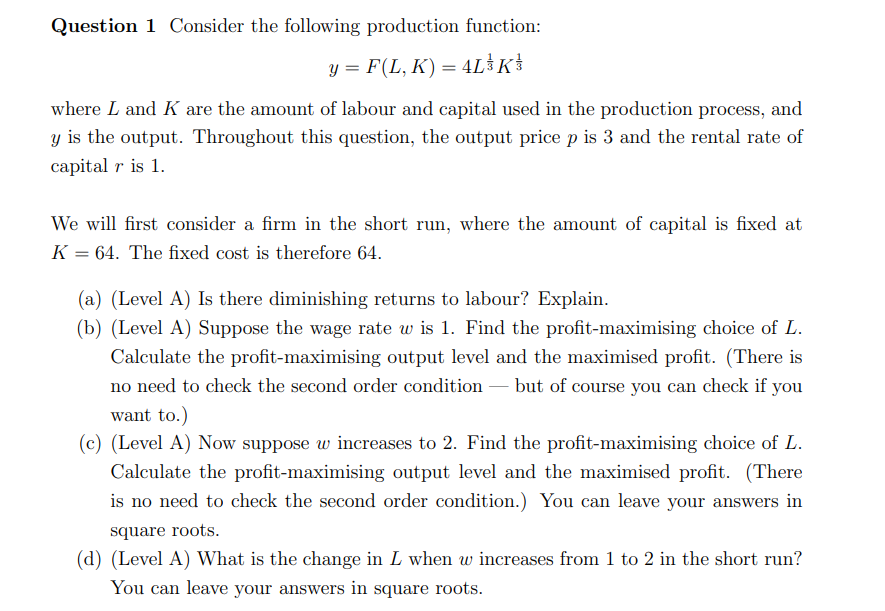
Question: Please only answer questions e , f , g and h. Thanks Question 1 Consider the following production function: y = max) = 4L%K% where
Please only answer questions e , f , g and h. Thanks
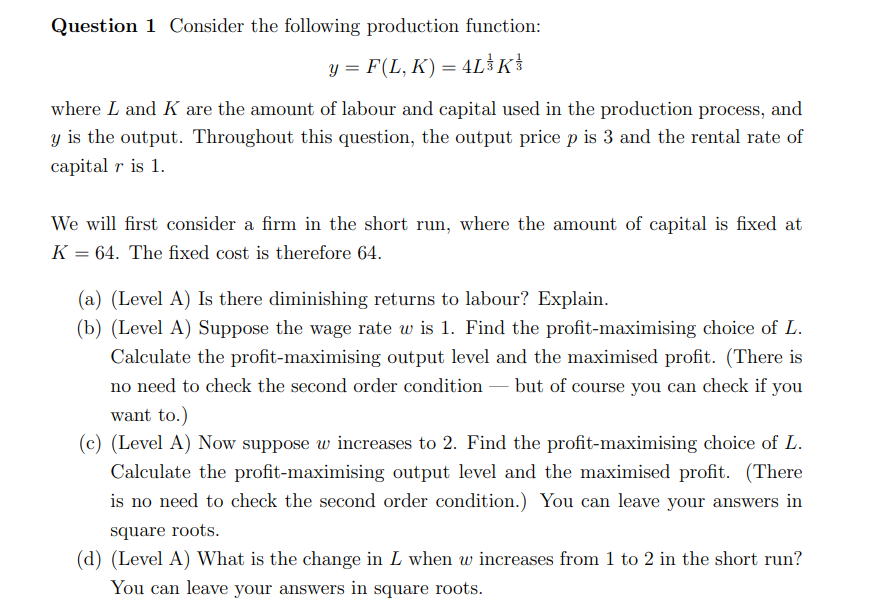
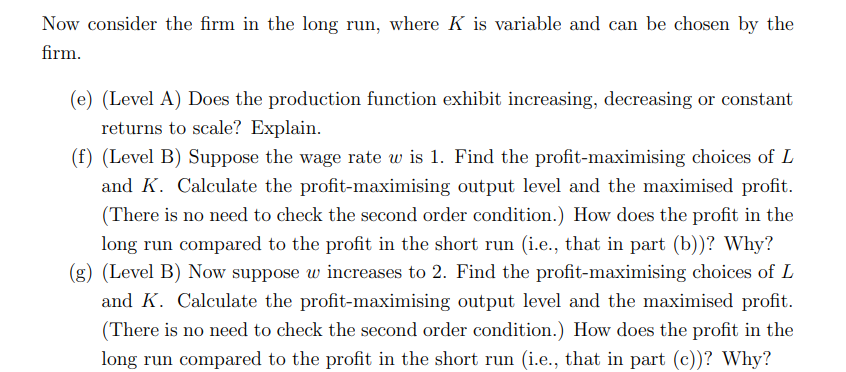
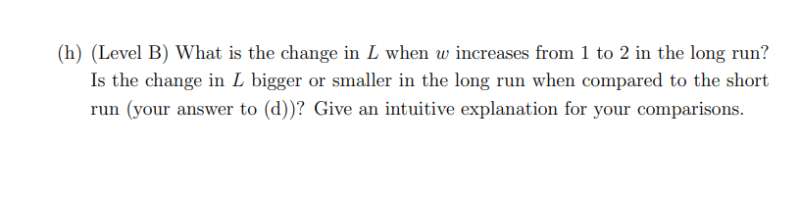
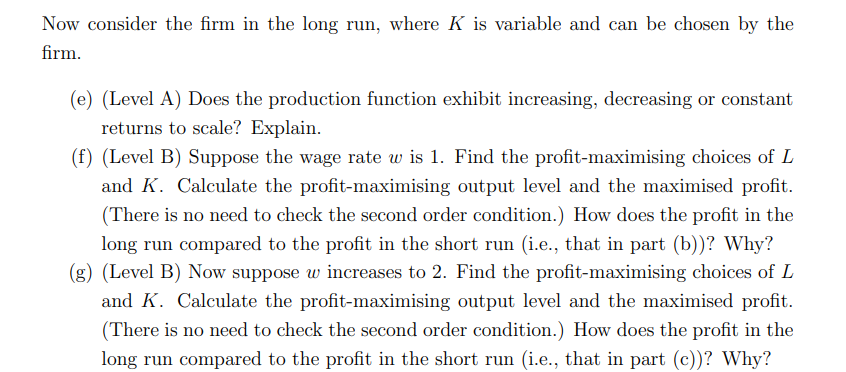
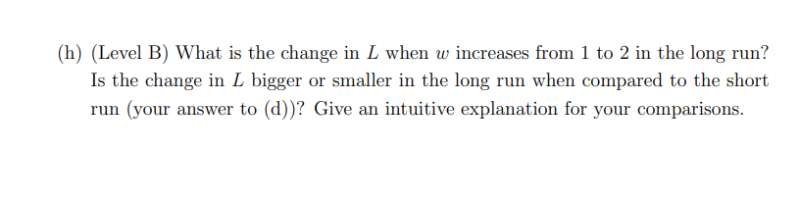
Question 1 Consider the following production function: y = max) = 4L%K% where L and K are the amount of labour and capital used in the production processI and y is the output. Throughout this question, the output price p is 3 and the rental rate of capital 1" is 1. We will rst consider a rm in the short run, where the amount of capital is xed at K = 64. The xed cost is therefore 64. (a) (Level A) Is there diminishing returns to labour? Explain. (b) (Level A) Suppose the wage rate in is 1. Find the prot-maximising choice of L. Calculate the prot-maximising output level and the maximised prot. (There is no need to check the second order condition but of course you can check if you want to.) (c) (Level A) Now suppose to increases to 2. Find the prot-maximising choice of L. Calculate the prot-maximising output level and the maximised prot. (There is no need to check the second order condition.) You can leave your answers in square roots. (d) (Level A) 1What is the change in L when to increases from 1 to 2 in the short run? You can leave your answers in square roots. Now consider the firm in the long run, where K is variable and can be chosen by the rm. (e) (Level A) Does the production function exhibit increasing, decreasing or constant returns to scale? Explain. (f) (Level B) Suppose the wage rate a: is 1. Find the prot-maximising choices of L and K. Calculate the prot-maximising output level and the maximised prot. (There is no need to check the second order condition.) How does the prot in the long run compared to the prot in the short run (i.e., that in part (13))? Why? (g) (Level B) Now suppose 11: increases to 2. Find the prot-maximising choices of L and K. Calculate the prot-maximising output level and the Inaxirnised prot. (There is no need to check the second order condition.) How does the prot in the long run compared to the prot in the short run (i.e., that in part ({3})? 1llifhjy\"? {11) (level B} 'What is the change in L when 11.! increases from 1 to 2 in the long run? Is the change in L bigger or smaller in the long run when compared to the short run (your answer to ((1))? Give an intuitive explanation for your comparisons
Step by Step Solution
There are 3 Steps involved in it

Get step-by-step solutions from verified subject matter experts
 Study Help