







Question: Please only answers 3 . Further exploration: a, Construct 100 confidence intervals with p = 0.3, level of confidence = 0.95, and sample size =
Please only answers
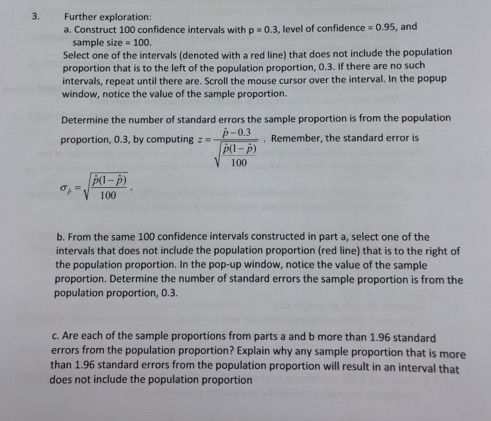
3 . Further exploration: a, Construct 100 confidence intervals with p = 0.3, level of confidence = 0.95, and sample size = 100. Select one of the intervals (denoted with a red line) that does not include the population proportion that is to the left of the population proportion, 0.3. If there are no such intervals, repeat until there are. Scroll the mouse cursor over the interval. In the popup window, notice the value of the sample proportion. Determine the number of standard errors the sample proportion is from the population proportion, 0.3, by computing = = p-0.3 Remember, the standard error is p(- P) 100 p(1- p) 100 b. From the same 100 confidence intervals constructed in part a, select one of the intervals that does not include the population proportion (red line) that is to the right of the population proportion. In the pop-up window, notice the value of the sample proportion. Determine the number of standard errors the sample proportion is from the population proportion, 0.3. c. Are each of the sample proportions from parts a and b more than 1.96 standard errors from the population proportion? Explain why any sample proportion that is more than 1.96 standard errors from the population proportion will result in an interval that does not include the population proportion
Step by Step Solution
There are 3 Steps involved in it

Get step-by-step solutions from verified subject matter experts
 Study Help