







Question: PLEASE ONLY EXPLAIN THE PART I CIRCLED. how do we get those 9 numbers? i dont understand, but i have the answer key Klein Campery
PLEASE ONLY EXPLAIN THE PART I CIRCLED. how do we get those 9 numbers? i dont understand, but i have the answer key
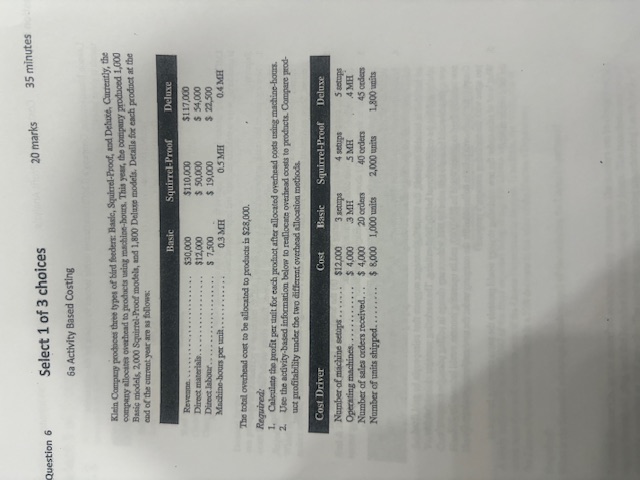
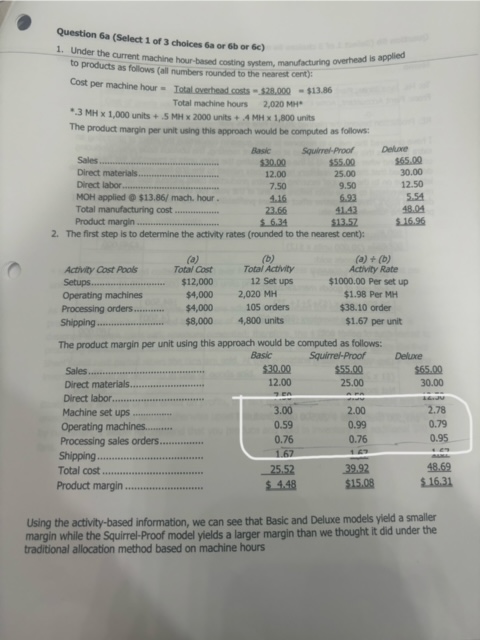
Klein Campery prodoces three types of bird foeders: Baslc, Squirrel-Proof, asd Delivee, Currently, the Basic models, 2,000 Squirrel-Proof models, and 1,800- Deluxp models. Detalls for each product at the end of the cirrent year are ss follows: The total ovathead cost to be allocated to products is $28,000. Reguired: 1. Caleulite the profit per unit for each proflact affer allocaled overhead costs using machine-hours. 2. Use the activity-based information belor to reallocute overhead costs to poodacts. Compare product profitability under the two different overhead allocation methods. Question 6a (Select 1 of 3 choices 6a or 6b or 6c ) 1. Under the current machine hour-based costing system, manufacturing overhead is applied to products as follows (all numbers rounded to the nearest cent): Cost per machine hour = Iotal overhead costs =$28,000=$13.86 Total machine hours 2,020MH 3 MH 1,000 units +.5 MH 2000 units +.4 MH 1,800 units The product margh per unit using this approach would be computed as follows: 2. The first step is to determine the activity rates (rounded to the nearest cent): The product margin per unit using this approach would be computed as follows: Using the activity-based information, we can see that Basic and Deluxe models yleld a smaller margin while the Squirrel-Proof model yields a larger margin than we thought it did under the traditional allocation method based on machine hours
Step by Step Solution
There are 3 Steps involved in it

Get step-by-step solutions from verified subject matter experts
 Study Help