







Question: Please ONLY solve d. Please provide a correct and neat answer. Upvote! 2) The process water is recycled from the tailing area following the settling
Please ONLY solve d. Please provide a correct and neat answer. Upvote!
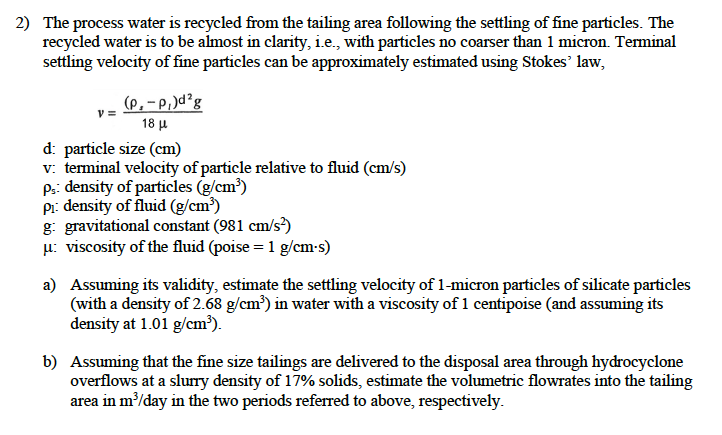
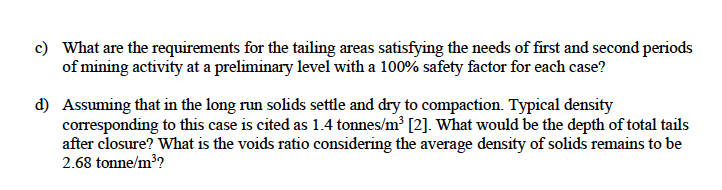
2) The process water is recycled from the tailing area following the settling of fine particles. The recycled water is to be almost in clarity, i.e., with particles no coarser than 1 micron. Terminal settling velocity of fine particles can be approximately estimated using Stokes law, (2,- p.)dg V = 18 u di particle size (cm) v: terminal velocity of particle relative to fluid (cm/s) Ps: density of particles (g/cm) pi: density of fluid (g/cm) g gravitational constant (981 cm/s2) u: viscosity of the fluid (poise = 1 g/cm-s) a) Assuming its validity, estimate the settling velocity of 1-micron particles of silicate particles (with a density of 2.68 g/cm) in water with a viscosity of 1 centipoise (and assuming its density at 1.01 g/cm). b) Assuming that the fine size tailings are delivered to the disposal area through hydrocyclone overflows at a slurry density of 17% solids, estimate the volumetric flowrates into the tailing area in m/day in the two periods referred to above, respectively. c) What are the requirements for the tailing areas satisfying the needs of first and second periods of mining activity at a preliminary level with a 100% safety factor for each case? d) Assuming that in the long run solids settle and dry to compaction. Typical density corresponding to this case is cited as 1.4 tonnes/m? [2]. What would be the depth of total tails after closure? What is the voids ratio considering the average density of solids remains to be 2.68 tonne/m
Step by Step Solution
There are 3 Steps involved in it

Get step-by-step solutions from verified subject matter experts
 Study Help