







Question: PLEASE PART D ONLY :) 2. Assume that x is the outcome of a random variable, X, y is the outcome of a random variable,
PLEASE PART D ONLY :)
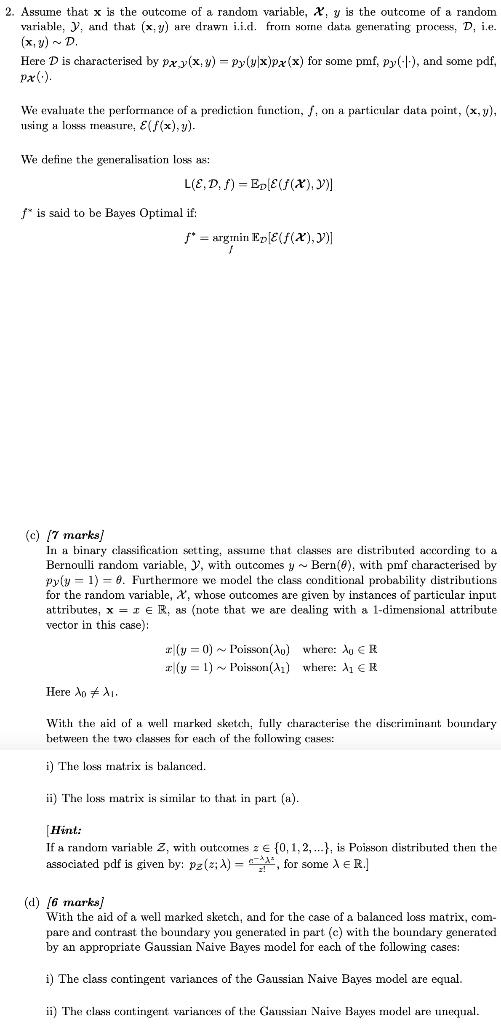
2. Assume that x is the outcome of a random variable, X, y is the outcome of a random variable, y, and that (x,y) are drawn i.i.d. from some data generating process, D, i.e. (x,y) - Here D is characterised by Pxy(x, y) = Py(y|x)Px(x) for some pmf, py(l'), and some pdf, Px). We evaluate the performance of a prediction function, /, on a particular data point, (x,y), using a losss measure, E(F(x),y). We define the generalisation losses: L(E, D, S) - EpE(X),V)] f' is said to be Bayes Optimal if: 1* = urgmin Ep[E(F(X),Y) (c) 7 marks) In a binary classification setting, assume that classes are distributed according to a Bernoulli random variable, y, with outcomes y Bern(6), with pmf characterised by pyly = 1) = 8. Furthermore we model the class conditional probability distributions for the random variable, X, whose outcomes are given by instances of particular input attributes, x= I ER, as (note that we are dealing with a 1-dimensional attribute vector in this case): (y=0) Poisson(o) where: A CR (y = 1) Poissan(A1) where: 11 ER Here Ap With the aid of a well marked sketch, fully characterise the discriminant boundary between the two classes for each of the following cases: i) The loss matrix is balanced. ii) The loss matrix is similar to that in part (a). Hint: If a random variable 2, with outcomes 2 {0,1,2,...}, is Poisson distributed then the associated pdf is given by: Pzl; ) =, for some 1 R. (d) /6 marks] With the aid of a well marked sketch, and for the case of a balanced loss matrix, com- pare and contrast the boundary you generated in part (c) with the boundary generated by an appropriate Gaussian Naive Bayes model for each of the following cases: i) The class contingent variances of the Gaussian Naive Bayes model are equal. ii) The class contingent variances of the Gaussian Naive Bayes model are unequal. 2. Assume that x is the outcome of a random variable, X, y is the outcome of a random variable, y, and that (x,y) are drawn i.i.d. from some data generating process, D, i.e. (x,y) - Here D is characterised by Pxy(x, y) = Py(y|x)Px(x) for some pmf, py(l'), and some pdf, Px). We evaluate the performance of a prediction function, /, on a particular data point, (x,y), using a losss measure, E(F(x),y). We define the generalisation losses: L(E, D, S) - EpE(X),V)] f' is said to be Bayes Optimal if: 1* = urgmin Ep[E(F(X),Y) (c) 7 marks) In a binary classification setting, assume that classes are distributed according to a Bernoulli random variable, y, with outcomes y Bern(6), with pmf characterised by pyly = 1) = 8. Furthermore we model the class conditional probability distributions for the random variable, X, whose outcomes are given by instances of particular input attributes, x= I ER, as (note that we are dealing with a 1-dimensional attribute vector in this case): (y=0) Poisson(o) where: A CR (y = 1) Poissan(A1) where: 11 ER Here Ap With the aid of a well marked sketch, fully characterise the discriminant boundary between the two classes for each of the following cases: i) The loss matrix is balanced. ii) The loss matrix is similar to that in part (a). Hint: If a random variable 2, with outcomes 2 {0,1,2,...}, is Poisson distributed then the associated pdf is given by: Pzl; ) =, for some 1 R. (d) /6 marks] With the aid of a well marked sketch, and for the case of a balanced loss matrix, com- pare and contrast the boundary you generated in part (c) with the boundary generated by an appropriate Gaussian Naive Bayes model for each of the following cases: i) The class contingent variances of the Gaussian Naive Bayes model are equal. ii) The class contingent variances of the Gaussian Naive Bayes model are unequal
Step by Step Solution
There are 3 Steps involved in it

Get step-by-step solutions from verified subject matter experts
 Study Help