







Question: please please do correctly sir will upvote Question 15 You need to assume many things in this question. The purpose of this question and the
please please do correctly sir will upvote
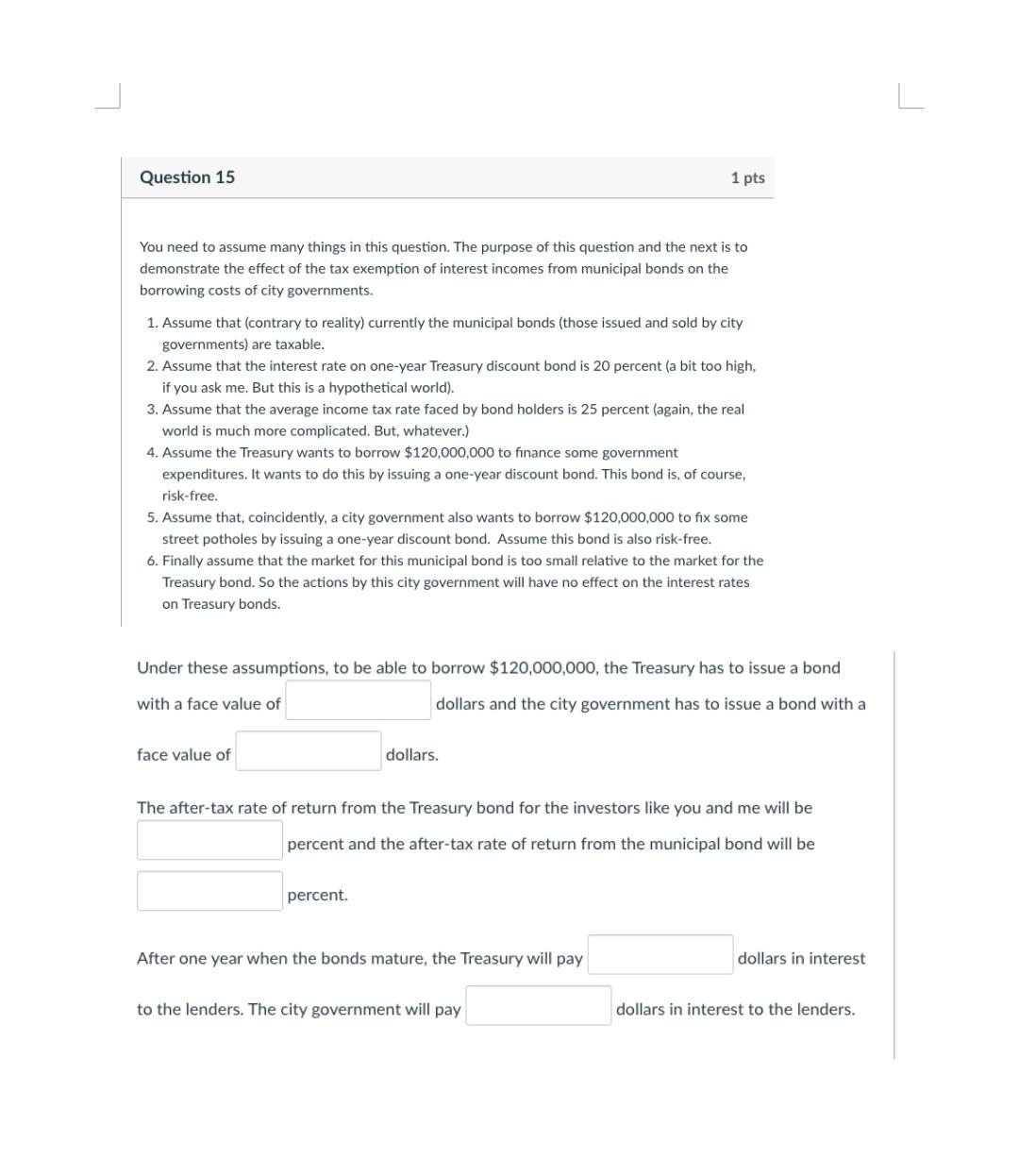
Question 15 You need to assume many things in this question. The purpose of this question and the next is to demonstrate the effect of the tax exemption of interest incomes from municipal bonds on the borrowing costs of city governments. 1. Assume that (contrary to reality) currently the municipal bonds (those issued and sold by city governments) are taxable. 2. Assume that the interest rate on one-year Treasury discount bond is 20 percent (a bit too high, if you ask me. But this is a hypothetical world). 3. Assume that the average income tax rate faced by bond holders is 25 percent (again, the real world is much more complicated. But, whatever.) 4. Assume the Treasury wants to borrow $120,000,000 to finance some government expenditures. It wants to do this by issuing a one-year discount bond. This bond is, of course, risk-free. 5. Assume that, coincidently, a city government also wants to borrow $120,000,000 to fix some street potholes by issuing a one-year discount bond. Assume this bond is also risk-free. 6. Finally assume that the market for this municipal bond is too small relative to the market for the Treasury bond. So the actions by this city government will have no effect on the interest rates on Treasury bonds. Under these assumptions, to be able to borrow $120,000,000, the Treasury has to issue a bond with a face value of dollars and the city government has to issue a bond with a face value of 1 pts dollars. percent. The after-tax rate of return from the Treasury bond for the investors like you and me will be percent and the after-tax rate of return from the municipal bond will be After one year when the bonds mature, the Treasury will pay to the lenders. The city government will pay dollars in interest dollars in interest to the lenders. Question 15 You need to assume many things in this question. The purpose of this question and the next is to demonstrate the effect of the tax exemption of interest incomes from municipal bonds on the borrowing costs of city governments. 1. Assume that (contrary to reality) currently the municipal bonds (those issued and sold by city governments) are taxable. 2. Assume that the interest rate on one-year Treasury discount bond is 20 percent (a bit too high, if you ask me. But this is a hypothetical world). 3. Assume that the average income tax rate faced by bond holders is 25 percent (again, the real world is much more complicated. But, whatever.) 4. Assume the Treasury wants to borrow $120,000,000 to finance some government expenditures. It wants to do this by issuing a one-year discount bond. This bond is, of course, risk-free. 5. Assume that, coincidently, a city government also wants to borrow $120,000,000 to fix some street potholes by issuing a one-year discount bond. Assume this bond is also risk-free. 6. Finally assume that the market for this municipal bond is too small relative to the market for the Treasury bond. So the actions by this city government will have no effect on the interest rates on Treasury bonds. Under these assumptions, to be able to borrow $120,000,000, the Treasury has to issue a bond with a face value of dollars and the city government has to issue a bond with a face value of 1 pts dollars. percent. The after-tax rate of return from the Treasury bond for the investors like you and me will be percent and the after-tax rate of return from the municipal bond will be After one year when the bonds mature, the Treasury will pay to the lenders. The city government will pay dollars in interest dollars in interest to the lenders
Step by Step Solution
There are 3 Steps involved in it

Get step-by-step solutions from verified subject matter experts
 Study Help