







Question: PLEASE PLEASE EXPLAIN Assumptions [edit | edit source] The consumer theory assumes that the consumer is rational. This implies that his preferences satisfy the following
![PLEASE PLEASE EXPLAIN Assumptions [edit | edit source] The consumer theory assumes](https://s3.amazonaws.com/si.experts.images/answers/2024/08/66c15829115b8_04866c1582875c74.jpg) PLEASE PLEASE EXPLAIN
PLEASE PLEASE EXPLAIN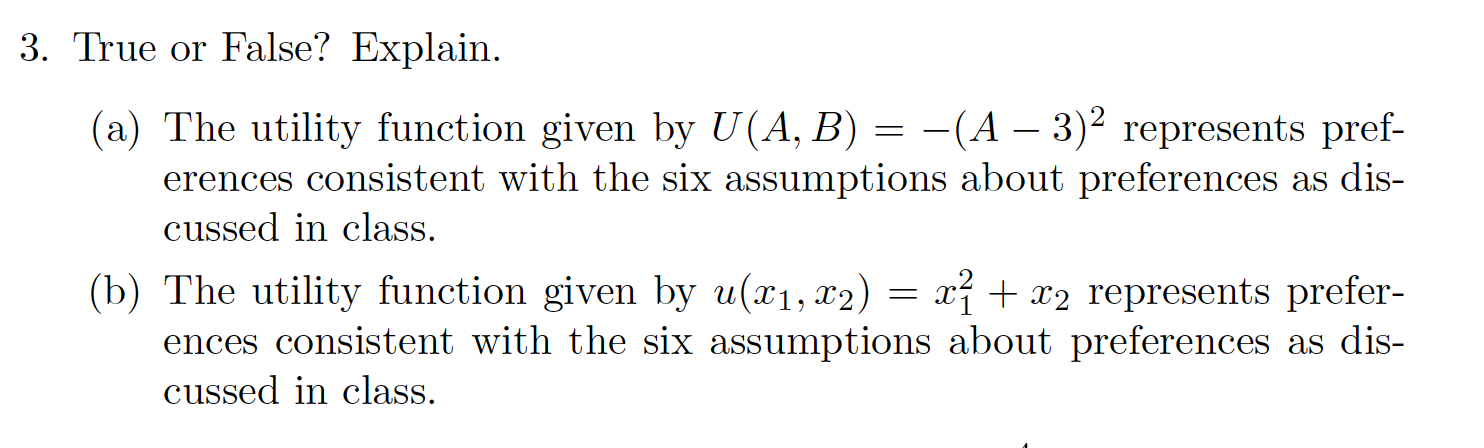
Assumptions [edit | edit source] The consumer theory assumes that the consumer is rational. This implies that his preferences satisfy the following properties: 1. They are complete; that is, given any set of possible bundles of goods, the consumer is always capable of deciding which one is preferable to the others and then ranking them in terms of preference. 2. They are reflexive; it means that any bundle is at least as good as itself. 3. They are transitive; meaning that if a bundle A is preferred to a bundle B, and this bundle B is preferable to a third bundle C, then it is implied that the first bundle A will be preferred to the bundle C. 4. They are continuous; there are no big jumps in the ranking of alternatives. The fulfillment of these properties ensures that consumer's preferences are consistent and can be represented by an utility function, U(.) such that if bundle A is preferred to bundle B, then U(A) > U(B) The locus of all bundles that give a certain level of utility to the consumer constitutes an indifference curve (or level curve), which is the usual way of representing preferences. Nevertheless, in spite of these four properties, there is still the possibility of having special cases" such as the existence of perfect substitutes or perfect complements, among others, which lead to special shapes for the indifference curves. For avoiding these cases, two additional properties are assumed: 5. Preferences are monotonic, or more is preferred to less; this implies that, given any set of two bundles, if one of them contains at least as much of all goods and more of one good than the other, then the first bundle will be preferred to the second. 6. Preferences are convex; that is, any combination of two equally preferable bundles will be more desirable than these bundles. These five properties confer a special shape to level curves: they are downward slopping and convex. 3. True or False? Explain. (a) The utility function given by U(A, B) = -(A 3)2 represents pref- erences consistent with the six assumptions about preferences as dis- cussed in class. (b) The utility function given by u(21, 12) = x + x2 represents prefer- ences consistent with the six assumptions about preferences as dis- cussed in class. Assumptions [edit | edit source] The consumer theory assumes that the consumer is rational. This implies that his preferences satisfy the following properties: 1. They are complete; that is, given any set of possible bundles of goods, the consumer is always capable of deciding which one is preferable to the others and then ranking them in terms of preference. 2. They are reflexive; it means that any bundle is at least as good as itself. 3. They are transitive; meaning that if a bundle A is preferred to a bundle B, and this bundle B is preferable to a third bundle C, then it is implied that the first bundle A will be preferred to the bundle C. 4. They are continuous; there are no big jumps in the ranking of alternatives. The fulfillment of these properties ensures that consumer's preferences are consistent and can be represented by an utility function, U(.) such that if bundle A is preferred to bundle B, then U(A) > U(B) The locus of all bundles that give a certain level of utility to the consumer constitutes an indifference curve (or level curve), which is the usual way of representing preferences. Nevertheless, in spite of these four properties, there is still the possibility of having special cases" such as the existence of perfect substitutes or perfect complements, among others, which lead to special shapes for the indifference curves. For avoiding these cases, two additional properties are assumed: 5. Preferences are monotonic, or more is preferred to less; this implies that, given any set of two bundles, if one of them contains at least as much of all goods and more of one good than the other, then the first bundle will be preferred to the second. 6. Preferences are convex; that is, any combination of two equally preferable bundles will be more desirable than these bundles. These five properties confer a special shape to level curves: they are downward slopping and convex. 3. True or False? Explain. (a) The utility function given by U(A, B) = -(A 3)2 represents pref- erences consistent with the six assumptions about preferences as dis- cussed in class. (b) The utility function given by u(21, 12) = x + x2 represents prefer- ences consistent with the six assumptions about preferences as dis- cussed in class
Step by Step Solution
There are 3 Steps involved in it

Get step-by-step solutions from verified subject matter experts
 Study Help