Question: Please, Please, Please answer this question. I am posting this question for the second time, it is very urgent and I need the answer. You
Please, Please, Please answer this question. I am posting this question for the second time, it is very urgent and I need the answer.
You just need to read these paragraphs quickly and give some recommendations related to this case and related to the evidence-based management course. It is not difficult, just read it quickly and give some recommendation that you think it works better for the case. I expect you to answer my question, I just need some recommendations, and that's it.
Thank you in advance I appreciate your help, I will definitely give good feedback if someone answers my question.
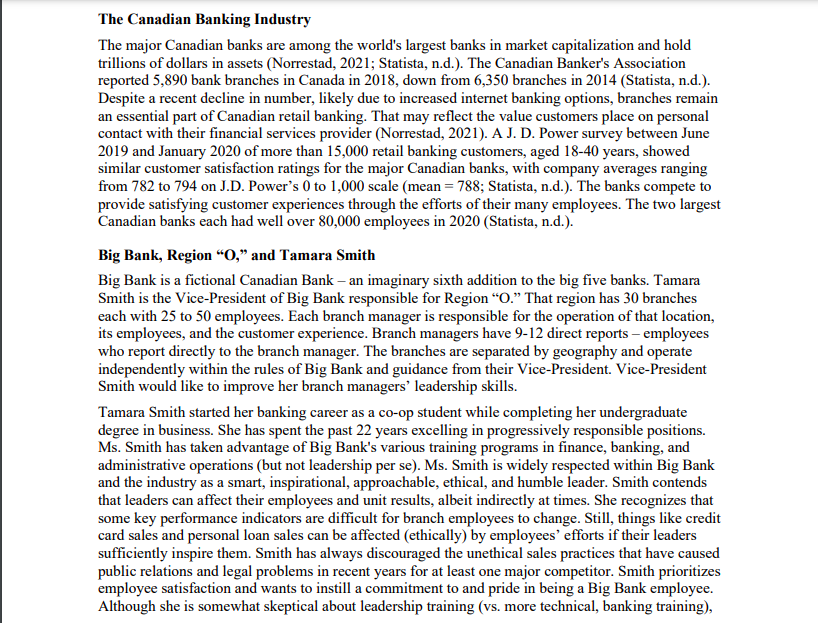
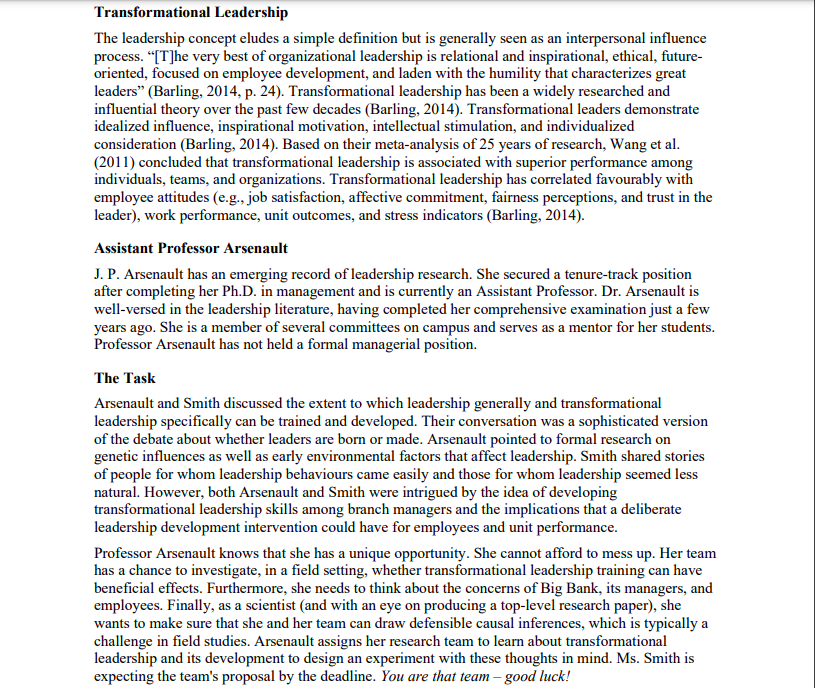
The Canadian Banking Industry The major Canadian banks are among the world's largest banks in market capitalization and hold trillions of dollars in assets (Norrestad, 2021; Statista, n.d.). The Canadian Banker's Association reported 5,890 bank branches in Canada in 2018, down from 6,350 branches in 2014 (Statista, n.d.). Despite a recent decline in number, likely due to increased internet banking options, branches remain an essential part of Canadian retail banking. That may reflect the value customers place on personal contact with their financial services provider (Norrestad, 2021). A J. D. Power survey between June 2019 and January 2020 of more than 15,000 retail banking customers, aged 18-40 years, showed similar customer satisfaction ratings for the major Canadian banks, with company averages ranging from 782 to 794 on J.D. Power's 0 to 1,000 scale (mean = 788; Statista, n.d.). The banks compete to provide satisfying customer experiences through the efforts of their many employees. The two largest Canadian banks each had well over 80,000 employees in 2020 (Statista, n.d.). Big Bank, Region "O," and Tamara Smith Big Bank is a fictional Canadian Bank an imaginary sixth addition to the big five banks. Tamara Smith is the Vice-President of Big Bank responsible for Region O. That region has 30 branches each with 25 to 50 employees. Each branch manager is responsible for the operation of that location, its employees, and the customer experience. Branch managers have 9-12 direct reports - employees who report directly to the branch manager. The branches are separated by geography and operate independently within the rules of Big Bank and guidance from their Vice-President. Vice-President Smith would like to improve her branch managers' leadership skills. Tamara Smith started her banking career as a co-op student while completing her undergraduate degree in business. She has spent the past 22 years excelling in progressively responsible positions. Ms. Smith has taken advantage of Big Bank's various training programs in finance, banking, and administrative operations (but not leadership per se). Ms. Smith is widely respected within Big Bank and the industry as a smart, inspirational, approachable, ethical, and humble leader. Smith contends that leaders can affect their employees and unit results, albeit indirectly at times. She recognizes that some key performance indicators are difficult for branch employees to change. Still, things like credit card sales and personal loan sales can be affected (ethically) by employees' efforts if their leaders sufficiently inspire them. Smith has always discouraged the unethical sales practices that have caused public relations and legal problems in recent years for at least one major competitor. Smith prioritizes employee satisfaction and wants to instill a commitment to and pride in being a Big Bank employee. Although she is somewhat skeptical about leadership training (vs. more technical, banking training), Transformational Leadership The leadership concept eludes a simple definition but is generally seen as an interpersonal influence process. [T]he very best of organizational leadership is relational and inspirational, ethical, future- oriented, focused on employee development, and laden with the humility that characterizes great leaders (Barling, 2014, p. 24). Transformational leadership has been a widely researched and influential theory over the past few decades (Barling, 2014). Transformational leaders demonstrate idealized influence, inspirational motivation, intellectual stimulation, and individualized consideration (Barling, 2014). Based on their meta-analysis of 25 years of research, Wang et al. (2011) concluded that transformational leadership is associated with superior performance among individuals, teams, and organizations. Transformational leadership has correlated favourably with employee attitudes (e.g., job satisfaction, affective commitment, fairness perceptions, and trust in the leader), work performance, unit outcomes, and stress indicators (Barling, 2014). Assistant Professor Arsenault J. P. Arsenault has an emerging record of leadership research. She secured a tenure-track position after completing her Ph.D. in management and is currently an Assistant Professor. Dr. Arsenault is well-versed in the leadership literature, having completed her comprehensive examination just a few years ago. She is a member of several committees on campus and serves as a mentor for her students. Professor Arsenault has not held a formal managerial position. The Task Arsenault and Smith discussed the extent to which leadership generally and transformational leadership specifically can be trained and developed. Their conversation was a sophisticated version of the debate about whether leaders are born or made. Arsenault pointed to formal research on genetic influences as well as early environmental factors that affect leadership. Smith shared stories of people for whom leadership behaviours came easily and those for whom leadership seemed less natural. However, both Arsenault and Smith were intrigued by the idea of developing transformational leadership skills among branch managers and the implications that a deliberate leadership development intervention could have for employees and unit performance. Professor Arsenault knows that she has a unique opportunity. She cannot afford to mess up. Her team has a chance to investigate, in a field setting, whether transformational leadership training can have beneficial effects. Furthermore, she needs to think about the concerns of Big Bank, its managers, and employees. Finally, as a scientist (and with an eye on producing a top-level research paper), she wants to make sure that she and her team can draw defensible causal inferences, which is typically a challenge in field studies. Arsenault assigns her research team to learn about transformational leadership and its development to design an experiment with these thoughts in mind. Ms. Smith is expecting the team's proposal by the deadline. You are that team - good luck









 Study Help