







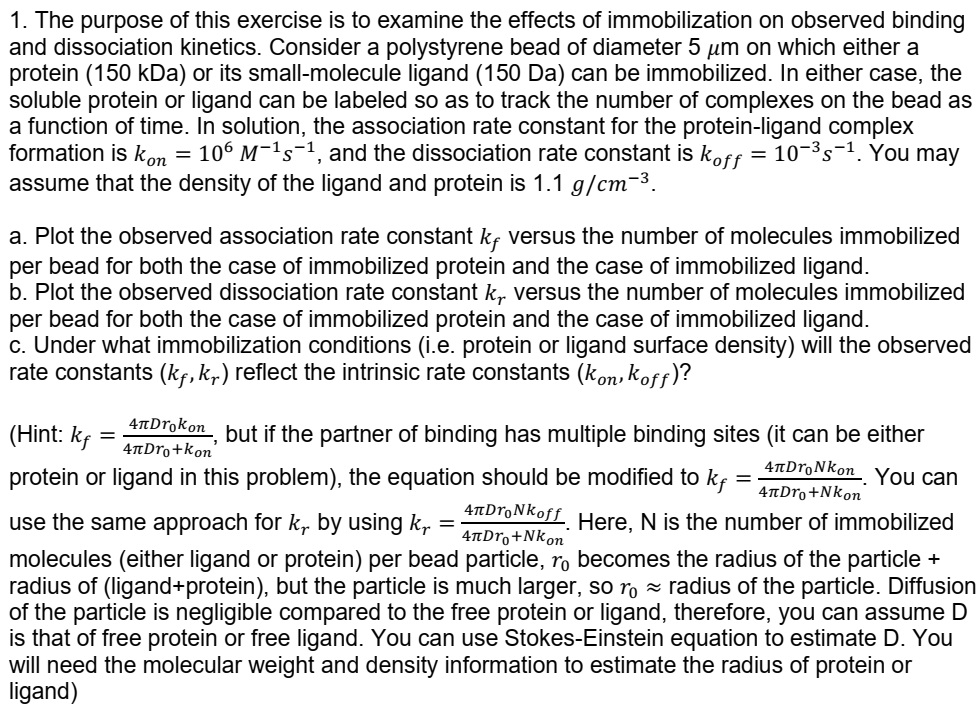
Question: ( please plot, in previous answer its not ploted ) The purpose of this exercise is to examine the effects of immobilization on observed binding
please plot, in previous answer its not ploted The purpose of this exercise is to examine the effects of immobilization on observed binding
and dissociation kinetics. Consider a polystyrene bead of diameter on which either a
protein kDa or its smallmolecule ligand can be immobilized. In either case, the
soluble protein or ligand can be labeled so as to track the number of complexes on the bead as
a function of time. In solution, the association rate constant for the proteinligand complex
formation is and the dissociation rate constant is You may
assume that the density of the ligand and protein is
a Plot the observed association rate constant versus the number of molecules immobilized
per bead for both the case of immobilized protein and the case of immobilized ligand.
b Plot the observed dissociation rate constant versus the number of molecules immobilized
per bead for both the case of immobilized protein and the case of immobilized ligand.
c Under what immobilization conditions ie protein or ligand surface density will the observed
rate constants reflect the intrinsic rate constants
Hint: but if the partner of binding has multiple binding sites it can be either
protein or ligand in this problem the equation should be modified to You can
use the same approach for by using Here, is the number of immobilized
molecules either ligand or protein per bead particle, becomes the radius of the particle
radius of ligandprotein but the particle is much larger, so ~~ radius of the particle. Diffusion
of the particle is negligible compared to the free protein or ligand, therefore, you can assume
is that of free protein or free ligand. You can use StokesEinstein equation to estimate D You
will need the molecular weight and density information to estimate the radius of protein or
ligand
Step by Step Solution
There are 3 Steps involved in it
1 Expert Approved Answer
Step: 1 Unlock

Question Has Been Solved by an Expert!
Get step-by-step solutions from verified subject matter experts
Step: 2 Unlock
Step: 3 Unlock
 Study Help