Question: please post answer with your own words and provide the refrence Critical Thinking Please read Case 2: Venezuela under Hugo Chvez and Beyond available in
please post answer with your own words and provide the refrence
Critical Thinking
Please read Case 2: Venezuela under Hugo Chvez and Beyond available in your e-book (page no.611), and answer the following questions:
Question(s):
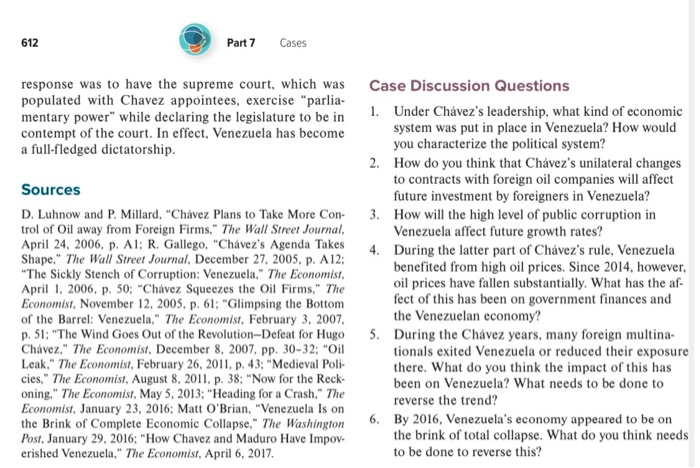
- Under Chvezs leadership, what kind of economic system was put in place in Venezuela? How would you characterize the political system?
- How do you think that Chvezs unilateral changes to contracts with foreign oil companies will affect future investment by foreigners in Venezuela?
- How will the high level of public corruption in Venezuela affect future growth rates?
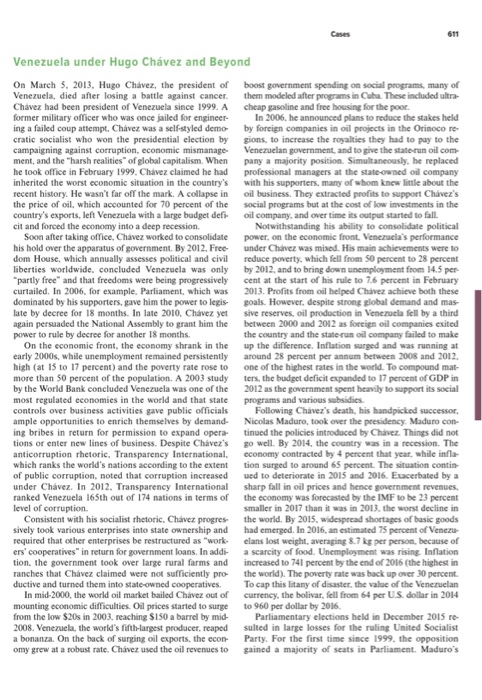
Venezuela under Hugo Chvez and Beyond On March 5, 2013. Hugo Chavez, the president of Venezuela, died after losing a battle against cancer Chavez had been president of Venezuela since 1999. A former military officer who was once jailed for engineer ing a failed coup attempt. Chavez was a selfstyled demo cratic socialist who won the presidential election by campaigning against corruption, economic mismanage ment, and the harsh realities of global capitalism. When he took office in February 1999. Chavez claimed he had inherited the worst economic situation in the country's recent history. He wasn't far off the mark. A collapse in the price of oil, which accounted for 70 percent of the country's exports, left Venezuela with a large budget def cit and forced the economy into a deep recession. Soon after taking office, Chave worked to consolidate his hold over the apparatus of government. By 2012. Free dom House, which annually assesses political and civil liberties worldwide, concluded Venezuela was only "partly free and that freedoms were being progressively curtailed. In 2006, for example, Parliament, which was dominated by his supporters, gave him the power to legis late by decree for 18 months. In late 2010. Chavez yet again persuaded the National Assembly to grant him the power to rule by decree for another 18 months. On the economic front, the economy shrank in the carly 2000s, while unemployment remained persistently high (at 15 to 17 percent) and the poverty rate rose to more than 50 percent of the population. A 2003 study by the World Bank concluded Venezuela was one of the most regulated economies in the world and that state controls over business activities gave public officials ample opportunities to enrich themselves by demand ing bribes in return for permission to expand opera tions or enter new lines of business. Despite Chavez's anticorruption rhetoric. Transparency International which ranks the world's nations according to the extent of public corruption, noted that corruption increased under Chavez. In 2012, Transparency International ranked Venezuela 16 5th out of 174 nations in terms of level of corruption Consistent with his socialist rhetoric, Chuvez progres sively took various enterprises into state ownership and required that other enterprises be restructured as "work ers' cooperatives in return for government loans. In adds tion, the government took over large rural farms and ranches that Chavez claimed were not sufficiently pro ductive and turned them into state-owned cooperatives In mid-2000, the world oil market bailed Chavez out of mounting economic difficulties Oil prices started to surge from the low $20s in 2003. Teaching SISO a barrel by mid- 2008. Venezuela, the world's fifths-largest producer, reaped a bonanza. On the back of surging oil exports, the coon omy grew at a robust rate Chave used the oil revenues to boost government spending on social programs, many of them modeled after programs in Cuba. These included alt cheap gasoline and free housing for the poor in 2006, he announced plans to reduce the stakes held by foreign companies in oil projects in the Orinoco gions to increase the royalties they had to pay to the Venezuelan government and to give the oil.com pamy a majority position Simultaneously, he replaced professional managers at the state-owned oil company with his supporters, many of whom knew little about the oil business. They extracted profits to support Chavez's social programs but at the cost of low investments in the oil company, and over time is output started to fall Notwithstanding his ability to consolidate political power, on the economic front. Venezuela's performance under Chavez was mixed. His main achievements were to reduce poverty, which fell from 50 percent to 28 percent by 2012, and to bring down unemployment from 14.5 per cent at the start of his rule to 76 percent in February 2013. Profits from oil helped Chavez achieve both these goals. However, despite stron global demand and mas sive reserves, oil production in Venerul fell by a third between 2000 and 2012 as foreign oil companies exited the country and the state-run oil company failed to make up the difference. Inflation surged and was running at around 28 percent per annum between 2008 and 2012 one of the highest rates in the world. To compound mat- ters, the budget deficit expanded to 17 percent of GDP in 2012 as the government spent heavily to support its social programs and various subsidies Following Chavez's death, his handpicked successor, Nicolas Maduro, took over the presidency. Maduro con tinued the policies introduced by Chavez. Things did not go well. By 2014, the country was in a recession. The economy contracted by 4 percent that year, while in tion surged to around 65 percent. The station contin ued to deteriorate in 2015 and 2016. Exacerbated by a sharp fall in oil prices and hence government revenues the economy was forecasted by the IMF to be 23 percent smaller in 2017 than it was in 2013. the worst decline in the world. By 2015. widespread shortages of basic goods had emerged. In 2016, an estimated 75 percent of Venen clans lost weight, averaging 87 kg per person, because of a scarcity of food. Unemployment was rising Inflation increased to 741 percent by the end of 2016 the highest in the world). The poverty rate was back up over 30 percent To cap this litany of disaster the value of the Venerulan Currency, the bolivar, fell from 64 per US dollar in 2014 to 960 per dollar by 2016 Parliamentary elections held in December 2015 sulted in large losses for the ruling United Socialist Party. For the first time since 1999. the opposition gained a majority of seats in Parliament. Maduro's 612 Part 7 Cases response was to have the supreme court, which was populated with Chavez appointees, exercise "parlia- mentary power" while declaring the legislature to be in contempt of the court. In effect, Venezuela has become a full-fledged dictatorship. Sources D. Luhnow and P. Millard, "Chvez Plans to Take More Con- trol of Oil away from Foreign Firms." The Wall Street Journal, April 24, 2006, p. Al; R. Gallego, "Chvez's Agenda Takes Shape." The Wall Street Journal. December 27, 2005. p. A 12: "The Sickly Stench of Corruption: Venezuela." The Economist, April 1, 2006, p. 50: "Chvez Squeezes the Oil Firms." The Economist, November 12, 2005, p. 61: "Glimpsing the Bottom of the Barrel: Venezuela." The Economist, February 3, 2007, p. 51; "The Wind Goes Out of the Revolution-Defeat for Hugo Chvez." The Economist, December 8, 2007, pp. 30-32: "Oil Leak, The Economist, February 26, 2011, p. 43: "Medieval Poli- cies," The Economist, August 8, 2011, p. 38: "Now for the Reck- oning." The Economist, May 5, 2013; "Heading for a Crash," The Economist, January 23, 2016; Matt O'Brian, "Venezuela Is on the Brink of Complete Economic Collapse," The Washington Post, January 29, 2016; "How Chavez and Maduro Have Impov. erished Venezuela, The Economist, April 6, 2017. Case Discussion Questions 1. Under Chvez's leadership, what kind of economic system was put in place in Venezuela? How would you characterize the political system? 2. How do you think that Chvez's unilateral changes to contracts with foreign oil companies will affect future investment by foreigners in Venezuela? 3. How will the high level of public corruption in Venezuela affect future growth rates? 4. During the latter part of Chvez's rule, Venezuela benefited from high oil prices. Since 2014, however, oil prices have fallen substantially. What has the af- fect of this has been on government finances and the Venezuelan economy? 5. During the Chvez years, many foreign multina- tionals exited Venezuela or reduced their exposure there. What do you think the impact of this has been on Venezuela? What needs to be done to reverse the trend? 6. By 2016, Venezuela's economy appeared to be on the brink of total collapse. What do you think needs to be done to reverse this









 Study Help