







Question: Please provide code in Lisp: Use LOCAL variables within functions ( e . g . , introduced by ' let' ) except for truly global
Please provide code in Lisp: Use LOCAL variables within functions eg introduced by let'
except for truly global parameters such as a hash table that multiple
functions need to access.
Unless stated otherwise, include type checking in your functions; ie
if the user gives an argument which is not of the specified type or form
of the corresponding parameter, your function should return
More generally one might print more specific error messages.
PREPARING FOR BUILDING BLOCK STRUCTURES
Preamble
The "Blocks World", where an AI system builds structures with children's
blocks on a table is a longstanding experimental domain in AI eg
going back to Terry Winograd's "SHRDLU" a name based on letter frequencies
in eg lowres demo,
Georgiy Platonov and Ben Kane,
experimented in
a physical blocks world, focusing on question answering about spatial
relations eg "Which blocks are to the left of a red block?" as well
as about past situations, and enabling structural concept learning, etc.
The Blocks World domain is interesting from a reasoning and planning
perspective, because it involves precisely the kinds of problems for
which current LLMs fail miserably. However, neuralnetbased systems
specifically designed for virtual Blocks World problems have been built
successfully. Once suitable data structures and models of possible
moves and relationships in such a virtual domain have been engineered,
a DNN can be "let loose", experimenting with millions of moves and
configurations, thereby learning what moves lead to what configurations.
But one feels that with more reasoning power and spatial conceptualization,
success should not depend on such massive experimentation.
We will be working towards the ability to create block structures in
a D Blocks World, given descriptions of those structures. In Lisp
we'll do some preliminary programming to enable this. Here is an example
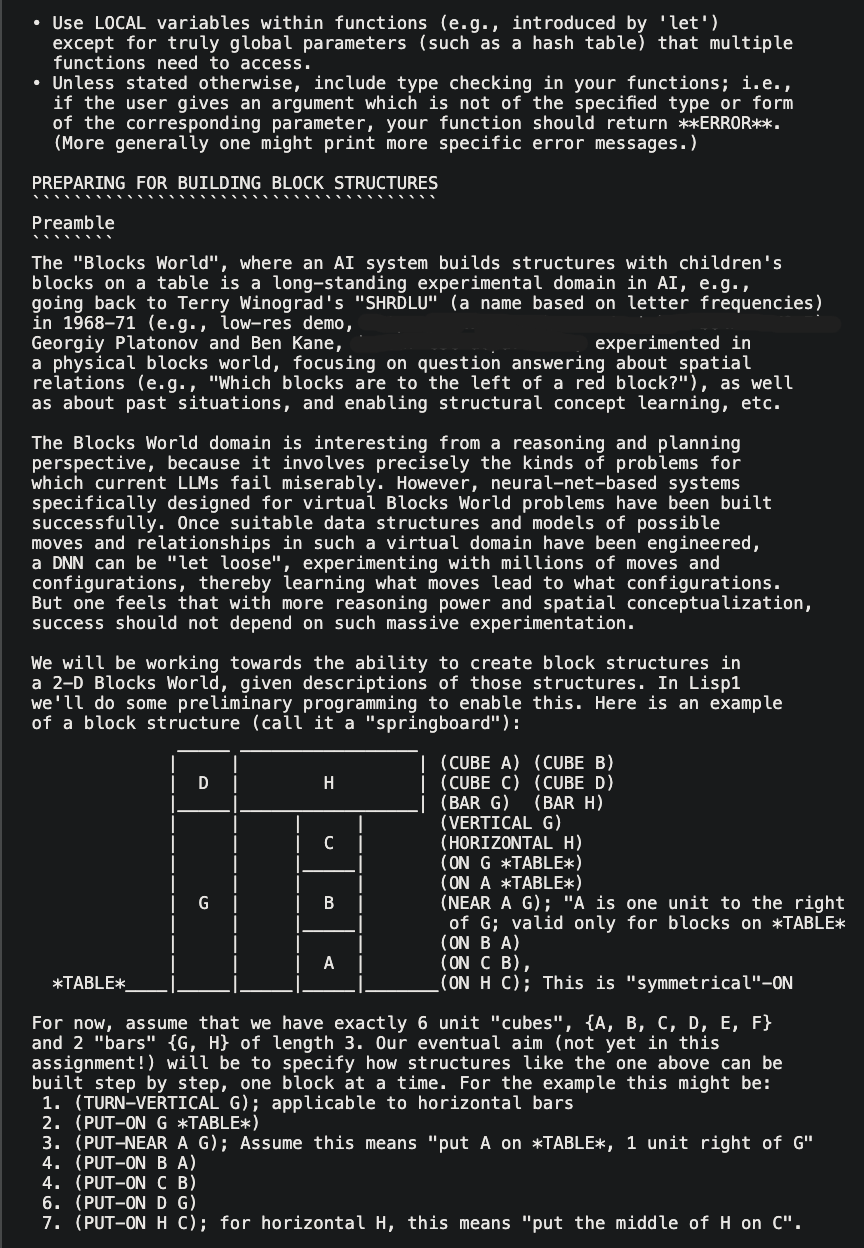
of a block structure call it a "springboard":
CUBE ACUBE B
CUBE CCUBE D
BAR GBAR H
VERTICAL G
HORIZONTAL H
ON G
ON A
NEAR A G; A is one unit to the right
of ; valid only for blocks on
ON B A
ON C B
ON H C; This is "symmetrical"ON
For now, assume that we have exactly unit "cubes",
and "bars" of length Our eventual aim not yet in this
assignment! will be to specify how structures like the one above can be
built step by step, one block at a time. For the example this might be:
TURNVERTICAL G; applicable to horizontal bars
PUTON G
PUTNEAR A G; Assume this means "put A on unit right of G
PUTON B A
PUTON C B
PUTON D G
PUTON H C; for horizontal H this means "put the middle of on
Step by Step Solution
There are 3 Steps involved in it
1 Expert Approved Answer
Step: 1 Unlock

Question Has Been Solved by an Expert!
Get step-by-step solutions from verified subject matter experts
Step: 2 Unlock
Step: 3 Unlock
 Study Help