







Question: please provide conclusion situation when team unity has prevalence over realistic consideration of alternative ways of action.. Group thinking is related to deterioration of mental
please provide conclusion
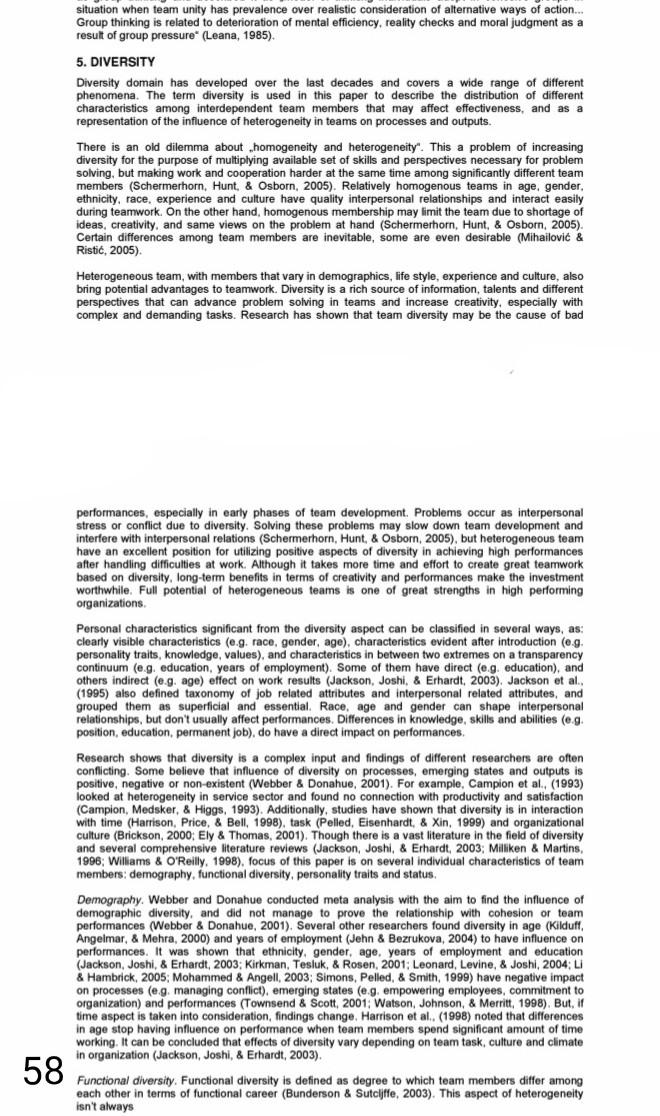
situation when team unity has prevalence over realistic consideration of alternative ways of action.. Group thinking is related to deterioration of mental efficiency, reality checks and moral judgment as a result of group pressure" (Leana, 1985) 5. DIVERSITY Diversity domain has developed over the last decades and covers a wide range of different phenomena. The term diversity is used in this paper to describe the distribution of different characteristics among interdependent team members that may affect effectiveness, and as a representation of the influence of heterogeneity in teams on processes and outputs There is an old dilemma about homogeneity and heterogeneity". This a problem of increasing diversity for the purpose of multiplying available set of skills and perspectives necessary for problem solving, but making work and cooperation harder at the same time among significantly different team members (Schermerhorn, Hunt, & Osborn, 2005). Relatively homogenous teams in age, gender, ethnicity, race, experience and culture have quality interpersonal relationships and interact easily during teamwork. On the other hand, homogenous membership may limit the team due to shortage of ideas, creativity, and same views on the problem at hand (Schermerhorn, Hunt, & Osborn, 2005). Certain differences among team members are inevitable, some are even desirable (Mihailovi & Risti, 2005) Heterogeneous team, with members that vary in demographics, life style, experience and culture, also bring potential advantages to teamwork. Diversity is a rich source of information, talents and different perspectives that can advance problem solving in teams and increase creativity, especially with complex and demanding tasks. Research has shown that team diversity may be the cause of bad performances, especially in early phases of team development. Problems occur as interpersonal stress or conflict due to diversity, Solving these problems may slow down team development and interfere with interpersonal relations (Schermerhorn, Hunt, & Osborn, 2005), but heterogeneous team have an excellent position for utilizing positive aspects of diversity in achieving high performances after handling difficulties at work. Although it takes more time and effort to create great teamwork based on diversity, long-term benefits in terms of creativity and performances make the investment worthwhile. Full potential of heterogeneous teams is one of great strengths in high performing organizations Personal characteristics significant from the diversity aspect can be classified in several ways, as: clearly visible characteristics (e.g. race, gender, age), characteristics evident after introduction (og personality traits, knowledge, values), and characteristics in between two extremes on a transparency continuum (e.g. education years of employment). Some of them have direct (e.g. education), and others indirect (e.g. age) effect on work results (Jackson, Joshi, & Erhardt, 2003). Jackson et al., (1995) also defined taxonomy of job related attributes and interpersonal related attributes, and grouped them as superficial and essential. Race, age and gender can shape interpersonal relationships, but don't usually affect performances. Differences in knowledge, skills and abilities (eg. position, education, permanent job), do have a direct impact on performances Research shows that diversity is a complex input and findings of different researchers are often conflicting. Some believe that influence of diversity on processes, emerging states and outputs is positive, negative or non-existent (Webber & Donahue, 2001). For example, Campion et al., (1993) looked at heterogeneity in service sector and found no connection with productivity and satisfaction (Campion, Medsker & Higgs, 1993). Additionally, studies have shown that diversity is in interaction with time (Harrison, Price, & Bell, 1998), task (Pelled, Eisenhardt, & Xin, 1999) and organizational culture (Brickson, 2000; Ely & Thomas, 2001). Though there is a vast literature in the field of diversity and several comprehensive literature reviews (Jackson, Joshi, & Erhardt, 2003; Milliken & Martins, 1996; Williams & O'Reilly, 1998), focus of this paper is on several individual characteristics of team members: demography, fund nal diversity, ona lity tra and status Demography. Webber and Donahue conducted meta analysis with the aim to find the influence of demographic diversity, and did not manage to prove the relationship with cohesion or team performances (Webber & Donahue, 2001). Several other researchers found diversity in age (Kilduft, Angelmar, & Mehra, 2000) and years of employment (Jehn & Bezrukova, 2004) to have influence on performances. It was shown that ethnicity, gender, age. years of employment and education (Jackson, Joshi, & Erhardt, 2003; Kirkman, Tesluk, & Rosen, 2001; Leonard, Levine, & Joshi, 2004; Li & Hambrick, 2005; Mohammed & Angell, 2003; Simons, Pelled, & Smith, 1999) have negative impact on processes (e.g. managing conflict), emerging states (eg. empowering employees, commitment to organization) and performances (Townsend & Scott, 2001; Watson, Johnson, & Merritt, 1998). But, if time aspect is taken into consideration, findings change, Harrison et al. (1998) noted that differences in age stop having influence on performance when team members spend significant amount of time working. It can be concluded that effects of diversity vary depending on team task, culture and climate in organization (Jackson, Joshi, & Erhardt, 2003). Functional diversity. Functional diversity is defined as degree to which team members differ among each other in terms of functional career (Bunderson & Sutcliffe, 2003). This aspect of heterogeneity isn't always 58Step by Step Solution
There are 3 Steps involved in it
1 Expert Approved Answer
Step: 1 Unlock

Question Has Been Solved by an Expert!
Get step-by-step solutions from verified subject matter experts
Step: 2 Unlock
Step: 3 Unlock
 Study Help