







Question: please provide excel sheet with cell references. Background: Pinwheel Cleaning Services (PCS) is a local business in the Tri-cities area. It provides cleaning services to
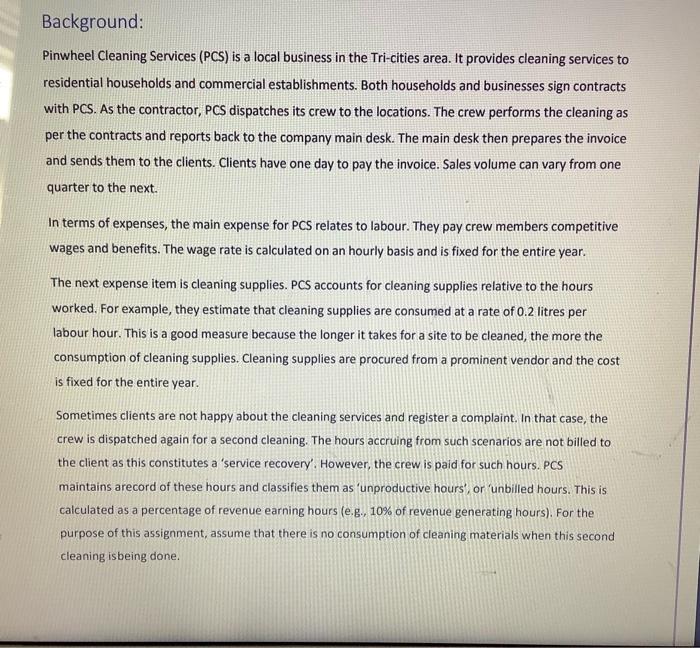
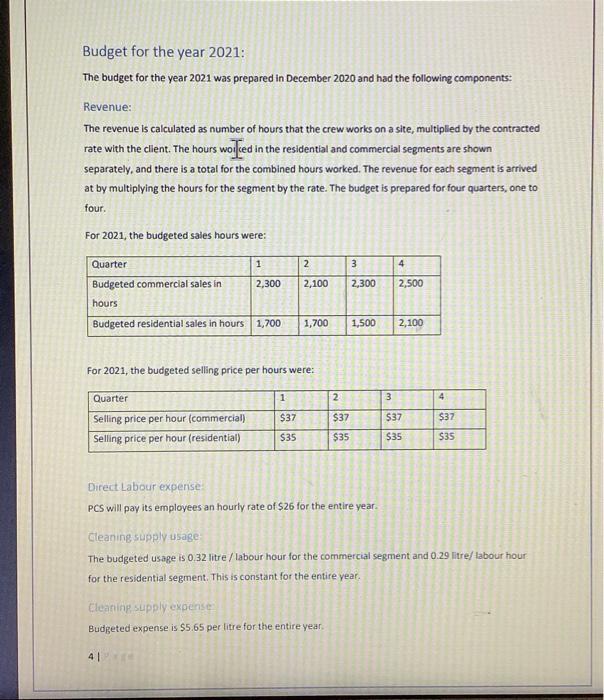
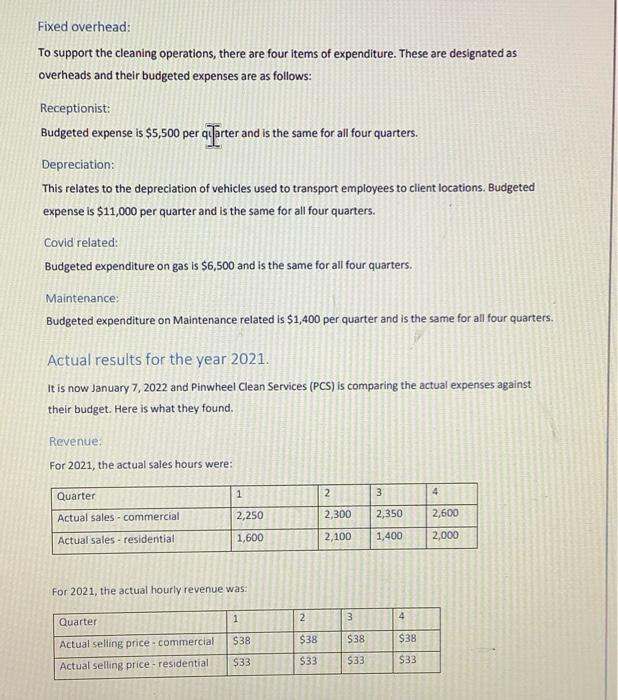
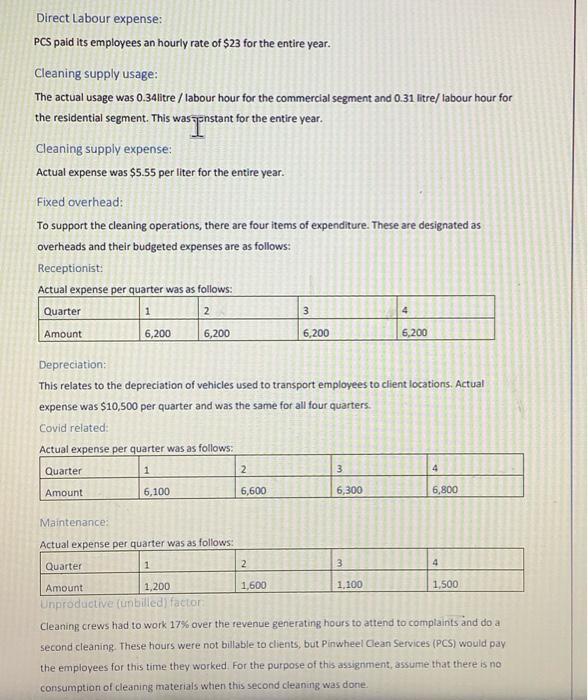
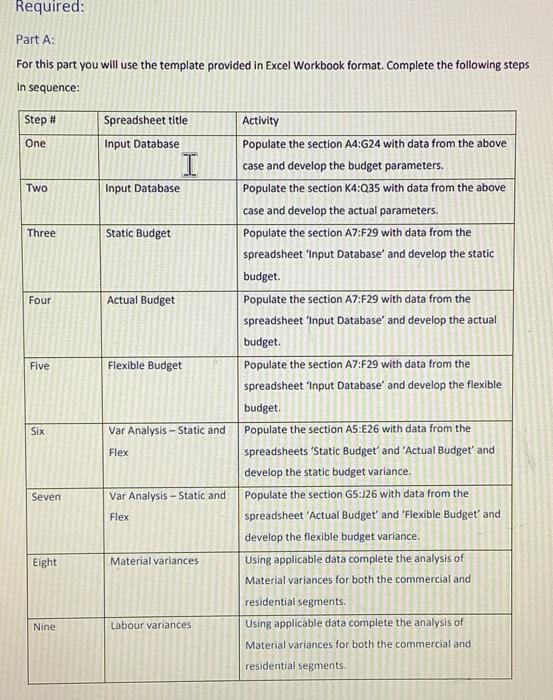

Background: Pinwheel Cleaning Services (PCS) is a local business in the Tri-cities area. It provides cleaning services to residential households and commercial establishments. Both households and businesses sign contracts with PCS. As the contractor, PCs dispatches its crew to the locations. The crew performs the cleaning as per the contracts and reports back to the company main desk. The main desk then prepares the invoice and sends them to the clients. Clients have one day to pay the invoice. Sales volume can vary from one quarter to the next. In terms of expenses, the main expense for PCS relates to labour. They pay crew members competitive wages and benefits. The wage rate is calculated on an hourly basis and is fixed for the entire year. The next expense item is cleaning supplies. PCS accounts for cleaning supplies relative to the hours worked. For example, they estimate that cleaning supplies are consumed at a rate of 0.2 litres per labour hour. This is a good measure because the longer it takes for a site to be cleaned, the more the consumption of cleaning supplies. Cleaning supplies are procured from a prominent vendor and the cost is fixed for the entire year. Sometimes clients are not happy about the cleaning services and register a complaint. In that case, the crew is dispatched again for a second cleaning. The hours accruing from such scenarios are not billed to the client as this constitutes a 'service recovery'. However, the crew is paid for such hours. PCS maintains arecord of these hours and classifies them as 'unproductive hours', or 'unbilled hours. This is calculated as a percentage of revenue earning hours (e.g., 10% of revenue generating hours). For the purpose of this assignment, assume that there is no consumption of cleaning materials when this second cleaning is being done. Budget for the year 2021: The budget for the year 2021 was prepared in December 2020 and had the following components: Revenue: The revenue is calculated as number of hours that the crew works on a site, multiplied by the contracted rate with the client. The hours worced in the residential and commercial segments are shown separately, and there is a total for the combined hours worked. The revenue for each segment is arrived at by multiplying the hours for the segment by the rate. The budget is prepared for four quarters, one to four. For 2021, the budgeted sales hours were: Quarter 1 2 3 4 Budgeted commercial sales in 2,300 2,100 2,300 2,500 hours Budgeted residential sales in hours 1,700 1,700 1,500 2,100 For 2021, the budgeted selling price per hours were: Quarter 1 2 3 4 $37 $37 $37 $37 Selling price per hour (commercial) Selling price per hour (residential) $35 $35 $35 $35 Direct Labour expense PCS will pay its employees an hourly rate of $26 for the entire year. Cleaning supply usage The budgeted usage is 0.32 litre / labour hour for the commercial segment and 0.29 litre/ tabour hour for the residential segment. This is constant for the entire year. Cleaning supply expense Budgeted expense is $5.65 per litre for the entire year. 41 Fixed overhead: To support the cleaning operations, there are four items of expenditure. These are designated as overheads and their budgeted expenses are as follows: Receptionist: Budgeted expense is $5,500 per quarter and is the same for all four quarters. Depreciation: This relates to the depreciation of vehicles used to transport employees to client locations. Budgeted expense is $11,000 per quarter and is the same for all four quarters. Covid related: Budgeted expenditure on gas is $6,500 and is the same for all four quarters. Maintenance: Budgeted expenditure on Maintenance related is $1,400 per quarter and is the same for all four quarters. Actual results for the year 2021. It is now January 7, 2022 and Pinwheel Clean Services (PCS) is comparing the actual expenses against their budget. Here is what they found. Revenue For 2021, the actual sales hours were: 1 2 3 4 2,250 Quarter Actual sales - commercial Actual sales - residential 2,300 2,350 2,600 1,600 2,100 1,400 2,000 For 2021, the actual hourly revenue was: 1 N 3 Quarter 4 $38 $38 $38 $38 Actual selling price-commercial Actual selling price - residential ull $33 $33 $33 $33 Direct Labour expense: PCS paid its employees an hourly rate of $23 for the entire year. Cleaning supply usage: The actual usage was 0.34litre / labour hour for the commercial segment and 0.31 litre/ labour hour for the residential segment. This was onstant for the entire year. Cleaning supply expense: Actual expense was $5.55 per liter for the entire year. Fixed overhead: To support the cleaning operations, there are four items of expenditure. These are designated as overheads and their budgeted expenses are as follows: Receptionist: Actual expense per quarter was as follows: 2 6,200 6,200 6,200 Quarter 1 3 4 Amount 6,200 Depreciation: This relates to the depreciation of vehicles used to transport employees to client locations. Actual expense was $10,500 per quarter and was the same for all four quarters Covid related: Actual expense per quarter was as follows: Quarter 1 2 3 4 Amount 6,100 6,600 6,300 6,800 Maintenance: Actual expense per quarter was as follows: Quarter 1 2 3 4 Amount 1,200 1,600 1,100 1.500 Unproductive (unbilled) factor Cleaning crews had to work 17% over the revenue generating hours to attend to complaints and do a second cleaning. These hours were not billable to clients, but Pinwheel Gean Services (PCS) would pay the employees for this time they worked for the purpose of this assignment, assume that there is no consumption of cleaning materials when this second cleaning was done. Required: Part A: For this part you will use the template provided in Excel Workbook format. Complete the following steps in sequence: Step # Spreadsheet title Activity One Input Database Populate the section A4:G24 with data from the above I case and develop the budget parameters. TWO Input Database Populate the section K4:035 with data from the above case and develop the actual parameters. Three Static Budget Populate the section A7:F29 with data from the spreadsheet 'Input Database' and develop the static budget. Four Actual Budget Populate the section A7: F29 with data from the spreadsheet 'Input Database' and develop the actual budget. Flexible Budget Populate the section A7:F29 with data from the spreadsheet 'Input Database and develop the flexible budget. Var Analysis - Static and Populate the section AS:E26 with data from the Flex spreadsheets 'Static Budget' and 'Actual Budget and develop the static budget variance. Seven Var Analysis - Static and Populate the section G5:26 with data from the spreadsheet 'Actual Budget' and 'Flexible Budget' and develop the flexible budget variance. Eight Material variances Using applicable data complete the analysis of Material variances for both the commercial and residential segments. Labour variances Using applicable data complete the analysis of Five Six Flex Nine Material variances for both the commercial and residential segments. . . Data should be entered in the 'Input Database' spreadsheet only. For all other spreadsheets, you must use cell references, linking data from 'Input Database' or other spreadsheets. Do not enter data or calculations without cell references. To calculate variances, you need to use 'IF formula
Step by Step Solution
There are 3 Steps involved in it

Get step-by-step solutions from verified subject matter experts
 Study Help